

yield and/or provide better isolation and purification [31–34]. Yet,
by far, none of these methods is able to significantly increase the
yields or reduce the isolation time of exosomes.
Cell-Derived Nanovesicles (CDNs) offer a promising alternative to exosomes. CDNs are produced by subjecting cells to serial
extrusions and purification using size exclusion columns. Hence,
their production is based on the principle of biomimicry of exosomes. As exosome-mimetics, CDNs were postulated to inherit the
intrinsic properties of exosomes (namely size and targeting ability,
biocompatibility, and non-immunogenicity), while being able to
circumvent the poor production yields and lengthy procedures.
Through the preservation of the membrane structures and components from the original parent cells, CDNs were hypothesized to be
able to endow improved cellular uptake and reduced risk of immunogenicity similarly to endogenously produced exosomes, in comparison to synthetic liposomes.
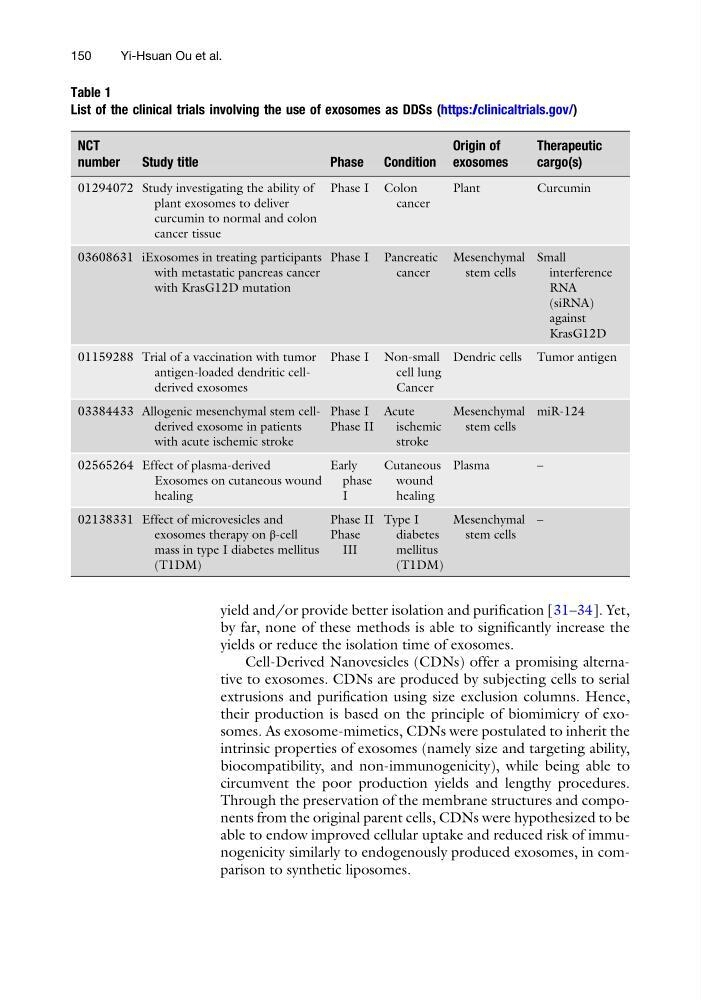
Table 1
List of the clinical trials involving the use of exosomes as DDSs (https:/ /clinicaltrials.gov/)
NCT
number
Study title
Phase Condition
Origin of
exosomes
Therapeutic
cargo(s)
01294072 Study investigating the ability of
plant exosomes to deliver
curcumin to normal and colon
cancer tissue
Phase I Colon
cancer
Plant
Curcumin
03608631 iExosomes in treating participants
with metastatic pancreas cancer
with KrasG12D mutation
Phase I Pancreatic
cancer
Mesenchymal
stem cells
Small
interference
RNA
(siRNA)
against
KrasG12D
01159288 Trial of a vaccination with tumor
antigen-loaded dendritic cellderived exosomes
Phase I Non-small
cell lung
Cancer
Dendric cells Tumor antigen
03384433 Allogenic mesenchymal stem cellderived exosome in patients
with acute ischemic stroke
Phase I
Phase II
Acute
ischemic
stroke
Mesenchymal
stem cells
miR-124
02565264 Effect of plasma-derived
Exosomes on cutaneous wound
healing
Early
phase
I
Cutaneous
wound
healing
Plasma
–
02138331 Effect of microvesicles and
exosomes therapy on β-cell
mass in type I diabetes mellitus
(T1DM)
Phase II
Phase
III
Type I
diabetes
mellitus
(T1DM)
Mesenchymal
stem cells
–
150
Yi-Hsuan Ou et al.
by far, none of these methods is able to significantly increase the
yields or reduce the isolation time of exosomes.
Cell-Derived Nanovesicles (CDNs) offer a promising alternative to exosomes. CDNs are produced by subjecting cells to serial
extrusions and purification using size exclusion columns. Hence,
their production is based on the principle of biomimicry of exosomes. As exosome-mimetics, CDNs were postulated to inherit the
intrinsic properties of exosomes (namely size and targeting ability,
biocompatibility, and non-immunogenicity), while being able to
circumvent the poor production yields and lengthy procedures.
Through the preservation of the membrane structures and components from the original parent cells, CDNs were hypothesized to be
able to endow improved cellular uptake and reduced risk of immunogenicity similarly to endogenously produced exosomes, in comparison to synthetic liposomes.
Table 1
List of the clinical trials involving the use of exosomes as DDSs (https:/ /clinicaltrials.gov/)
NCT
number
Study title
Phase Condition
Origin of
exosomes
Therapeutic
cargo(s)
01294072 Study investigating the ability of
plant exosomes to deliver
curcumin to normal and colon
cancer tissue
Phase I Colon
cancer
Plant
Curcumin
03608631 iExosomes in treating participants
with metastatic pancreas cancer
with KrasG12D mutation
Phase I Pancreatic
cancer
Mesenchymal
stem cells
Small
interference
RNA
(siRNA)
against
KrasG12D
01159288 Trial of a vaccination with tumor
antigen-loaded dendritic cellderived exosomes
Phase I Non-small
cell lung
Cancer
Dendric cells Tumor antigen
03384433 Allogenic mesenchymal stem cellderived exosome in patients
with acute ischemic stroke
Phase I
Phase II
Acute
ischemic
stroke
Mesenchymal
stem cells
miR-124
02565264 Effect of plasma-derived
Exosomes on cutaneous wound
healing
Early
phase
I
Cutaneous
wound
healing
Plasma
–
02138331 Effect of microvesicles and
exosomes therapy on β-cell
mass in type I diabetes mellitus
(T1DM)
Phase II
Phase
III
Type I
diabetes
mellitus
(T1DM)
Mesenchymal
stem cells
–
150
Yi-Hsuan Ou et al.