

Acknowledgments
This work was supported by Consorzio Interuniversitario di Biotecnologie, Ministero dell’Istruzione, dell’Universita ` e della
Ricerca [PRIN-2017 project 2017E44A9P, bacHound; PRIN2009 project 20093N774P, Riconoscimento molecolare di
micro-RNA (miR) mediante PNA modificati: dalla struttura alla
attivita `; COMP-HUB initiative, Departments of Excellence Program 2018-2022], Associazione Italiana per la Ricerca sul Cancro
[project IG 13575, Peptide nucleic acids targeting oncomiR and
tumor-suppressor miRNAs: cancer diagnosis and therapy],
EU-FP7 [THALAMOSS Project—Thalassemia Modular Stratification System for Personalized Therapy of B-Thalassemia; n.306201FP7-HEALTH-2012-INNOVATION-1], Wellcome Trust, AIFA,
and by Fondazione Fibrosi Cistica [Project “Revealing the
microRNAs-transcription factors network in cystic fibrosis: from
microRNA therapeutics to precision medicine (CF-miRNATHER),” FFC#7/2018].
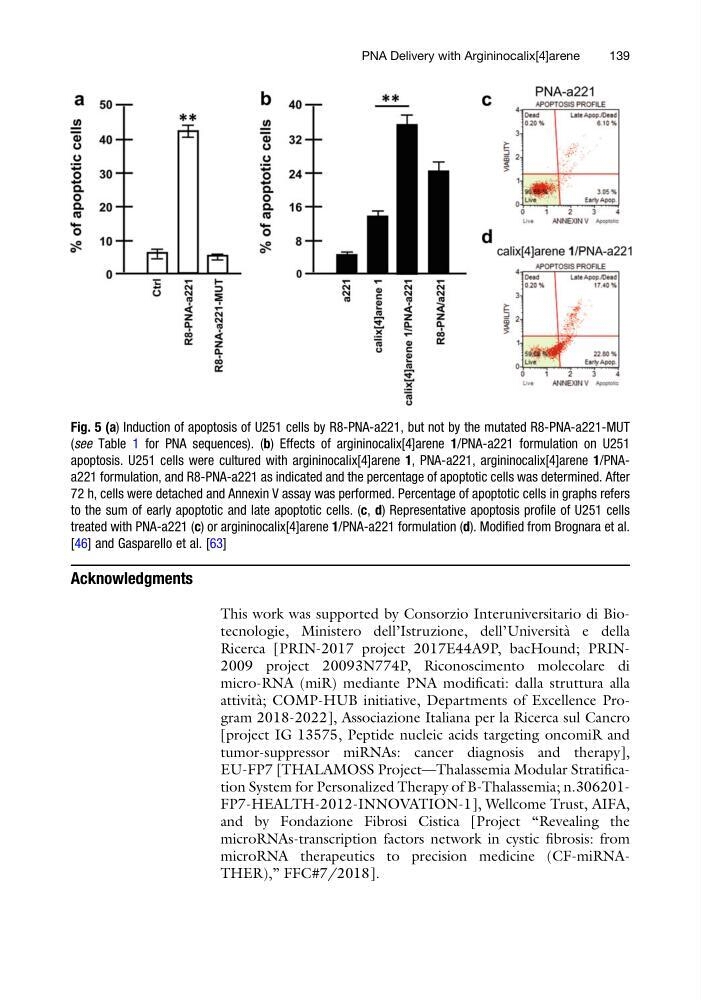
Fig. 5 (a) Induction of apoptosis of U251 cells by R8-PNA-a221, but not by the mutated R8-PNA-a221-MUT
(see Table 1 for PNA sequences). (b) Effects of argininocalix[4]arene 1/PNA-a221 formulation on U251
apoptosis. U251 cells were cultured with argininocalix[4]arene 1, PNA-a221, argininocalix[4]arene 1/PNAa221 formulation, and R8-PNA-a221 as indicated and the percentage of apoptotic cells was determined. After
72 h, cells were detached and Annexin V assay was performed. Percentage of apoptotic cells in graphs refers
to the sum of early apoptotic and late apoptotic cells. (c, d) Representative apoptosis profile of U251 cells
treated with PNA-a221 (c) or argininocalix[4]arene 1/PNA-a221 formulation (d). Modified from Brognara et al.
[46] and Gasparello et al. [63]
PNA Delivery with Argininocalix[4]arene
139
This work was supported by Consorzio Interuniversitario di Biotecnologie, Ministero dell’Istruzione, dell’Universita ` e della
Ricerca [PRIN-2017 project 2017E44A9P, bacHound; PRIN2009 project 20093N774P, Riconoscimento molecolare di
micro-RNA (miR) mediante PNA modificati: dalla struttura alla
attivita `; COMP-HUB initiative, Departments of Excellence Program 2018-2022], Associazione Italiana per la Ricerca sul Cancro
[project IG 13575, Peptide nucleic acids targeting oncomiR and
tumor-suppressor miRNAs: cancer diagnosis and therapy],
EU-FP7 [THALAMOSS Project—Thalassemia Modular Stratification System for Personalized Therapy of B-Thalassemia; n.306201FP7-HEALTH-2012-INNOVATION-1], Wellcome Trust, AIFA,
and by Fondazione Fibrosi Cistica [Project “Revealing the
microRNAs-transcription factors network in cystic fibrosis: from
microRNA therapeutics to precision medicine (CF-miRNATHER),” FFC#7/2018].
Fig. 5 (a) Induction of apoptosis of U251 cells by R8-PNA-a221, but not by the mutated R8-PNA-a221-MUT
(see Table 1 for PNA sequences). (b) Effects of argininocalix[4]arene 1/PNA-a221 formulation on U251
apoptosis. U251 cells were cultured with argininocalix[4]arene 1, PNA-a221, argininocalix[4]arene 1/PNAa221 formulation, and R8-PNA-a221 as indicated and the percentage of apoptotic cells was determined. After
72 h, cells were detached and Annexin V assay was performed. Percentage of apoptotic cells in graphs refers
to the sum of early apoptotic and late apoptotic cells. (c, d) Representative apoptosis profile of U251 cells
treated with PNA-a221 (c) or argininocalix[4]arene 1/PNA-a221 formulation (d). Modified from Brognara et al.
[46] and Gasparello et al. [63]
PNA Delivery with Argininocalix[4]arene
139