

82
M. Burgay et al.
2.5.2 Tests Using PK Parameters
Relativistic effects are strongest when the pulsar’s companion is another compact
object, whether a neutron star or a white dwarf. In those binaries, the curvature of
spacetime is large around each of the two compact objects, while in close orbits,
the orbital velocity is very high. Both of these conditions lead to strong relativistic
effects, which can be detected by the precise monitoring of times of arrival of radio
pulses from the pulsar, and which can be compared to the predictions of general
relativity and alternative theories. Damour and Deruelle [88, 89] have developed a
successful framework for constraining gravity theories in relativistic binary systems.
They introduced post-Keplerian (PK) parameters to describe the relativistic effects
in the orbital motion of relativistic binaries, such as those composed of a pulsar
and an additional compact object. PK parameters are determined by the chosen
gravity theory, therefore the PK parameters of each theory can be constrained using
precise measurements. They are a function of the masses of the system as well
as the Keplerian parameters of the binary system. However since the Keplerian
parameters are determined to very high precision, the PK parameters are essentially
just a function of the two masses. Therefore, measuring two PK parameters leads to
the complete determination of the two masses in the system (for any given gravity
theory). In some binary systems, more than two PK parameters can be measured. In
that case, the additional N PK − 2 parameters lead to independent tests of the chosen
gravity theory. In a mass-mass plot for the two binary compact objects, lines are
plotted for each measured PK parameter. If no overlap is found between allowed
regions of each parameter, the gravity theory has to be rejected.
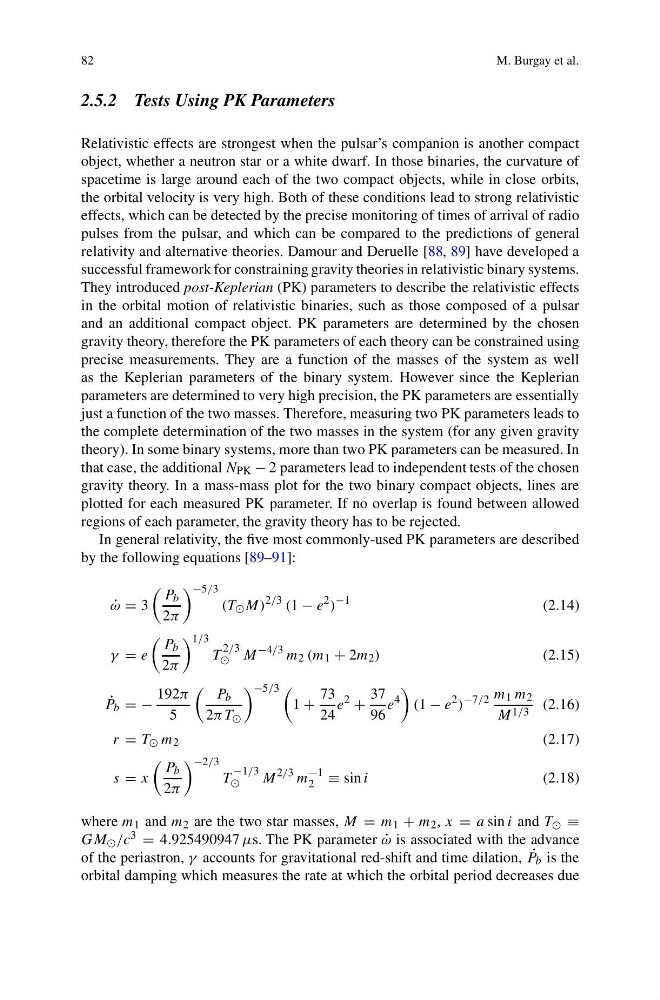
In general relativity, the five most commonly-used PK parameters are described
by the following equations [89–91]:
˙
ω = 3
P b
2π
−5/3
(T M)
2/3 (1 − e
2 )
−1
(2.14)
γ = e
P b
2π
1/3
T
2/3
M
−4/3 m 2 (m 1 + 2m 2 )
(2.15)
˙
P b = −
192π
5
P b
2πT
−5/3
1 +
73
24
e
2
+
37
96
e
4
(1 − e
2 )
−7/2 m 1 m 2
M 1/3 (2.16)
r = T m 2
(2.17)
s = x
P b
2π
−2/3
T
−1/3
M
2/3 m
−1
2 ≡ sin i
(2.18)
where m 1 and m 2 are the two star masses, M = m 1 + m 2 , x = a sin i and T ≡
GM /c 3 = 4.925490947 μs. The PK parameter ˙
ω is associated with the advance
of the periastron, γ accounts for gravitational red-shift and time dilation, ˙
P b is the
orbital damping which measures the rate at which the orbital period decreases due
M. Burgay et al.
2.5.2 Tests Using PK Parameters
Relativistic effects are strongest when the pulsar’s companion is another compact
object, whether a neutron star or a white dwarf. In those binaries, the curvature of
spacetime is large around each of the two compact objects, while in close orbits,
the orbital velocity is very high. Both of these conditions lead to strong relativistic
effects, which can be detected by the precise monitoring of times of arrival of radio
pulses from the pulsar, and which can be compared to the predictions of general
relativity and alternative theories. Damour and Deruelle [88, 89] have developed a
successful framework for constraining gravity theories in relativistic binary systems.
They introduced post-Keplerian (PK) parameters to describe the relativistic effects
in the orbital motion of relativistic binaries, such as those composed of a pulsar
and an additional compact object. PK parameters are determined by the chosen
gravity theory, therefore the PK parameters of each theory can be constrained using
precise measurements. They are a function of the masses of the system as well
as the Keplerian parameters of the binary system. However since the Keplerian
parameters are determined to very high precision, the PK parameters are essentially
just a function of the two masses. Therefore, measuring two PK parameters leads to
the complete determination of the two masses in the system (for any given gravity
theory). In some binary systems, more than two PK parameters can be measured. In
that case, the additional N PK − 2 parameters lead to independent tests of the chosen
gravity theory. In a mass-mass plot for the two binary compact objects, lines are
plotted for each measured PK parameter. If no overlap is found between allowed
regions of each parameter, the gravity theory has to be rejected.
In general relativity, the five most commonly-used PK parameters are described
by the following equations [89–91]:
˙
ω = 3
P b
2π
−5/3
(T M)
2/3 (1 − e
2 )
−1
(2.14)
γ = e
P b
2π
1/3
T
2/3
M
−4/3 m 2 (m 1 + 2m 2 )
(2.15)
˙
P b = −
192π
5
P b
2πT
−5/3
1 +
73
24
e
2
+
37
96
e
4
(1 − e
2 )
−7/2 m 1 m 2
M 1/3 (2.16)
r = T m 2
(2.17)
s = x
P b
2π
−2/3
T
−1/3
M
2/3 m
−1
2 ≡ sin i
(2.18)
where m 1 and m 2 are the two star masses, M = m 1 + m 2 , x = a sin i and T ≡
GM /c 3 = 4.925490947 μs. The PK parameter ˙
ω is associated with the advance
of the periastron, γ accounts for gravitational red-shift and time dilation, ˙
P b is the
orbital damping which measures the rate at which the orbital period decreases due