

2 General Relativity Measurements from Pulsars
75
A good timing model should therefore provide residuals randomly scattered
around a zero mean value, when plotted against time.
If our telescope were in an inertial reference frame, the procedure described
above would be sufficient to completely time an isolated pulsar. Since this is not
the case, a preliminary step is needed to convert the topocentric ToAs to the Solar
System Barycenter (SSB) reference frame and get barycentric ToAs t i,bary . Because
of the frequency-dependent dispersion delay introduced by the interstellar medium
(see Sect. 2.2.1), all ToAs also need to be referred to infinite frequency. The adopted
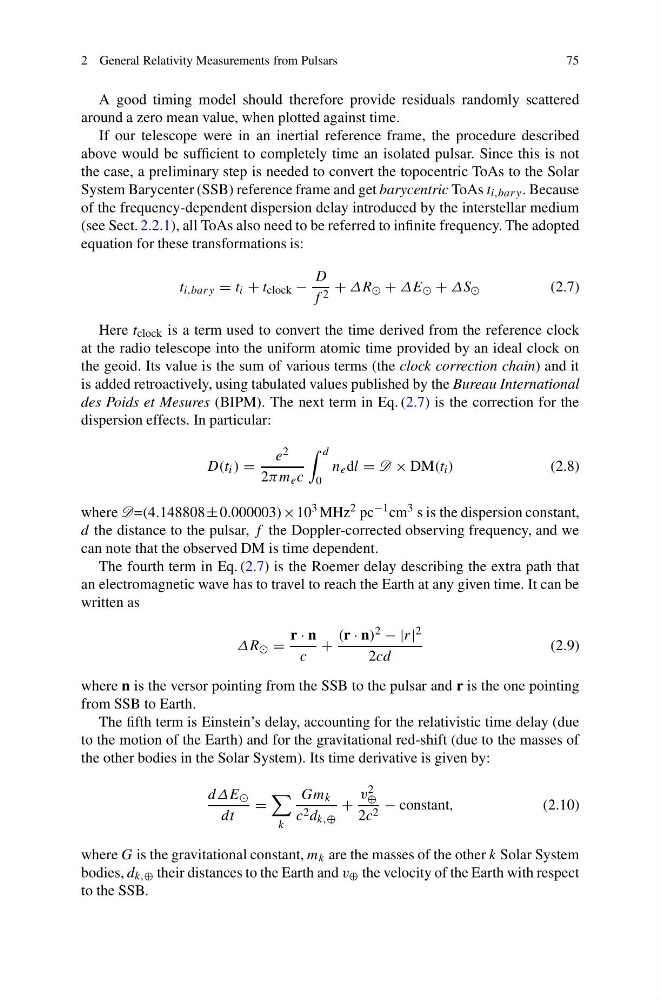
equation for these transformations is:
t i,bary = t i + t clock −
D
f 2 + ΔR + ΔE + ΔS
(2.7)
Here t clock is a term used to convert the time derived from the reference clock
at the radio telescope into the uniform atomic time provided by an ideal clock on
the geoid. Its value is the sum of various terms (the clock correction chain) and it
is added retroactively, using tabulated values published by the Bureau International
des Poids et Mesures (BIPM). The next term in Eq. (2.7) is the correction for the
dispersion effects. In particular:
D(t i ) =
e 2
2πm e c
d
0
n e dl = D × DM(t i )
(2.8)
where D=(4.148808 ±0.000003)×10 3 MHz 2 pc −1 cm 3 s is the dispersion constant,
d the distance to the pulsar, f the Doppler-corrected observing frequency, and we
can note that the observed DM is time dependent.
The fourth term in Eq. (2.7) is the Roemer delay describing the extra path that
an electromagnetic wave has to travel to reach the Earth at any given time. It can be
written as
ΔR =
r · n
c
+
(r · n) 2 − |r| 2
2cd
(2.9)
where n is the versor pointing from the SSB to the pulsar and r is the one pointing
from SSB to Earth.
The fifth term is Einstein’s delay, accounting for the relativistic time delay (due
to the motion of the Earth) and for the gravitational red-shift (due to the masses of
the other bodies in the Solar System). Its time derivative is given by:
dΔE
dt
=
k
Gm k
c 2 d k,⊕
+
v 2
⊕
2c 2 − constant,
(2.10)
where G is the gravitational constant, m k are the masses of the other k Solar System
bodies, d k,⊕ their distances to the Earth and v ⊕ the velocity of the Earth with respect
to the SSB.
75
A good timing model should therefore provide residuals randomly scattered
around a zero mean value, when plotted against time.
If our telescope were in an inertial reference frame, the procedure described
above would be sufficient to completely time an isolated pulsar. Since this is not
the case, a preliminary step is needed to convert the topocentric ToAs to the Solar
System Barycenter (SSB) reference frame and get barycentric ToAs t i,bary . Because
of the frequency-dependent dispersion delay introduced by the interstellar medium
(see Sect. 2.2.1), all ToAs also need to be referred to infinite frequency. The adopted
equation for these transformations is:
t i,bary = t i + t clock −
D
f 2 + ΔR + ΔE + ΔS
(2.7)
Here t clock is a term used to convert the time derived from the reference clock
at the radio telescope into the uniform atomic time provided by an ideal clock on
the geoid. Its value is the sum of various terms (the clock correction chain) and it
is added retroactively, using tabulated values published by the Bureau International
des Poids et Mesures (BIPM). The next term in Eq. (2.7) is the correction for the
dispersion effects. In particular:
D(t i ) =
e 2
2πm e c
d
0
n e dl = D × DM(t i )
(2.8)
where D=(4.148808 ±0.000003)×10 3 MHz 2 pc −1 cm 3 s is the dispersion constant,
d the distance to the pulsar, f the Doppler-corrected observing frequency, and we
can note that the observed DM is time dependent.
The fourth term in Eq. (2.7) is the Roemer delay describing the extra path that
an electromagnetic wave has to travel to reach the Earth at any given time. It can be
written as
ΔR =
r · n
c
+
(r · n) 2 − |r| 2
2cd
(2.9)
where n is the versor pointing from the SSB to the pulsar and r is the one pointing
from SSB to Earth.
The fifth term is Einstein’s delay, accounting for the relativistic time delay (due
to the motion of the Earth) and for the gravitational red-shift (due to the masses of
the other bodies in the Solar System). Its time derivative is given by:
dΔE
dt
=
k
Gm k
c 2 d k,⊕
+
v 2
⊕
2c 2 − constant,
(2.10)
where G is the gravitational constant, m k are the masses of the other k Solar System
bodies, d k,⊕ their distances to the Earth and v ⊕ the velocity of the Earth with respect
to the SSB.