

2 General Relativity Measurements from Pulsars
63
the polar caps. During the recycling process, the radio emission is switched off,
both because, in some stages, the combination of spin and magnetic field is not
suitable for sustaining the mechanism responsible for pair production and particle
acceleration (hence the system lies below the death-line in the P − ˙
P diagram of
Fig. 2.2), and because the matter engulfing the system quenches the radio emission.
In the mass accretion phase, not only is the star spun up, moving right to left
in the P − ˙
P diagram (or, analogously, in the P − B s diagram of Fig. 2.8), but
its magnetic field is also believed to decrease, either because of accretion itself
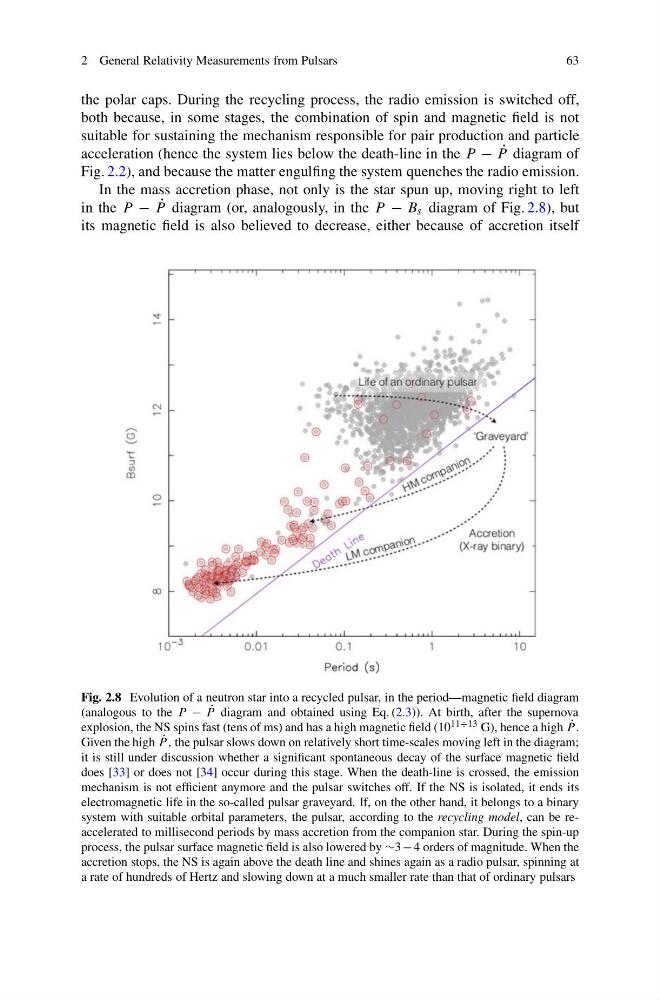
Fig. 2.8 Evolution of a neutron star into a recycled pulsar, in the period—magnetic field diagram
(analogous to the P − ˙
P diagram and obtained using Eq. (2.3)). At birth, after the supernova
explosion, the NS spins fast (tens of ms) and has a high magnetic field (10 11÷13 G), hence a high ˙
P .
Given the high ˙
P , the pulsar slows down on relatively short time-scales moving left in the diagram;
it is still under discussion whether a significant spontaneous decay of the surface magnetic field
does [33] or does not [34] occur during this stage. When the death-line is crossed, the emission
mechanism is not efficient anymore and the pulsar switches off. If the NS is isolated, it ends its
electromagnetic life in the so-called pulsar graveyard. If, on the other hand, it belongs to a binary
system with suitable orbital parameters, the pulsar, according to the recycling model, can be reaccelerated to millisecond periods by mass accretion from the companion star. During the spin-up
process, the pulsar surface magnetic field is also lowered by ∼3−4 orders of magnitude. When the
accretion stops, the NS is again above the death line and shines again as a radio pulsar, spinning at
a rate of hundreds of Hertz and slowing down at a much smaller rate than that of ordinary pulsars
63
the polar caps. During the recycling process, the radio emission is switched off,
both because, in some stages, the combination of spin and magnetic field is not
suitable for sustaining the mechanism responsible for pair production and particle
acceleration (hence the system lies below the death-line in the P − ˙
P diagram of
Fig. 2.2), and because the matter engulfing the system quenches the radio emission.
In the mass accretion phase, not only is the star spun up, moving right to left
in the P − ˙
P diagram (or, analogously, in the P − B s diagram of Fig. 2.8), but
its magnetic field is also believed to decrease, either because of accretion itself
Fig. 2.8 Evolution of a neutron star into a recycled pulsar, in the period—magnetic field diagram
(analogous to the P − ˙
P diagram and obtained using Eq. (2.3)). At birth, after the supernova
explosion, the NS spins fast (tens of ms) and has a high magnetic field (10 11÷13 G), hence a high ˙
P .
Given the high ˙
P , the pulsar slows down on relatively short time-scales moving left in the diagram;
it is still under discussion whether a significant spontaneous decay of the surface magnetic field
does [33] or does not [34] occur during this stage. When the death-line is crossed, the emission
mechanism is not efficient anymore and the pulsar switches off. If the NS is isolated, it ends its
electromagnetic life in the so-called pulsar graveyard. If, on the other hand, it belongs to a binary
system with suitable orbital parameters, the pulsar, according to the recycling model, can be reaccelerated to millisecond periods by mass accretion from the companion star. During the spin-up
process, the pulsar surface magnetic field is also lowered by ∼3−4 orders of magnitude. When the
accretion stops, the NS is again above the death line and shines again as a radio pulsar, spinning at
a rate of hundreds of Hertz and slowing down at a much smaller rate than that of ordinary pulsars