

1 Astrophysical Constraints on Dense Matter in Neutron Stars
21
radius of 11.5 ± 1.2 km [105, 106] assuming a distance of 120 pc, which makes the
radius consistent with standard nucleonic and quark matter equations of state.
Other stars have been fit in the same manner; see for example [92, 93, 233].
Table 2 of [233] gives fitted radii for three neutron stars in globular clusters, and
Table 4 of [92] gives fits for R ∞ ≡ R(1 − 2GM/Rc 2 ) −1/2 for a number of
qLMXBs and neutron stars in globulars. The uncertainties are large in many cases
and thus these measurements tend not to be good discriminants between equations
of state. In addition, it must be kept in mind that, as with the qLMXBs, the stars
are so dim that their observed spectra cannot easily discriminate between quite
different models, whether these be hydrogen atmospheres, helium atmospheres,
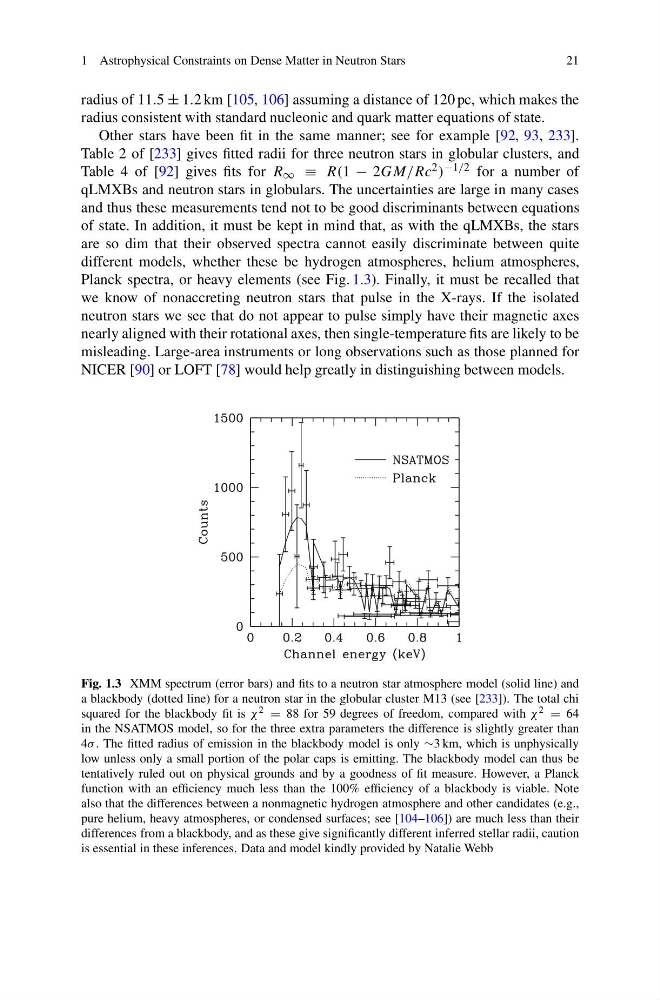
Planck spectra, or heavy elements (see Fig. 1.3). Finally, it must be recalled that
we know of nonaccreting neutron stars that pulse in the X-rays. If the isolated
neutron stars we see that do not appear to pulse simply have their magnetic axes
nearly aligned with their rotational axes, then single-temperature fits are likely to be
misleading. Large-area instruments or long observations such as those planned for
NICER [90] or LOFT [78] would help greatly in distinguishing between models.
Fig. 1.3 XMM spectrum (error bars) and fits to a neutron star atmosphere model (solid line) and
a blackbody (dotted line) for a neutron star in the globular cluster M13 (see [233]). The total chi
squared for the blackbody fit is χ 2 = 88 for 59 degrees of freedom, compared with χ 2 = 64
in the NSATMOS model, so for the three extra parameters the difference is slightly greater than
4σ . The fitted radius of emission in the blackbody model is only ∼3 km, which is unphysically
low unless only a small portion of the polar caps is emitting. The blackbody model can thus be
tentatively ruled out on physical grounds and by a goodness of fit measure. However, a Planck
function with an efficiency much less than the 100% efficiency of a blackbody is viable. Note
also that the differences between a nonmagnetic hydrogen atmosphere and other candidates (e.g.,
pure helium, heavy atmospheres, or condensed surfaces; see [104–106]) are much less than their
differences from a blackbody, and as these give significantly different inferred stellar radii, caution
is essential in these inferences. Data and model kindly provided by Natalie Webb
21
radius of 11.5 ± 1.2 km [105, 106] assuming a distance of 120 pc, which makes the
radius consistent with standard nucleonic and quark matter equations of state.
Other stars have been fit in the same manner; see for example [92, 93, 233].
Table 2 of [233] gives fitted radii for three neutron stars in globular clusters, and
Table 4 of [92] gives fits for R ∞ ≡ R(1 − 2GM/Rc 2 ) −1/2 for a number of
qLMXBs and neutron stars in globulars. The uncertainties are large in many cases
and thus these measurements tend not to be good discriminants between equations
of state. In addition, it must be kept in mind that, as with the qLMXBs, the stars
are so dim that their observed spectra cannot easily discriminate between quite
different models, whether these be hydrogen atmospheres, helium atmospheres,
Planck spectra, or heavy elements (see Fig. 1.3). Finally, it must be recalled that
we know of nonaccreting neutron stars that pulse in the X-rays. If the isolated
neutron stars we see that do not appear to pulse simply have their magnetic axes
nearly aligned with their rotational axes, then single-temperature fits are likely to be
misleading. Large-area instruments or long observations such as those planned for
NICER [90] or LOFT [78] would help greatly in distinguishing between models.
Fig. 1.3 XMM spectrum (error bars) and fits to a neutron star atmosphere model (solid line) and
a blackbody (dotted line) for a neutron star in the globular cluster M13 (see [233]). The total chi
squared for the blackbody fit is χ 2 = 88 for 59 degrees of freedom, compared with χ 2 = 64
in the NSATMOS model, so for the three extra parameters the difference is slightly greater than
4σ . The fitted radius of emission in the blackbody model is only ∼3 km, which is unphysically
low unless only a small portion of the polar caps is emitting. The blackbody model can thus be
tentatively ruled out on physical grounds and by a goodness of fit measure. However, a Planck
function with an efficiency much less than the 100% efficiency of a blackbody is viable. Note
also that the differences between a nonmagnetic hydrogen atmosphere and other candidates (e.g.,
pure helium, heavy atmospheres, or condensed surfaces; see [104–106]) are much less than their
differences from a blackbody, and as these give significantly different inferred stellar radii, caution
is essential in these inferences. Data and model kindly provided by Natalie Webb