

6 High-Frequency Variability in Neutron-Star Low-Mass X-ray Binaries
283
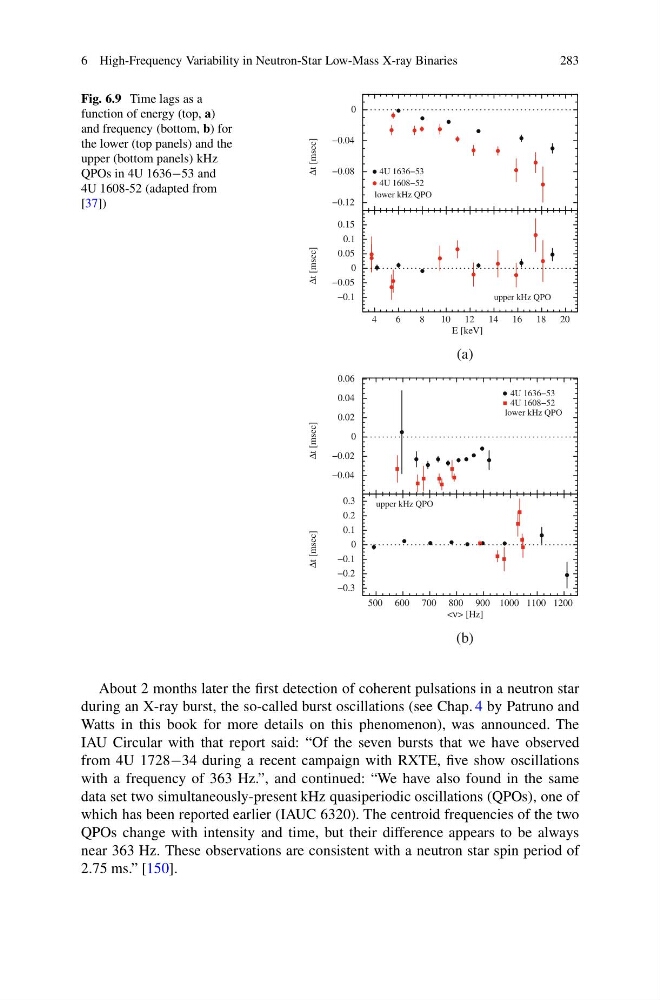
Fig. 6.9 Time lags as a
function of energy (top, a)
and frequency (bottom, b) for
the lower (top panels) and the
upper (bottom panels) kHz
QPOs in 4U 1636−53 and
4U 1608-52 (adapted from
[37])
−0.12
−0.08
−0.04
0
Δt [msec]
4U 1636−53
4U 1608−52
lower kHz QPO
4
6
8
10 12 14 16 18 20
−0.1
−0.05
0
0.05
0.1
0.15
Δt [msec]
E [keV]
upper kHz QPO
(a)
−0.04
−0.02
0
0.02
0.04
0.06
Δt [msec]
4U 1636−53
4U 1608−52
lower kHz QPO
500 600 700 800 900 1000 1100 1200
−0.3
−0.2
−0.1
0
0.1
0.2
0.3
Δt [msec]
<ν> [Hz]
upper kHz QPO
(b)
About 2 months later the first detection of coherent pulsations in a neutron star
during an X-ray burst, the so-called burst oscillations (see Chap. 4 by Patruno and
Watts in this book for more details on this phenomenon), was announced. The
IAU Circular with that report said: “Of the seven bursts that we have observed
from 4U 1728−34 during a recent campaign with RXTE, five show oscillations
with a frequency of 363 Hz.”, and continued: “We have also found in the same
data set two simultaneously-present kHz quasiperiodic oscillations (QPOs), one of
which has been reported earlier (IAUC 6320). The centroid frequencies of the two
QPOs change with intensity and time, but their difference appears to be always
near 363 Hz. These observations are consistent with a neutron star spin period of
2.75 ms.” [150].
283
Fig. 6.9 Time lags as a
function of energy (top, a)
and frequency (bottom, b) for
the lower (top panels) and the
upper (bottom panels) kHz
QPOs in 4U 1636−53 and
4U 1608-52 (adapted from
[37])
−0.12
−0.08
−0.04
0
Δt [msec]
4U 1636−53
4U 1608−52
lower kHz QPO
4
6
8
10 12 14 16 18 20
−0.1
−0.05
0
0.05
0.1
0.15
Δt [msec]
E [keV]
upper kHz QPO
(a)
−0.04
−0.02
0
0.02
0.04
0.06
Δt [msec]
4U 1636−53
4U 1608−52
lower kHz QPO
500 600 700 800 900 1000 1100 1200
−0.3
−0.2
−0.1
0
0.1
0.2
0.3
Δt [msec]
<ν> [Hz]
upper kHz QPO
(b)
About 2 months later the first detection of coherent pulsations in a neutron star
during an X-ray burst, the so-called burst oscillations (see Chap. 4 by Patruno and
Watts in this book for more details on this phenomenon), was announced. The
IAU Circular with that report said: “Of the seven bursts that we have observed
from 4U 1728−34 during a recent campaign with RXTE, five show oscillations
with a frequency of 363 Hz.”, and continued: “We have also found in the same
data set two simultaneously-present kHz quasiperiodic oscillations (QPOs), one of
which has been reported earlier (IAUC 6320). The centroid frequencies of the two
QPOs change with intensity and time, but their difference appears to be always
near 363 Hz. These observations are consistent with a neutron star spin period of
2.75 ms.” [150].