

276
M. Méndez and T. M. Belloni
400
600
800
1000
1200
0
2
4
6
8
10
12
14
16
Fractional rms (%)
Frequency (Hz)
All energies
Upper kHz QPO
Lower kHz QPO
(a)
(b)
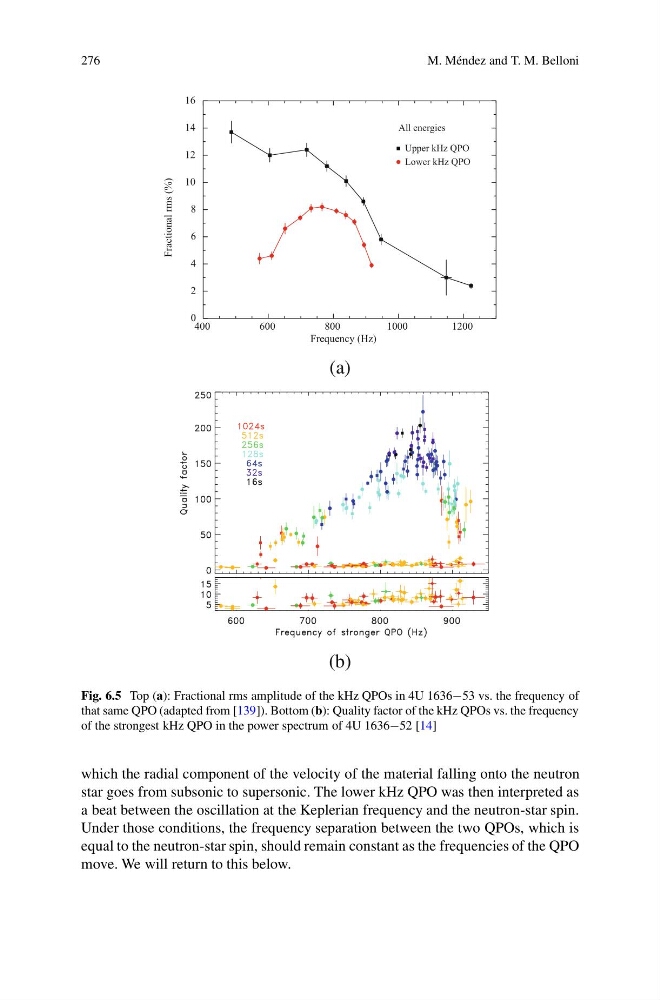
Fig. 6.5 Top (a): Fractional rms amplitude of the kHz QPOs in 4U 1636−53 vs. the frequency of
that same QPO (adapted from [139]). Bottom (b): Quality factor of the kHz QPOs vs. the frequency
of the strongest kHz QPO in the power spectrum of 4U 1636−52 [14]
which the radial component of the velocity of the material falling onto the neutron
star goes from subsonic to supersonic. The lower kHz QPO was then interpreted as
a beat between the oscillation at the Keplerian frequency and the neutron-star spin.
Under those conditions, the frequency separation between the two QPOs, which is
equal to the neutron-star spin, should remain constant as the frequencies of the QPO
move. We will return to this below.
M. Méndez and T. M. Belloni
400
600
800
1000
1200
0
2
4
6
8
10
12
14
16
Fractional rms (%)
Frequency (Hz)
All energies
Upper kHz QPO
Lower kHz QPO
(a)
(b)
Fig. 6.5 Top (a): Fractional rms amplitude of the kHz QPOs in 4U 1636−53 vs. the frequency of
that same QPO (adapted from [139]). Bottom (b): Quality factor of the kHz QPOs vs. the frequency
of the strongest kHz QPO in the power spectrum of 4U 1636−52 [14]
which the radial component of the velocity of the material falling onto the neutron
star goes from subsonic to supersonic. The lower kHz QPO was then interpreted as
a beat between the oscillation at the Keplerian frequency and the neutron-star spin.
Under those conditions, the frequency separation between the two QPOs, which is
equal to the neutron-star spin, should remain constant as the frequencies of the QPO
move. We will return to this below.