

250
D. K. Galloway and L. Keek
Any individual reaction will have little impact on the burst profile unless a
significant fraction of the fuel mass is processed through that reaction, and it’s
timescale is unusually slow [188]. Substantial experimental work has established
several such “waiting points”, including 60 Zn, 64 Ge, 68 Se and 72 Kr (e.g. [15, 150,
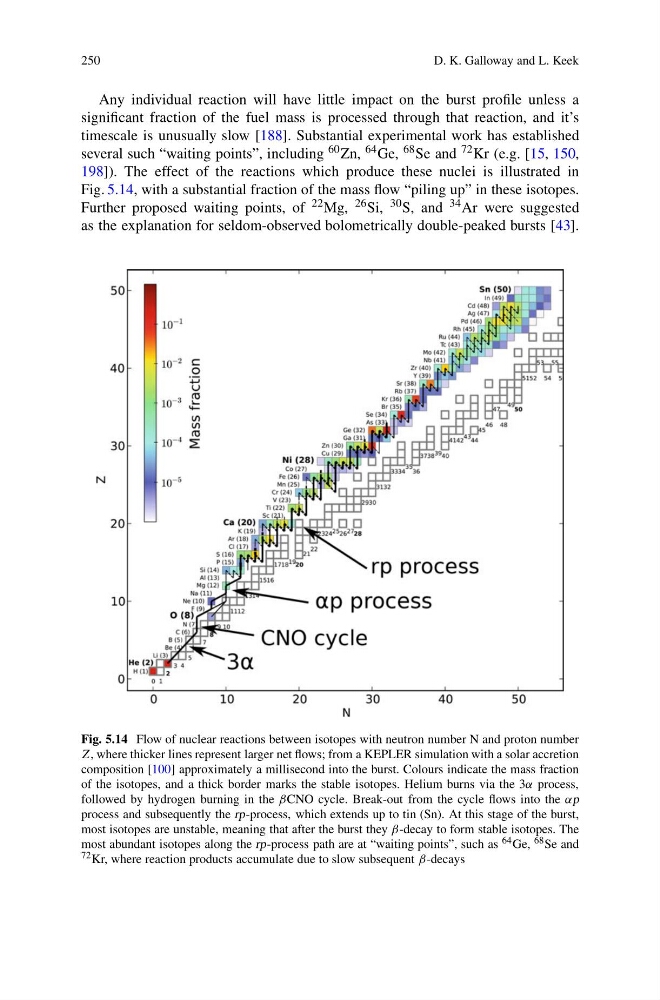
198]). The effect of the reactions which produce these nuclei is illustrated in
Fig. 5.14, with a substantial fraction of the mass flow “piling up” in these isotopes.
Further proposed waiting points, of 22 Mg, 26 Si, 30 S, and 34 Ar were suggested
as the explanation for seldom-observed bolometrically double-peaked bursts [43].
Fig. 5.14 Flow of nuclear reactions between isotopes with neutron number N and proton number
Z, where thicker lines represent larger net flows; from a KEPLER simulation with a solar accretion
composition [100] approximately a millisecond into the burst. Colours indicate the mass fraction
of the isotopes, and a thick border marks the stable isotopes. Helium burns via the 3α process,
followed by hydrogen burning in the βCNO cycle. Break-out from the cycle flows into the αp
process and subsequently the rp-process, which extends up to tin (Sn). At this stage of the burst,
most isotopes are unstable, meaning that after the burst they β-decay to form stable isotopes. The
most abundant isotopes along the rp-process path are at “waiting points”, such as 64 Ge, 68 Se and
72 Kr, where reaction products accumulate due to slow subsequent β-decays
D. K. Galloway and L. Keek
Any individual reaction will have little impact on the burst profile unless a
significant fraction of the fuel mass is processed through that reaction, and it’s
timescale is unusually slow [188]. Substantial experimental work has established
several such “waiting points”, including 60 Zn, 64 Ge, 68 Se and 72 Kr (e.g. [15, 150,
198]). The effect of the reactions which produce these nuclei is illustrated in
Fig. 5.14, with a substantial fraction of the mass flow “piling up” in these isotopes.
Further proposed waiting points, of 22 Mg, 26 Si, 30 S, and 34 Ar were suggested
as the explanation for seldom-observed bolometrically double-peaked bursts [43].
Fig. 5.14 Flow of nuclear reactions between isotopes with neutron number N and proton number
Z, where thicker lines represent larger net flows; from a KEPLER simulation with a solar accretion
composition [100] approximately a millisecond into the burst. Colours indicate the mass fraction
of the isotopes, and a thick border marks the stable isotopes. Helium burns via the 3α process,
followed by hydrogen burning in the βCNO cycle. Break-out from the cycle flows into the αp
process and subsequently the rp-process, which extends up to tin (Sn). At this stage of the burst,
most isotopes are unstable, meaning that after the burst they β-decay to form stable isotopes. The
most abundant isotopes along the rp-process path are at “waiting points”, such as 64 Ge, 68 Se and
72 Kr, where reaction products accumulate due to slow subsequent β-decays