

248
D. K. Galloway and L. Keek
in a limited way thus far. The same holds true for rotationally induces turbulent
mixing [98, 151].
5.8.3 Multi-Dimensional Models
Multi-dimensional models of X-ray bursts either simulate a small box in the neutron
star envelope aiming to resolve convection, or they simulate flame spreading across
the entire envelope with a cruder implementation of turbulent mixing. The earliest
efforts in the former category are simulations of deep helium ignition [165, 210],
which may be applicable to the most powerful intermediate duration bursts. For pure
helium bursts, a small nuclear network may suffice. Furthermore, these simulations
find that at large depths, the fast helium flame travels as a detonation, such that only
a short simulation time is required. Fast flame propagation could be a requirement
for explaining exceptionally fast rise times observed in the most powerful helium
bursts [84]. Recognizing that most observed bursts ignite at a shallower depth
and thus propagate more slowly as a deflagration, a new “low Mach number”
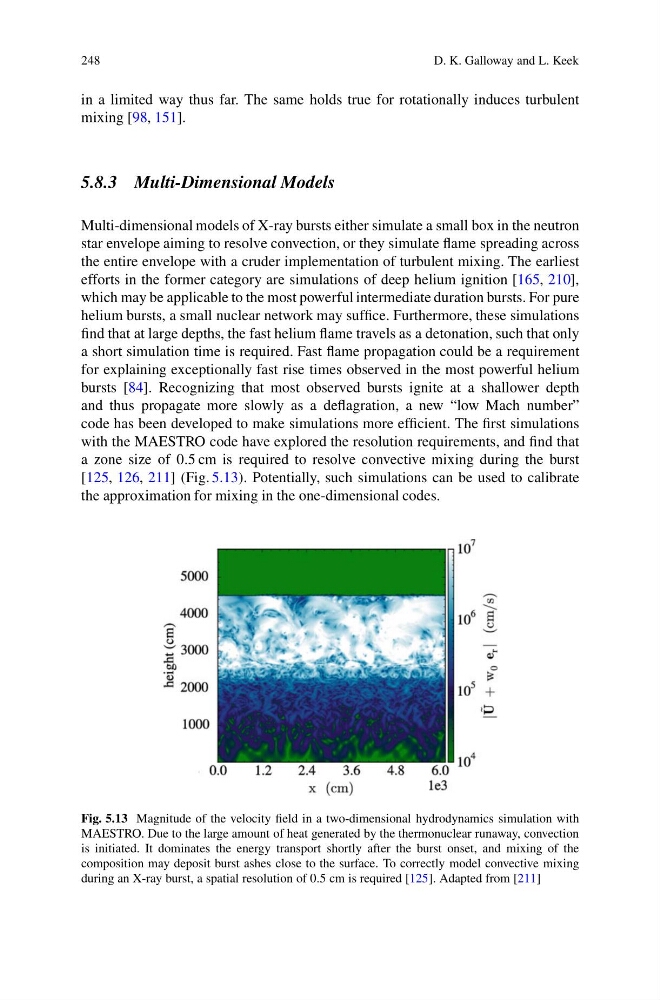
code has been developed to make simulations more efficient. The first simulations
with the MAESTRO code have explored the resolution requirements, and find that
a zone size of 0.5 cm is required to resolve convective mixing during the burst
[125, 126, 211] (Fig. 5.13). Potentially, such simulations can be used to calibrate
the approximation for mixing in the one-dimensional codes.
Fig. 5.13 Magnitude of the velocity field in a two-dimensional hydrodynamics simulation with
MAESTRO. Due to the large amount of heat generated by the thermonuclear runaway, convection
is initiated. It dominates the energy transport shortly after the burst onset, and mixing of the
composition may deposit burst ashes close to the surface. To correctly model convective mixing
during an X-ray burst, a spatial resolution of 0.5 cm is required [125]. Adapted from [211]
D. K. Galloway and L. Keek
in a limited way thus far. The same holds true for rotationally induces turbulent
mixing [98, 151].
5.8.3 Multi-Dimensional Models
Multi-dimensional models of X-ray bursts either simulate a small box in the neutron
star envelope aiming to resolve convection, or they simulate flame spreading across
the entire envelope with a cruder implementation of turbulent mixing. The earliest
efforts in the former category are simulations of deep helium ignition [165, 210],
which may be applicable to the most powerful intermediate duration bursts. For pure
helium bursts, a small nuclear network may suffice. Furthermore, these simulations
find that at large depths, the fast helium flame travels as a detonation, such that only
a short simulation time is required. Fast flame propagation could be a requirement
for explaining exceptionally fast rise times observed in the most powerful helium
bursts [84]. Recognizing that most observed bursts ignite at a shallower depth
and thus propagate more slowly as a deflagration, a new “low Mach number”
code has been developed to make simulations more efficient. The first simulations
with the MAESTRO code have explored the resolution requirements, and find that
a zone size of 0.5 cm is required to resolve convective mixing during the burst
[125, 126, 211] (Fig. 5.13). Potentially, such simulations can be used to calibrate
the approximation for mixing in the one-dimensional codes.
Fig. 5.13 Magnitude of the velocity field in a two-dimensional hydrodynamics simulation with
MAESTRO. Due to the large amount of heat generated by the thermonuclear runaway, convection
is initiated. It dominates the energy transport shortly after the burst onset, and mixing of the
composition may deposit burst ashes close to the surface. To correctly model convective mixing
during an X-ray burst, a spatial resolution of 0.5 cm is required [125]. Adapted from [211]