

244
D. K. Galloway and L. Keek
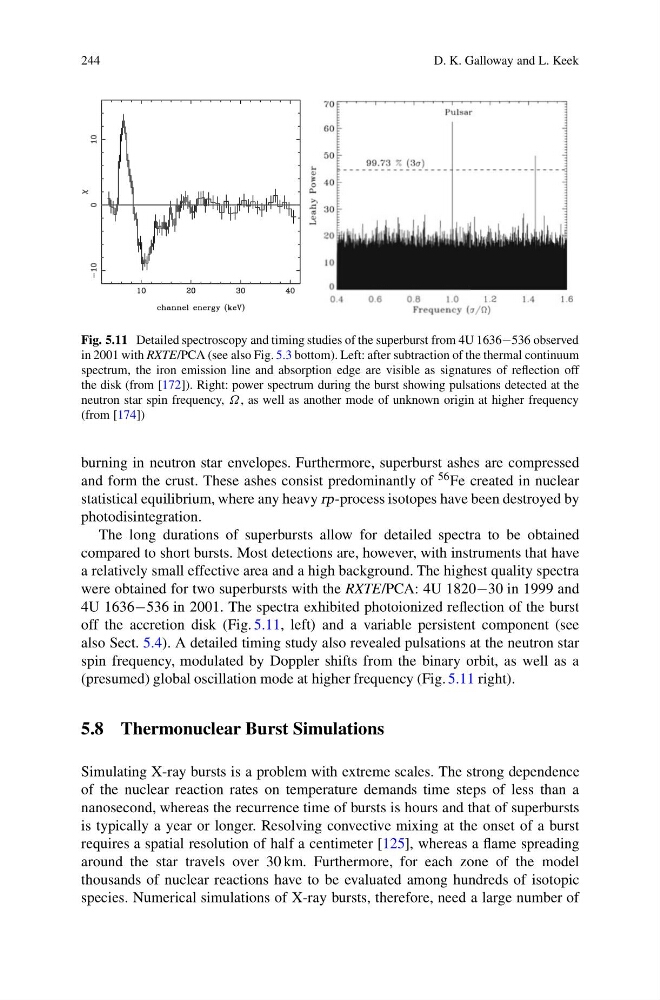
Fig. 5.11 Detailed spectroscopy and timing studies of the superburst from 4U 1636−536 observed
in 2001 with RXTE/PCA (see also Fig. 5.3 bottom). Left: after subtraction of the thermal continuum
spectrum, the iron emission line and absorption edge are visible as signatures of reflection off
the disk (from [172]). Right: power spectrum during the burst showing pulsations detected at the
neutron star spin frequency, Ω, as well as another mode of unknown origin at higher frequency
(from [174])
burning in neutron star envelopes. Furthermore, superburst ashes are compressed
and form the crust. These ashes consist predominantly of 56 Fe created in nuclear
statistical equilibrium, where any heavy rp-process isotopes have been destroyed by
photodisintegration.
The long durations of superbursts allow for detailed spectra to be obtained
compared to short bursts. Most detections are, however, with instruments that have
a relatively small effective area and a high background. The highest quality spectra
were obtained for two superbursts with the RXTE/PCA: 4U 1820−30 in 1999 and
4U 1636−536 in 2001. The spectra exhibited photoionized reflection of the burst
off the accretion disk (Fig. 5.11, left) and a variable persistent component (see
also Sect. 5.4). A detailed timing study also revealed pulsations at the neutron star
spin frequency, modulated by Doppler shifts from the binary orbit, as well as a
(presumed) global oscillation mode at higher frequency (Fig. 5.11 right).
5.8 Thermonuclear Burst Simulations
Simulating X-ray bursts is a problem with extreme scales. The strong dependence
of the nuclear reaction rates on temperature demands time steps of less than a
nanosecond, whereas the recurrence time of bursts is hours and that of superbursts
is typically a year or longer. Resolving convective mixing at the onset of a burst
requires a spatial resolution of half a centimeter [125], whereas a flame spreading
around the star travels over 30 km. Furthermore, for each zone of the model
thousands of nuclear reactions have to be evaluated among hundreds of isotopic
species. Numerical simulations of X-ray bursts, therefore, need a large number of
D. K. Galloway and L. Keek
Fig. 5.11 Detailed spectroscopy and timing studies of the superburst from 4U 1636−536 observed
in 2001 with RXTE/PCA (see also Fig. 5.3 bottom). Left: after subtraction of the thermal continuum
spectrum, the iron emission line and absorption edge are visible as signatures of reflection off
the disk (from [172]). Right: power spectrum during the burst showing pulsations detected at the
neutron star spin frequency, Ω, as well as another mode of unknown origin at higher frequency
(from [174])
burning in neutron star envelopes. Furthermore, superburst ashes are compressed
and form the crust. These ashes consist predominantly of 56 Fe created in nuclear
statistical equilibrium, where any heavy rp-process isotopes have been destroyed by
photodisintegration.
The long durations of superbursts allow for detailed spectra to be obtained
compared to short bursts. Most detections are, however, with instruments that have
a relatively small effective area and a high background. The highest quality spectra
were obtained for two superbursts with the RXTE/PCA: 4U 1820−30 in 1999 and
4U 1636−536 in 2001. The spectra exhibited photoionized reflection of the burst
off the accretion disk (Fig. 5.11, left) and a variable persistent component (see
also Sect. 5.4). A detailed timing study also revealed pulsations at the neutron star
spin frequency, modulated by Doppler shifts from the binary orbit, as well as a
(presumed) global oscillation mode at higher frequency (Fig. 5.11 right).
5.8 Thermonuclear Burst Simulations
Simulating X-ray bursts is a problem with extreme scales. The strong dependence
of the nuclear reaction rates on temperature demands time steps of less than a
nanosecond, whereas the recurrence time of bursts is hours and that of superbursts
is typically a year or longer. Resolving convective mixing at the onset of a burst
requires a spatial resolution of half a centimeter [125], whereas a flame spreading
around the star travels over 30 km. Furthermore, for each zone of the model
thousands of nuclear reactions have to be evaluated among hundreds of isotopic
species. Numerical simulations of X-ray bursts, therefore, need a large number of