

5 Thermonuclear X-ray Bursts
241
could be observed for several hours [36, 105]. Observationally, the start of these
longer events often falls in a data gap, so that the burst duration and fluence are
only known approximately, making it difficult to accurately classify them. These
events are observed both from sources where the accretion composition is heliumrich [110] and hydrogen-rich [42]. In the latter case, hydrogen burns at a shallow
depth either stably (regime III in Table 5.1) or in weak flashes (regime II), producing
a deep layer of helium.
As in all energetic helium-rich bursts, the burst flux reaches the Eddington
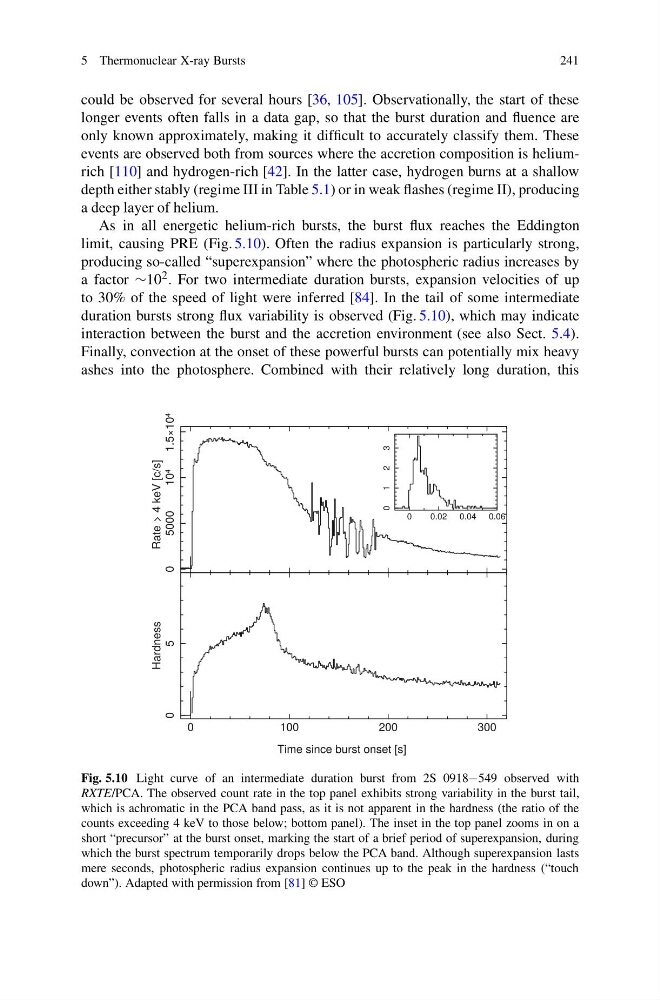
limit, causing PRE (Fig. 5.10). Often the radius expansion is particularly strong,
producing so-called “superexpansion” where the photospheric radius increases by
a factor ∼10 2 . For two intermediate duration bursts, expansion velocities of up
to 30% of the speed of light were inferred [84]. In the tail of some intermediate
duration bursts strong flux variability is observed (Fig. 5.10), which may indicate
interaction between the burst and the accretion environment (see also Sect. 5.4).
Finally, convection at the onset of these powerful bursts can potentially mix heavy
ashes into the photosphere. Combined with their relatively long duration, this
Fig. 5.10 Light curve of an intermediate duration burst from 2S 0918−549 observed with
RXTE/PCA. The observed count rate in the top panel exhibits strong variability in the burst tail,
which is achromatic in the PCA band pass, as it is not apparent in the hardness (the ratio of the
counts exceeding 4 keV to those below; bottom panel). The inset in the top panel zooms in on a
short “precursor” at the burst onset, marking the start of a brief period of superexpansion, during
which the burst spectrum temporarily drops below the PCA band. Although superexpansion lasts
mere seconds, photospheric radius expansion continues up to the peak in the hardness (“touch
down”). Adapted with permission from [81] © ESO
241
could be observed for several hours [36, 105]. Observationally, the start of these
longer events often falls in a data gap, so that the burst duration and fluence are
only known approximately, making it difficult to accurately classify them. These
events are observed both from sources where the accretion composition is heliumrich [110] and hydrogen-rich [42]. In the latter case, hydrogen burns at a shallow
depth either stably (regime III in Table 5.1) or in weak flashes (regime II), producing
a deep layer of helium.
As in all energetic helium-rich bursts, the burst flux reaches the Eddington
limit, causing PRE (Fig. 5.10). Often the radius expansion is particularly strong,
producing so-called “superexpansion” where the photospheric radius increases by
a factor ∼10 2 . For two intermediate duration bursts, expansion velocities of up
to 30% of the speed of light were inferred [84]. In the tail of some intermediate
duration bursts strong flux variability is observed (Fig. 5.10), which may indicate
interaction between the burst and the accretion environment (see also Sect. 5.4).
Finally, convection at the onset of these powerful bursts can potentially mix heavy
ashes into the photosphere. Combined with their relatively long duration, this
Fig. 5.10 Light curve of an intermediate duration burst from 2S 0918−549 observed with
RXTE/PCA. The observed count rate in the top panel exhibits strong variability in the burst tail,
which is achromatic in the PCA band pass, as it is not apparent in the hardness (the ratio of the
counts exceeding 4 keV to those below; bottom panel). The inset in the top panel zooms in on a
short “precursor” at the burst onset, marking the start of a brief period of superexpansion, during
which the burst spectrum temporarily drops below the PCA band. Although superexpansion lasts
mere seconds, photospheric radius expansion continues up to the peak in the hardness (“touch
down”). Adapted with permission from [81] © ESO