

12
M. C. Miller
• Binary orbital decay ˙
P b . Gravitational waves are emitted by anything that has
a time-variable quadrupole (or higher-order) mass moment. This shrinks and
circularizes binary orbits.
• Shapiro delay, r and s. When the signal from the pulsar passes near its
companion, time dilation in the enhanced potential delays the signal compared
to the arrival time of a photon in flat spacetime. The magnitude of the delay over
the orbit is characterized by the range r and shape s of the delay as a function
of phase. See [83] for a recent reparameterization of the Shapiro delay that may
represent the error region better for some orbital geometries.
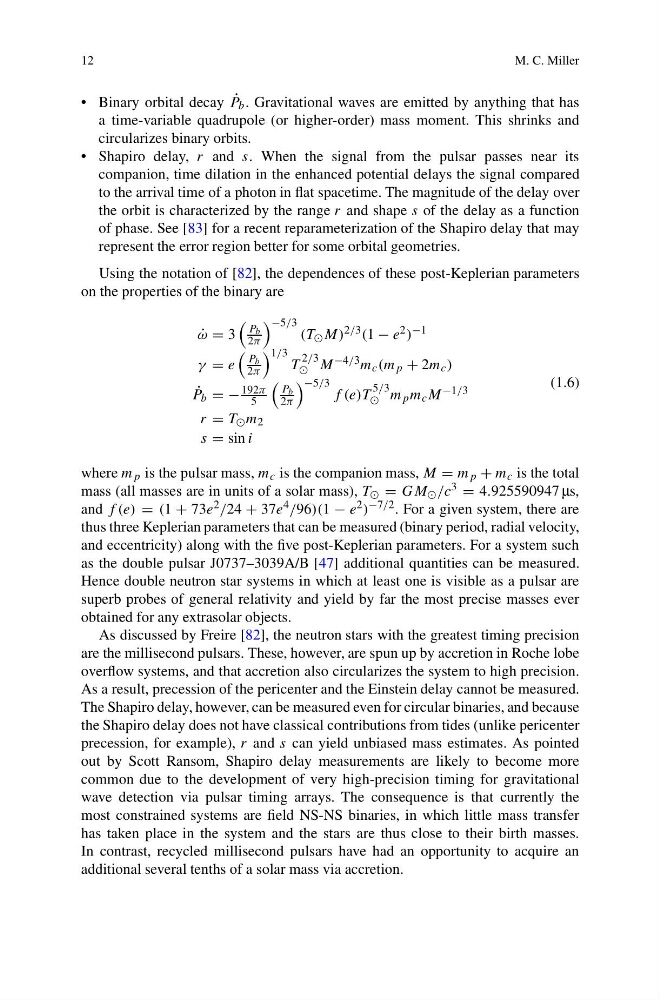
Using the notation of [82], the dependences of these post-Keplerian parameters
on the properties of the binary are
˙
ω = 3
P b
2π
−5/3
(T M) 2/3 (1 − e 2 ) −1
γ = e
P b
2π
1/3
T
2/3
M −4/3 m c (m p + 2m c )
˙
P b = −
192π
5
P b
2π
−5/3
f (e)T
5/3
m p m c M −1/3
r = T m 2
s = sin i
(1.6)
where m p is the pulsar mass, m c is the companion mass, M = m p + m c is the total
mass (all masses are in units of a solar mass), T = GM /c 3 = 4.925590947 μs,
and f (e) = (1 + 73e 2 /24 + 37e 4 /96)(1 − e 2 ) −7/2 . For a given system, there are
thus three Keplerian parameters that can be measured (binary period, radial velocity,
and eccentricity) along with the five post-Keplerian parameters. For a system such
as the double pulsar J0737–3039A/B [47] additional quantities can be measured.
Hence double neutron star systems in which at least one is visible as a pulsar are
superb probes of general relativity and yield by far the most precise masses ever
obtained for any extrasolar objects.
As discussed by Freire [82], the neutron stars with the greatest timing precision
are the millisecond pulsars. These, however, are spun up by accretion in Roche lobe
overflow systems, and that accretion also circularizes the system to high precision.
As a result, precession of the pericenter and the Einstein delay cannot be measured.
The Shapiro delay, however, can be measured even for circular binaries, and because
the Shapiro delay does not have classical contributions from tides (unlike pericenter
precession, for example), r and s can yield unbiased mass estimates. As pointed
out by Scott Ransom, Shapiro delay measurements are likely to become more
common due to the development of very high-precision timing for gravitational
wave detection via pulsar timing arrays. The consequence is that currently the
most constrained systems are field NS-NS binaries, in which little mass transfer
has taken place in the system and the stars are thus close to their birth masses.
In contrast, recycled millisecond pulsars have had an opportunity to acquire an
additional several tenths of a solar mass via accretion.
M. C. Miller
• Binary orbital decay ˙
P b . Gravitational waves are emitted by anything that has
a time-variable quadrupole (or higher-order) mass moment. This shrinks and
circularizes binary orbits.
• Shapiro delay, r and s. When the signal from the pulsar passes near its
companion, time dilation in the enhanced potential delays the signal compared
to the arrival time of a photon in flat spacetime. The magnitude of the delay over
the orbit is characterized by the range r and shape s of the delay as a function
of phase. See [83] for a recent reparameterization of the Shapiro delay that may
represent the error region better for some orbital geometries.
Using the notation of [82], the dependences of these post-Keplerian parameters
on the properties of the binary are
˙
ω = 3
P b
2π
−5/3
(T M) 2/3 (1 − e 2 ) −1
γ = e
P b
2π
1/3
T
2/3
M −4/3 m c (m p + 2m c )
˙
P b = −
192π
5
P b
2π
−5/3
f (e)T
5/3
m p m c M −1/3
r = T m 2
s = sin i
(1.6)
where m p is the pulsar mass, m c is the companion mass, M = m p + m c is the total
mass (all masses are in units of a solar mass), T = GM /c 3 = 4.925590947 μs,
and f (e) = (1 + 73e 2 /24 + 37e 4 /96)(1 − e 2 ) −7/2 . For a given system, there are
thus three Keplerian parameters that can be measured (binary period, radial velocity,
and eccentricity) along with the five post-Keplerian parameters. For a system such
as the double pulsar J0737–3039A/B [47] additional quantities can be measured.
Hence double neutron star systems in which at least one is visible as a pulsar are
superb probes of general relativity and yield by far the most precise masses ever
obtained for any extrasolar objects.
As discussed by Freire [82], the neutron stars with the greatest timing precision
are the millisecond pulsars. These, however, are spun up by accretion in Roche lobe
overflow systems, and that accretion also circularizes the system to high precision.
As a result, precession of the pericenter and the Einstein delay cannot be measured.
The Shapiro delay, however, can be measured even for circular binaries, and because
the Shapiro delay does not have classical contributions from tides (unlike pericenter
precession, for example), r and s can yield unbiased mass estimates. As pointed
out by Scott Ransom, Shapiro delay measurements are likely to become more
common due to the development of very high-precision timing for gravitational
wave detection via pulsar timing arrays. The consequence is that currently the
most constrained systems are field NS-NS binaries, in which little mass transfer
has taken place in the system and the stars are thus close to their birth masses.
In contrast, recycled millisecond pulsars have had an opportunity to acquire an
additional several tenths of a solar mass via accretion.