

214
D. K. Galloway and L. Keek
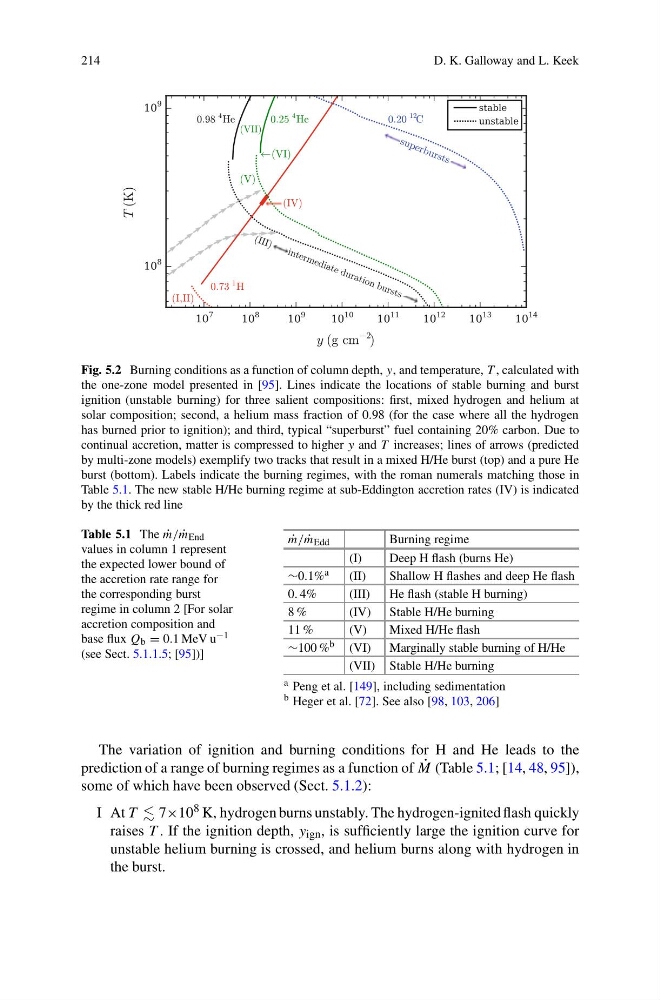
Fig. 5.2 Burning conditions as a function of column depth, y, and temperature, T , calculated with
the one-zone model presented in [95]. Lines indicate the locations of stable burning and burst
ignition (unstable burning) for three salient compositions: first, mixed hydrogen and helium at
solar composition; second, a helium mass fraction of 0.98 (for the case where all the hydrogen
has burned prior to ignition); and third, typical “superburst” fuel containing 20% carbon. Due to
continual accretion, matter is compressed to higher y and T increases; lines of arrows (predicted
by multi-zone models) exemplify two tracks that result in a mixed H/He burst (top) and a pure He
burst (bottom). Labels indicate the burning regimes, with the roman numerals matching those in
Table 5.1. The new stable H/He burning regime at sub-Eddington accretion rates (IV) is indicated
by the thick red line
Table 5.1 The ˙
m/ ˙
m End
values in column 1 represent
the expected lower bound of
the accretion rate range for
the corresponding burst
regime in column 2 [For solar
accretion composition and
base flux Q b = 0.1 MeV u −1
(see Sect. 5.1.1.5; [95])]
˙
m/ ˙
m Edd
Burning regime
(I)
Deep H flash (burns He)
∼0.1% a
(II)
Shallow H flashes and deep He flash
0. 4%
(III)
He flash (stable H burning)
8 %
(IV) Stable H/He burning
11 %
(V)
Mixed H/He flash
∼100 % b (VI) Marginally stable burning of H/He
(VII) Stable H/He burning
a Peng et al. [149], including sedimentation
b Heger et al. [72]. See also [98, 103, 206]
The variation of ignition and burning conditions for H and He leads to the
prediction of a range of burning regimes as a function of ˙
M (Table 5.1; [14, 48, 95]),
some of which have been observed (Sect. 5.1.2):
I At T 7×10 8 K, hydrogen burns unstably. The hydrogen-ignited flash quickly
raises T . If the ignition depth, y ign , is sufficiently large the ignition curve for
unstable helium burning is crossed, and helium burns along with hydrogen in
the burst.
D. K. Galloway and L. Keek
Fig. 5.2 Burning conditions as a function of column depth, y, and temperature, T , calculated with
the one-zone model presented in [95]. Lines indicate the locations of stable burning and burst
ignition (unstable burning) for three salient compositions: first, mixed hydrogen and helium at
solar composition; second, a helium mass fraction of 0.98 (for the case where all the hydrogen
has burned prior to ignition); and third, typical “superburst” fuel containing 20% carbon. Due to
continual accretion, matter is compressed to higher y and T increases; lines of arrows (predicted
by multi-zone models) exemplify two tracks that result in a mixed H/He burst (top) and a pure He
burst (bottom). Labels indicate the burning regimes, with the roman numerals matching those in
Table 5.1. The new stable H/He burning regime at sub-Eddington accretion rates (IV) is indicated
by the thick red line
Table 5.1 The ˙
m/ ˙
m End
values in column 1 represent
the expected lower bound of
the accretion rate range for
the corresponding burst
regime in column 2 [For solar
accretion composition and
base flux Q b = 0.1 MeV u −1
(see Sect. 5.1.1.5; [95])]
˙
m/ ˙
m Edd
Burning regime
(I)
Deep H flash (burns He)
∼0.1% a
(II)
Shallow H flashes and deep He flash
0. 4%
(III)
He flash (stable H burning)
8 %
(IV) Stable H/He burning
11 %
(V)
Mixed H/He flash
∼100 % b (VI) Marginally stable burning of H/He
(VII) Stable H/He burning
a Peng et al. [149], including sedimentation
b Heger et al. [72]. See also [98, 103, 206]
The variation of ignition and burning conditions for H and He leads to the
prediction of a range of burning regimes as a function of ˙
M (Table 5.1; [14, 48, 95]),
some of which have been observed (Sect. 5.1.2):
I At T 7×10 8 K, hydrogen burns unstably. The hydrogen-ignited flash quickly
raises T . If the ignition depth, y ign , is sufficiently large the ignition curve for
unstable helium burning is crossed, and helium burns along with hydrogen in
the burst.