

212
D. K. Galloway and L. Keek
5.1.1.2 Runaway Thermonuclear Burning in a Thin Shell
Accretion grows the fuel layer on top of the neutron star until the depth for
thermonuclear ignition is reached. It is convenient to express the depth of the layer
as the column depth at radius r: y(r) =
∞
r ρ(r )dr , with ρ the mass density. The
column depth y measures the mass above a unit area at radius r, making y a mass
coordinate measured from the outside in. Hydrostatic equilibrium in the layer can be
expressed as dP = −gρdr, with P the pressure and g the gravitational acceleration.
Because the envelope is relatively thin, g can be approximated as being constant in
the outer layers. Hydrostatic equilibrium is then simplified to P = −gy, which
shows that y is also a pressure coordinate.
Compression increases the density and temperature in the fuel layer with depth.
A few meters below the stellar surface (from y 10 8 g cm −2 for hydrogen/helium),
the conditions for thermonuclear fusion can be achieved, and the neutron star
envelope is heated by nuclear burning. The thin-shell instability (aided by mild
electron degeneracy) prevents the neutron star envelope from cooling by expansion,
and allows the fuel layer to continue to heat up (see Sect. 5.2 for further discussion).
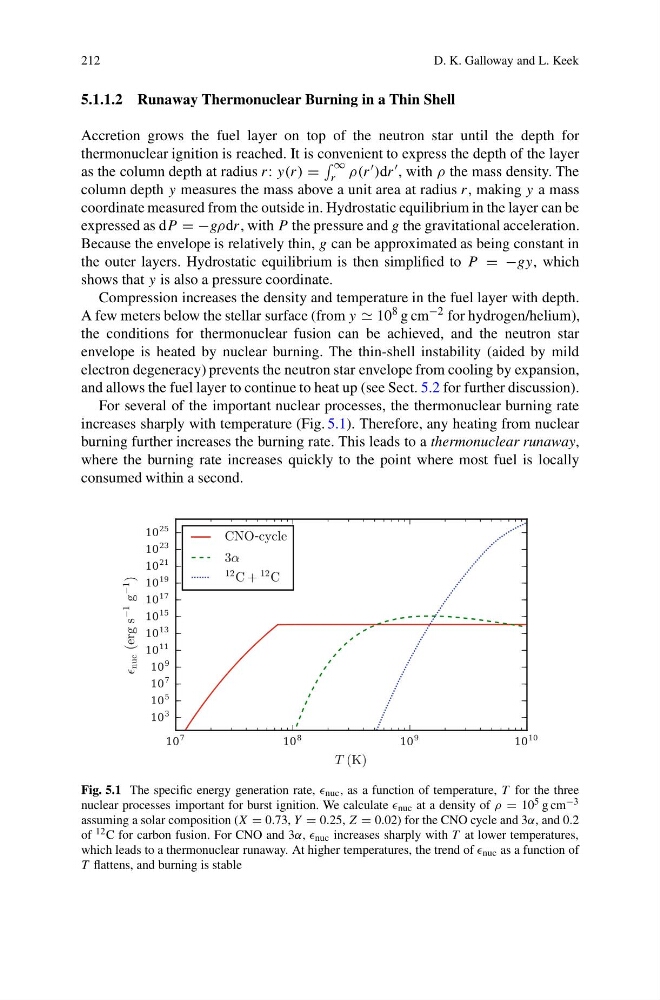
For several of the important nuclear processes, the thermonuclear burning rate
increases sharply with temperature (Fig. 5.1). Therefore, any heating from nuclear
burning further increases the burning rate. This leads to a thermonuclear runaway,
where the burning rate increases quickly to the point where most fuel is locally
consumed within a second.
Fig. 5.1 The specific energy generation rate, nuc , as a function of temperature, T for the three
nuclear processes important for burst ignition. We calculate nuc at a density of ρ = 10 5 g cm −3
assuming a solar composition (X = 0.73, Y = 0.25, Z = 0.02) for the CNO cycle and 3α, and 0.2
of 12 C for carbon fusion. For CNO and 3α, nuc increases sharply with T at lower temperatures,
which leads to a thermonuclear runaway. At higher temperatures, the trend of nuc as a function of
T flattens, and burning is stable
D. K. Galloway and L. Keek
5.1.1.2 Runaway Thermonuclear Burning in a Thin Shell
Accretion grows the fuel layer on top of the neutron star until the depth for
thermonuclear ignition is reached. It is convenient to express the depth of the layer
as the column depth at radius r: y(r) =
∞
r ρ(r )dr , with ρ the mass density. The
column depth y measures the mass above a unit area at radius r, making y a mass
coordinate measured from the outside in. Hydrostatic equilibrium in the layer can be
expressed as dP = −gρdr, with P the pressure and g the gravitational acceleration.
Because the envelope is relatively thin, g can be approximated as being constant in
the outer layers. Hydrostatic equilibrium is then simplified to P = −gy, which
shows that y is also a pressure coordinate.
Compression increases the density and temperature in the fuel layer with depth.
A few meters below the stellar surface (from y 10 8 g cm −2 for hydrogen/helium),
the conditions for thermonuclear fusion can be achieved, and the neutron star
envelope is heated by nuclear burning. The thin-shell instability (aided by mild
electron degeneracy) prevents the neutron star envelope from cooling by expansion,
and allows the fuel layer to continue to heat up (see Sect. 5.2 for further discussion).
For several of the important nuclear processes, the thermonuclear burning rate
increases sharply with temperature (Fig. 5.1). Therefore, any heating from nuclear
burning further increases the burning rate. This leads to a thermonuclear runaway,
where the burning rate increases quickly to the point where most fuel is locally
consumed within a second.
Fig. 5.1 The specific energy generation rate, nuc , as a function of temperature, T for the three
nuclear processes important for burst ignition. We calculate nuc at a density of ρ = 10 5 g cm −3
assuming a solar composition (X = 0.73, Y = 0.25, Z = 0.02) for the CNO cycle and 3α, and 0.2
of 12 C for carbon fusion. For CNO and 3α, nuc increases sharply with T at lower temperatures,
which leads to a thermonuclear runaway. At higher temperatures, the trend of nuc as a function of
T flattens, and burning is stable