

1 Astrophysical Constraints on Dense Matter in Neutron Stars
9
1.2.3 Construction of Neutron Star Models from Microphysics
We argued earlier that the Fermi energy in the cores of neutron stars is much greater
than the thermal energy. If we also assume that the matter is in its ground state at a
given density, this implies that the pressure is only a function of density: P = P (ρ)
(this is called a barotropic equation of state). If we have such an equation of state
we can compute the structure of a nonrotating and hence spherically symmetric star
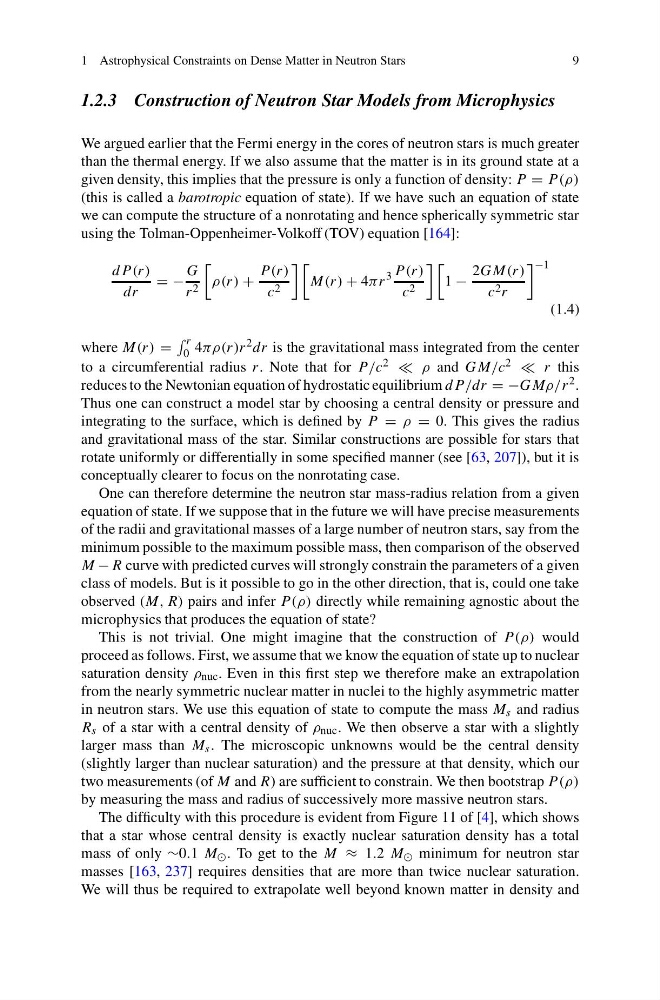
using the Tolman-Oppenheimer-Volkoff (TOV) equation [164]:
dP (r)
dr
= −
G
r 2
ρ(r) +
P (r)
c 2
M(r) + 4πr
3 P (r)
c 2
1 −
2GM(r)
c 2 r
−1
(1.4)
where M(r) =
r
0 4πρ(r)r 2 dr is the gravitational mass integrated from the center
to a circumferential radius r. Note that for P /c 2 ρ and GM/c 2 r this
reduces to the Newtonian equation of hydrostatic equilibrium dP /dr = −GMρ/r 2 .
Thus one can construct a model star by choosing a central density or pressure and
integrating to the surface, which is defined by P = ρ = 0. This gives the radius
and gravitational mass of the star. Similar constructions are possible for stars that
rotate uniformly or differentially in some specified manner (see [63, 207]), but it is
conceptually clearer to focus on the nonrotating case.
One can therefore determine the neutron star mass-radius relation from a given
equation of state. If we suppose that in the future we will have precise measurements
of the radii and gravitational masses of a large number of neutron stars, say from the
minimum possible to the maximum possible mass, then comparison of the observed
M − R curve with predicted curves will strongly constrain the parameters of a given
class of models. But is it possible to go in the other direction, that is, could one take
observed (M, R) pairs and infer P (ρ) directly while remaining agnostic about the
microphysics that produces the equation of state?
This is not trivial. One might imagine that the construction of P (ρ) would
proceed as follows. First, we assume that we know the equation of state up to nuclear
saturation density ρ nuc . Even in this first step we therefore make an extrapolation
from the nearly symmetric nuclear matter in nuclei to the highly asymmetric matter
in neutron stars. We use this equation of state to compute the mass M s and radius
R s of a star with a central density of ρ nuc . We then observe a star with a slightly
larger mass than M s . The microscopic unknowns would be the central density
(slightly larger than nuclear saturation) and the pressure at that density, which our
two measurements (of M and R) are sufficient to constrain. We then bootstrap P (ρ)
by measuring the mass and radius of successively more massive neutron stars.
The difficulty with this procedure is evident from Figure 11 of [4], which shows
that a star whose central density is exactly nuclear saturation density has a total
mass of only ∼0.1 M . To get to the M ≈ 1.2 M minimum for neutron star
masses [163, 237] requires densities that are more than twice nuclear saturation.
We will thus be required to extrapolate well beyond known matter in density and
9
1.2.3 Construction of Neutron Star Models from Microphysics
We argued earlier that the Fermi energy in the cores of neutron stars is much greater
than the thermal energy. If we also assume that the matter is in its ground state at a
given density, this implies that the pressure is only a function of density: P = P (ρ)
(this is called a barotropic equation of state). If we have such an equation of state
we can compute the structure of a nonrotating and hence spherically symmetric star
using the Tolman-Oppenheimer-Volkoff (TOV) equation [164]:
dP (r)
dr
= −
G
r 2
ρ(r) +
P (r)
c 2
M(r) + 4πr
3 P (r)
c 2
1 −
2GM(r)
c 2 r
−1
(1.4)
where M(r) =
r
0 4πρ(r)r 2 dr is the gravitational mass integrated from the center
to a circumferential radius r. Note that for P /c 2 ρ and GM/c 2 r this
reduces to the Newtonian equation of hydrostatic equilibrium dP /dr = −GMρ/r 2 .
Thus one can construct a model star by choosing a central density or pressure and
integrating to the surface, which is defined by P = ρ = 0. This gives the radius
and gravitational mass of the star. Similar constructions are possible for stars that
rotate uniformly or differentially in some specified manner (see [63, 207]), but it is
conceptually clearer to focus on the nonrotating case.
One can therefore determine the neutron star mass-radius relation from a given
equation of state. If we suppose that in the future we will have precise measurements
of the radii and gravitational masses of a large number of neutron stars, say from the
minimum possible to the maximum possible mass, then comparison of the observed
M − R curve with predicted curves will strongly constrain the parameters of a given
class of models. But is it possible to go in the other direction, that is, could one take
observed (M, R) pairs and infer P (ρ) directly while remaining agnostic about the
microphysics that produces the equation of state?
This is not trivial. One might imagine that the construction of P (ρ) would
proceed as follows. First, we assume that we know the equation of state up to nuclear
saturation density ρ nuc . Even in this first step we therefore make an extrapolation
from the nearly symmetric nuclear matter in nuclei to the highly asymmetric matter
in neutron stars. We use this equation of state to compute the mass M s and radius
R s of a star with a central density of ρ nuc . We then observe a star with a slightly
larger mass than M s . The microscopic unknowns would be the central density
(slightly larger than nuclear saturation) and the pressure at that density, which our
two measurements (of M and R) are sufficient to constrain. We then bootstrap P (ρ)
by measuring the mass and radius of successively more massive neutron stars.
The difficulty with this procedure is evident from Figure 11 of [4], which shows
that a star whose central density is exactly nuclear saturation density has a total
mass of only ∼0.1 M . To get to the M ≈ 1.2 M minimum for neutron star
masses [163, 237] requires densities that are more than twice nuclear saturation.
We will thus be required to extrapolate well beyond known matter in density and