

4 Accreting Millisecond X-ray Pulsars
195
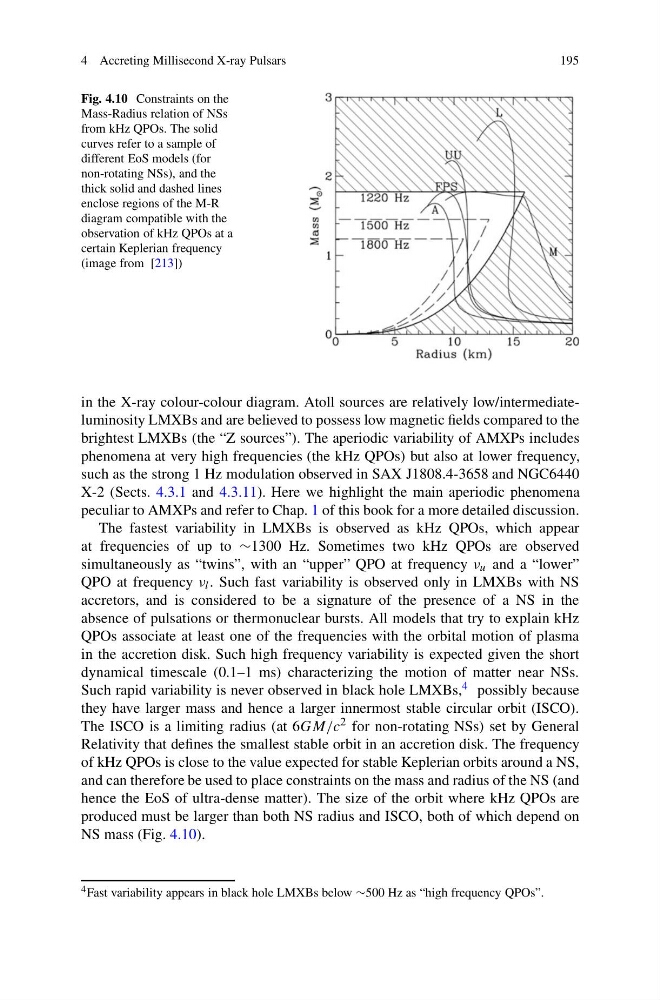
Fig. 4.10 Constraints on the
Mass-Radius relation of NSs
from kHz QPOs. The solid
curves refer to a sample of
different EoS models (for
non-rotating NSs), and the
thick solid and dashed lines
enclose regions of the M-R
diagram compatible with the
observation of kHz QPOs at a
certain Keplerian frequency
(image from [213])
in the X-ray colour-colour diagram. Atoll sources are relatively low/intermediateluminosity LMXBs and are believed to possess low magnetic fields compared to the
brightest LMXBs (the “Z sources”). The aperiodic variability of AMXPs includes
phenomena at very high frequencies (the kHz QPOs) but also at lower frequency,
such as the strong 1 Hz modulation observed in SAX J1808.4-3658 and NGC6440
X-2 (Sects. 4.3.1 and 4.3.11). Here we highlight the main aperiodic phenomena
peculiar to AMXPs and refer to Chap. 1 of this book for a more detailed discussion.
The fastest variability in LMXBs is observed as kHz QPOs, which appear
at frequencies of up to ∼1300 Hz. Sometimes two kHz QPOs are observed
simultaneously as “twins”, with an “upper” QPO at frequency ν u and a “lower”
QPO at frequency ν l . Such fast variability is observed only in LMXBs with NS
accretors, and is considered to be a signature of the presence of a NS in the
absence of pulsations or thermonuclear bursts. All models that try to explain kHz
QPOs associate at least one of the frequencies with the orbital motion of plasma
in the accretion disk. Such high frequency variability is expected given the short
dynamical timescale (0.1–1 ms) characterizing the motion of matter near NSs.
Such rapid variability is never observed in black hole LMXBs, 4 possibly because
they have larger mass and hence a larger innermost stable circular orbit (ISCO).
The ISCO is a limiting radius (at 6GM/c 2 for non-rotating NSs) set by General
Relativity that defines the smallest stable orbit in an accretion disk. The frequency
of kHz QPOs is close to the value expected for stable Keplerian orbits around a NS,
and can therefore be used to place constraints on the mass and radius of the NS (and
hence the EoS of ultra-dense matter). The size of the orbit where kHz QPOs are
produced must be larger than both NS radius and ISCO, both of which depend on
NS mass (Fig. 4.10).
4 Fast variability appears in black hole LMXBs below ∼500 Hz as “high frequency QPOs”.
195
Fig. 4.10 Constraints on the
Mass-Radius relation of NSs
from kHz QPOs. The solid
curves refer to a sample of
different EoS models (for
non-rotating NSs), and the
thick solid and dashed lines
enclose regions of the M-R
diagram compatible with the
observation of kHz QPOs at a
certain Keplerian frequency
(image from [213])
in the X-ray colour-colour diagram. Atoll sources are relatively low/intermediateluminosity LMXBs and are believed to possess low magnetic fields compared to the
brightest LMXBs (the “Z sources”). The aperiodic variability of AMXPs includes
phenomena at very high frequencies (the kHz QPOs) but also at lower frequency,
such as the strong 1 Hz modulation observed in SAX J1808.4-3658 and NGC6440
X-2 (Sects. 4.3.1 and 4.3.11). Here we highlight the main aperiodic phenomena
peculiar to AMXPs and refer to Chap. 1 of this book for a more detailed discussion.
The fastest variability in LMXBs is observed as kHz QPOs, which appear
at frequencies of up to ∼1300 Hz. Sometimes two kHz QPOs are observed
simultaneously as “twins”, with an “upper” QPO at frequency ν u and a “lower”
QPO at frequency ν l . Such fast variability is observed only in LMXBs with NS
accretors, and is considered to be a signature of the presence of a NS in the
absence of pulsations or thermonuclear bursts. All models that try to explain kHz
QPOs associate at least one of the frequencies with the orbital motion of plasma
in the accretion disk. Such high frequency variability is expected given the short
dynamical timescale (0.1–1 ms) characterizing the motion of matter near NSs.
Such rapid variability is never observed in black hole LMXBs, 4 possibly because
they have larger mass and hence a larger innermost stable circular orbit (ISCO).
The ISCO is a limiting radius (at 6GM/c 2 for non-rotating NSs) set by General
Relativity that defines the smallest stable orbit in an accretion disk. The frequency
of kHz QPOs is close to the value expected for stable Keplerian orbits around a NS,
and can therefore be used to place constraints on the mass and radius of the NS (and
hence the EoS of ultra-dense matter). The size of the orbit where kHz QPOs are
produced must be larger than both NS radius and ISCO, both of which depend on
NS mass (Fig. 4.10).
4 Fast variability appears in black hole LMXBs below ∼500 Hz as “high frequency QPOs”.