

190
A. Patruno and A. L. Watts
Table 4.5 Burst oscillation properties for the nine AMXPs that have shown thermonuclear bursts
Source
Burst osc.
Phase locking
References
Accreting millisecond X-ray pulsars
SAX J1808.4-3658
Yes
No
[21, 22, 51, 98, 103, 147, 149]
XTE J1814-338
Yes
Yes
[24, 103, 324, 350–352]
Aql X-1
Yes
No
[69, 103, 166, 188, 223, 227, 368]
SAX J1748.9-2021
No
[2, 103, 148, 157]
HETE J1900.1-2455
Yes
No
[101, 103, 158, 325, 354]
IGR J17511-3057
Yes
No
[4, 30, 89, 289]
IGR J17498-2921
Yes
Unknown
[49, 194]
Swift J1749.4-2807
No
[91, 363]
IGR J18245-2452
Yes
Possible
[247, 251, 290]
Mildly recycled X-ray pulsar
IGR J17480-2466
Yes
Yes
[46, 48, 54, 193, 196, 221]
The table indicates whether a source shows burst oscillations and whether their phases match and
follow the evolution of the accretion-powered pulses observed before and after the bursts (“Phase
Locking”)
cooling, which leads to the runaway of temperature-dependent thermonuclear
reactions [188]. There are however many aspects of burst physics that remain
puzzling, such as discrepancies between predicted and observed recurrence times,
and the phenomenon of burst oscillations [319, 349]. The latter are high frequency
oscillations (11–600 Hz) often detected in the X-ray flux produced by thermonuclear
bursts [103], and whose cause remains unknown. AMXPs can offer particular
insight into burst physics and the burst oscillation mechanism, for two reasons.
Firstly, they are the only sources where we have an independent measurement of
the stellar spin, allowing us to measure the dependence on rotation. Secondly, they
are the only sources where we can make a reasonable assessment of the effects of the
magnetic field, and the role of uneven fuel distribution (due to magnetic channeling
of material onto the poles of the star).
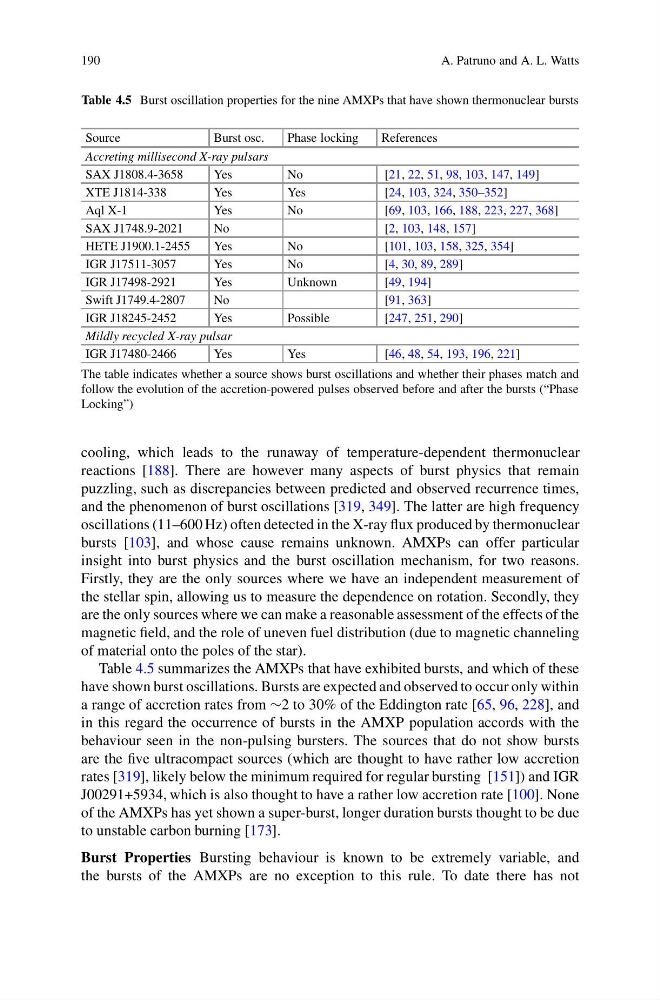
Table 4.5 summarizes the AMXPs that have exhibited bursts, and which of these
have shown burst oscillations. Bursts are expected and observed to occur only within
a range of accretion rates from ∼2 to 30% of the Eddington rate [65, 96, 228], and
in this regard the occurrence of bursts in the AMXP population accords with the
behaviour seen in the non-pulsing bursters. The sources that do not show bursts
are the five ultracompact sources (which are thought to have rather low accretion
rates [319], likely below the minimum required for regular bursting [151]) and IGR
J00291+5934, which is also thought to have a rather low accretion rate [100]. None
of the AMXPs has yet shown a super-burst, longer duration bursts thought to be due
to unstable carbon burning [173].
Burst Properties Bursting behaviour is known to be extremely variable, and
the bursts of the AMXPs are no exception to this rule. To date there has not
A. Patruno and A. L. Watts
Table 4.5 Burst oscillation properties for the nine AMXPs that have shown thermonuclear bursts
Source
Burst osc.
Phase locking
References
Accreting millisecond X-ray pulsars
SAX J1808.4-3658
Yes
No
[21, 22, 51, 98, 103, 147, 149]
XTE J1814-338
Yes
Yes
[24, 103, 324, 350–352]
Aql X-1
Yes
No
[69, 103, 166, 188, 223, 227, 368]
SAX J1748.9-2021
No
[2, 103, 148, 157]
HETE J1900.1-2455
Yes
No
[101, 103, 158, 325, 354]
IGR J17511-3057
Yes
No
[4, 30, 89, 289]
IGR J17498-2921
Yes
Unknown
[49, 194]
Swift J1749.4-2807
No
[91, 363]
IGR J18245-2452
Yes
Possible
[247, 251, 290]
Mildly recycled X-ray pulsar
IGR J17480-2466
Yes
Yes
[46, 48, 54, 193, 196, 221]
The table indicates whether a source shows burst oscillations and whether their phases match and
follow the evolution of the accretion-powered pulses observed before and after the bursts (“Phase
Locking”)
cooling, which leads to the runaway of temperature-dependent thermonuclear
reactions [188]. There are however many aspects of burst physics that remain
puzzling, such as discrepancies between predicted and observed recurrence times,
and the phenomenon of burst oscillations [319, 349]. The latter are high frequency
oscillations (11–600 Hz) often detected in the X-ray flux produced by thermonuclear
bursts [103], and whose cause remains unknown. AMXPs can offer particular
insight into burst physics and the burst oscillation mechanism, for two reasons.
Firstly, they are the only sources where we have an independent measurement of
the stellar spin, allowing us to measure the dependence on rotation. Secondly, they
are the only sources where we can make a reasonable assessment of the effects of the
magnetic field, and the role of uneven fuel distribution (due to magnetic channeling
of material onto the poles of the star).
Table 4.5 summarizes the AMXPs that have exhibited bursts, and which of these
have shown burst oscillations. Bursts are expected and observed to occur only within
a range of accretion rates from ∼2 to 30% of the Eddington rate [65, 96, 228], and
in this regard the occurrence of bursts in the AMXP population accords with the
behaviour seen in the non-pulsing bursters. The sources that do not show bursts
are the five ultracompact sources (which are thought to have rather low accretion
rates [319], likely below the minimum required for regular bursting [151]) and IGR
J00291+5934, which is also thought to have a rather low accretion rate [100]. None
of the AMXPs has yet shown a super-burst, longer duration bursts thought to be due
to unstable carbon burning [173].
Burst Properties Bursting behaviour is known to be extremely variable, and
the bursts of the AMXPs are no exception to this rule. To date there has not