

184
A. Patruno and A. L. Watts
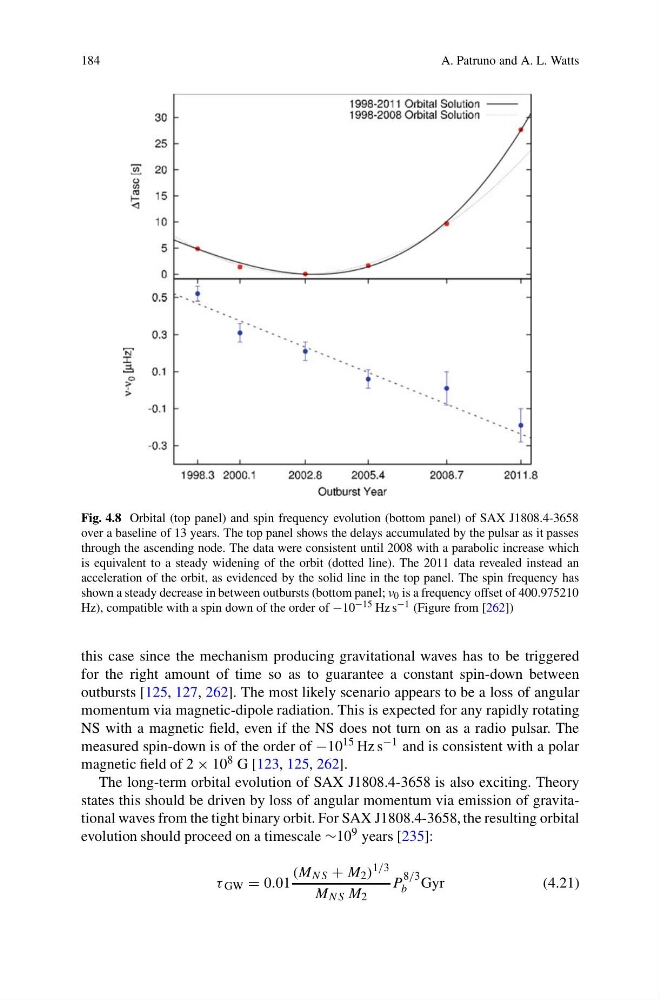
Fig. 4.8 Orbital (top panel) and spin frequency evolution (bottom panel) of SAX J1808.4-3658
over a baseline of 13 years. The top panel shows the delays accumulated by the pulsar as it passes
through the ascending node. The data were consistent until 2008 with a parabolic increase which
is equivalent to a steady widening of the orbit (dotted line). The 2011 data revealed instead an
acceleration of the orbit, as evidenced by the solid line in the top panel. The spin frequency has
shown a steady decrease in between outbursts (bottom panel; ν 0 is a frequency offset of 400.975210
Hz), compatible with a spin down of the order of −10 −15 Hz s −1 (Figure from [262])
this case since the mechanism producing gravitational waves has to be triggered
for the right amount of time so as to guarantee a constant spin-down between
outbursts [125, 127, 262]. The most likely scenario appears to be a loss of angular
momentum via magnetic-dipole radiation. This is expected for any rapidly rotating
NS with a magnetic field, even if the NS does not turn on as a radio pulsar. The
measured spin-down is of the order of −10 15 Hz s −1 and is consistent with a polar
magnetic field of 2 × 10 8 G [123, 125, 262].
The long-term orbital evolution of SAX J1808.4-3658 is also exciting. Theory
states this should be driven by loss of angular momentum via emission of gravitational waves from the tight binary orbit. For SAX J1808.4-3658, the resulting orbital
evolution should proceed on a timescale ∼10 9 years [235]:
τ GW = 0.01
(M NS + M 2 )
1/3
M NS M 2
P
8/3
b Gyr
(4.21)
A. Patruno and A. L. Watts
Fig. 4.8 Orbital (top panel) and spin frequency evolution (bottom panel) of SAX J1808.4-3658
over a baseline of 13 years. The top panel shows the delays accumulated by the pulsar as it passes
through the ascending node. The data were consistent until 2008 with a parabolic increase which
is equivalent to a steady widening of the orbit (dotted line). The 2011 data revealed instead an
acceleration of the orbit, as evidenced by the solid line in the top panel. The spin frequency has
shown a steady decrease in between outbursts (bottom panel; ν 0 is a frequency offset of 400.975210
Hz), compatible with a spin down of the order of −10 −15 Hz s −1 (Figure from [262])
this case since the mechanism producing gravitational waves has to be triggered
for the right amount of time so as to guarantee a constant spin-down between
outbursts [125, 127, 262]. The most likely scenario appears to be a loss of angular
momentum via magnetic-dipole radiation. This is expected for any rapidly rotating
NS with a magnetic field, even if the NS does not turn on as a radio pulsar. The
measured spin-down is of the order of −10 15 Hz s −1 and is consistent with a polar
magnetic field of 2 × 10 8 G [123, 125, 262].
The long-term orbital evolution of SAX J1808.4-3658 is also exciting. Theory
states this should be driven by loss of angular momentum via emission of gravitational waves from the tight binary orbit. For SAX J1808.4-3658, the resulting orbital
evolution should proceed on a timescale ∼10 9 years [235]:
τ GW = 0.01
(M NS + M 2 )
1/3
M NS M 2
P
8/3
b Gyr
(4.21)