

4 Accreting Millisecond X-ray Pulsars
181
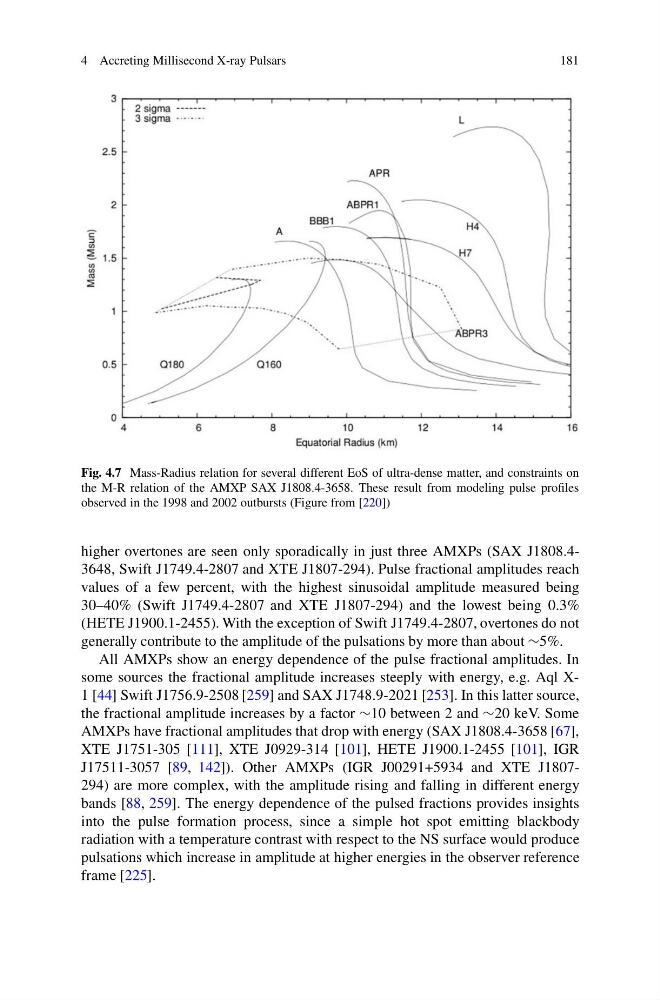
Fig. 4.7 Mass-Radius relation for several different EoS of ultra-dense matter, and constraints on
the M-R relation of the AMXP SAX J1808.4-3658. These result from modeling pulse profiles
observed in the 1998 and 2002 outbursts (Figure from [220])
higher overtones are seen only sporadically in just three AMXPs (SAX J1808.43648, Swift J1749.4-2807 and XTE J1807-294). Pulse fractional amplitudes reach
values of a few percent, with the highest sinusoidal amplitude measured being
30–40% (Swift J1749.4-2807 and XTE J1807-294) and the lowest being 0.3%
(HETE J1900.1-2455). With the exception of Swift J1749.4-2807, overtones do not
generally contribute to the amplitude of the pulsations by more than about ∼5%.
All AMXPs show an energy dependence of the pulse fractional amplitudes. In
some sources the fractional amplitude increases steeply with energy, e.g. Aql X1 [44] Swift J1756.9-2508 [259] and SAX J1748.9-2021 [253]. In this latter source,
the fractional amplitude increases by a factor ∼10 between 2 and ∼20 keV. Some
AMXPs have fractional amplitudes that drop with energy (SAX J1808.4-3658 [67],
XTE J1751-305 [111], XTE J0929-314 [101], HETE J1900.1-2455 [101], IGR
J17511-3057 [89, 142]). Other AMXPs (IGR J00291+5934 and XTE J1807294) are more complex, with the amplitude rising and falling in different energy
bands [88, 259]. The energy dependence of the pulsed fractions provides insights
into the pulse formation process, since a simple hot spot emitting blackbody
radiation with a temperature contrast with respect to the NS surface would produce
pulsations which increase in amplitude at higher energies in the observer reference
frame [225].
181
Fig. 4.7 Mass-Radius relation for several different EoS of ultra-dense matter, and constraints on
the M-R relation of the AMXP SAX J1808.4-3658. These result from modeling pulse profiles
observed in the 1998 and 2002 outbursts (Figure from [220])
higher overtones are seen only sporadically in just three AMXPs (SAX J1808.43648, Swift J1749.4-2807 and XTE J1807-294). Pulse fractional amplitudes reach
values of a few percent, with the highest sinusoidal amplitude measured being
30–40% (Swift J1749.4-2807 and XTE J1807-294) and the lowest being 0.3%
(HETE J1900.1-2455). With the exception of Swift J1749.4-2807, overtones do not
generally contribute to the amplitude of the pulsations by more than about ∼5%.
All AMXPs show an energy dependence of the pulse fractional amplitudes. In
some sources the fractional amplitude increases steeply with energy, e.g. Aql X1 [44] Swift J1756.9-2508 [259] and SAX J1748.9-2021 [253]. In this latter source,
the fractional amplitude increases by a factor ∼10 between 2 and ∼20 keV. Some
AMXPs have fractional amplitudes that drop with energy (SAX J1808.4-3658 [67],
XTE J1751-305 [111], XTE J0929-314 [101], HETE J1900.1-2455 [101], IGR
J17511-3057 [89, 142]). Other AMXPs (IGR J00291+5934 and XTE J1807294) are more complex, with the amplitude rising and falling in different energy
bands [88, 259]. The energy dependence of the pulsed fractions provides insights
into the pulse formation process, since a simple hot spot emitting blackbody
radiation with a temperature contrast with respect to the NS surface would produce
pulsations which increase in amplitude at higher energies in the observer reference
frame [225].