

6
M. C. Miller
energy per particle is E G ∼ −GMm/R, where G = 6.67 × 10 −8 g −1 cm 3 s −2
is Newton’s gravitational constant, so the total energy per particle is E tot =
C 1 M 2/3 /R 2 − C 2 M/R where C 1 and C 2 are constants. Minimizing with respect to
R gives R ∼ M −1/3 . Effects associated with interactions can change this slightly,
but in practice most equations of state produce a radius that either decreases with
increasing mass or is nearly constant over a broad range in mass. This led [130] to
note that even for a star of unknown mass a measurement of the radius to within
∼10% would provide meaningful constraints on the equation of state.
1.2.2 Models of Matter at High Densities
There are several classes of matter beyond nuclear density: ones in which neutrons
and protons are the only baryons, ones in which other baryons enter (especially
those with strange quarks), ones involving deconfined quark matter, and so on.
Within each class there are a number of adjustable parameters, some of which are
constrained by laboratory measurements at nuclear density or below but many of
which can be changed to accommodate observations of neutron stars.
When confronted by this complexity a common question is: why is there
uncertainty about dense matter? The fundamental theory, QCD, is well-established.
Asymptotic freedom is not reached at neutron star densities, so the coupling constant
is large enough that expansions similar to those in quantum electrodynamics are not
straightforward, but in principle one could imagine Monte Carlo calculations that
establish the ground state of degenerate high-density matter.
This approach is unfortunately not currently practical, due to the lack of a viable
algorithm for high baryon densities. This is because of the so-called “fermion
sign problem”, which has been known for many years. We start by considering a
representative but small volume of matter at some density and chemical potential μ
that can exchange energy and particles with its surroundings but has a fixed volume
[109]. The thermodynamic state of the matter is therefore described by a grand
canonical ensemble using a partition function
Z = Z(T , μ) = Tr {exp[−(H − μN)/kT ]}
(1.2)
where H is the Hamiltonian and N is the particle number operator. It is common
to use β ≡ 1/(kT ). The trace is evaluated over Fock space, which makes this
formulation inconvenient. One can instead rewrite Z as
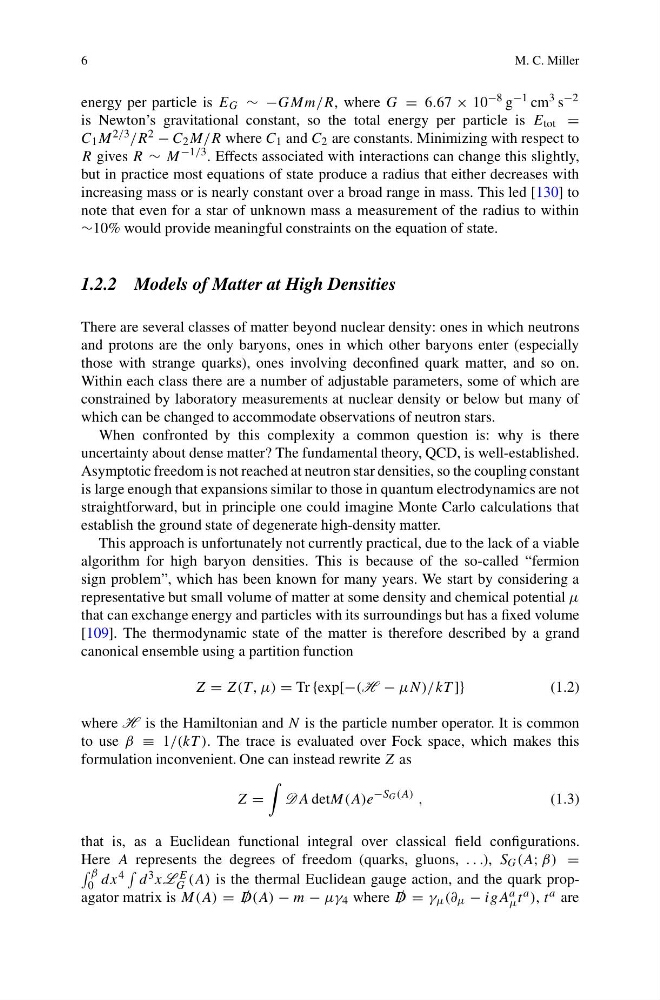
Z =
DA detM(A)e
−S G (A) ,
(1.3)
that is, as a Euclidean functional integral over classical field configurations.
Here A represents the degrees of freedom (quarks, gluons, . . .), S G (A; β) =
β
0 dx 4
d 3 xL E
G (A) is the thermal Euclidean gauge action, and the quark propagator matrix is M(A) = /
D(A) − m − μγ 4 where /
D = γ μ (∂ μ − igA a
μ t a ), t a are
M. C. Miller
energy per particle is E G ∼ −GMm/R, where G = 6.67 × 10 −8 g −1 cm 3 s −2
is Newton’s gravitational constant, so the total energy per particle is E tot =
C 1 M 2/3 /R 2 − C 2 M/R where C 1 and C 2 are constants. Minimizing with respect to
R gives R ∼ M −1/3 . Effects associated with interactions can change this slightly,
but in practice most equations of state produce a radius that either decreases with
increasing mass or is nearly constant over a broad range in mass. This led [130] to
note that even for a star of unknown mass a measurement of the radius to within
∼10% would provide meaningful constraints on the equation of state.
1.2.2 Models of Matter at High Densities
There are several classes of matter beyond nuclear density: ones in which neutrons
and protons are the only baryons, ones in which other baryons enter (especially
those with strange quarks), ones involving deconfined quark matter, and so on.
Within each class there are a number of adjustable parameters, some of which are
constrained by laboratory measurements at nuclear density or below but many of
which can be changed to accommodate observations of neutron stars.
When confronted by this complexity a common question is: why is there
uncertainty about dense matter? The fundamental theory, QCD, is well-established.
Asymptotic freedom is not reached at neutron star densities, so the coupling constant
is large enough that expansions similar to those in quantum electrodynamics are not
straightforward, but in principle one could imagine Monte Carlo calculations that
establish the ground state of degenerate high-density matter.
This approach is unfortunately not currently practical, due to the lack of a viable
algorithm for high baryon densities. This is because of the so-called “fermion
sign problem”, which has been known for many years. We start by considering a
representative but small volume of matter at some density and chemical potential μ
that can exchange energy and particles with its surroundings but has a fixed volume
[109]. The thermodynamic state of the matter is therefore described by a grand
canonical ensemble using a partition function
Z = Z(T , μ) = Tr {exp[−(H − μN)/kT ]}
(1.2)
where H is the Hamiltonian and N is the particle number operator. It is common
to use β ≡ 1/(kT ). The trace is evaluated over Fock space, which makes this
formulation inconvenient. One can instead rewrite Z as
Z =
DA detM(A)e
−S G (A) ,
(1.3)
that is, as a Euclidean functional integral over classical field configurations.
Here A represents the degrees of freedom (quarks, gluons, . . .), S G (A; β) =
β
0 dx 4
d 3 xL E
G (A) is the thermal Euclidean gauge action, and the quark propagator matrix is M(A) = /
D(A) − m − μγ 4 where /
D = γ μ (∂ μ − igA a
μ t a ), t a are