

4 Accreting Millisecond X-ray Pulsars
163
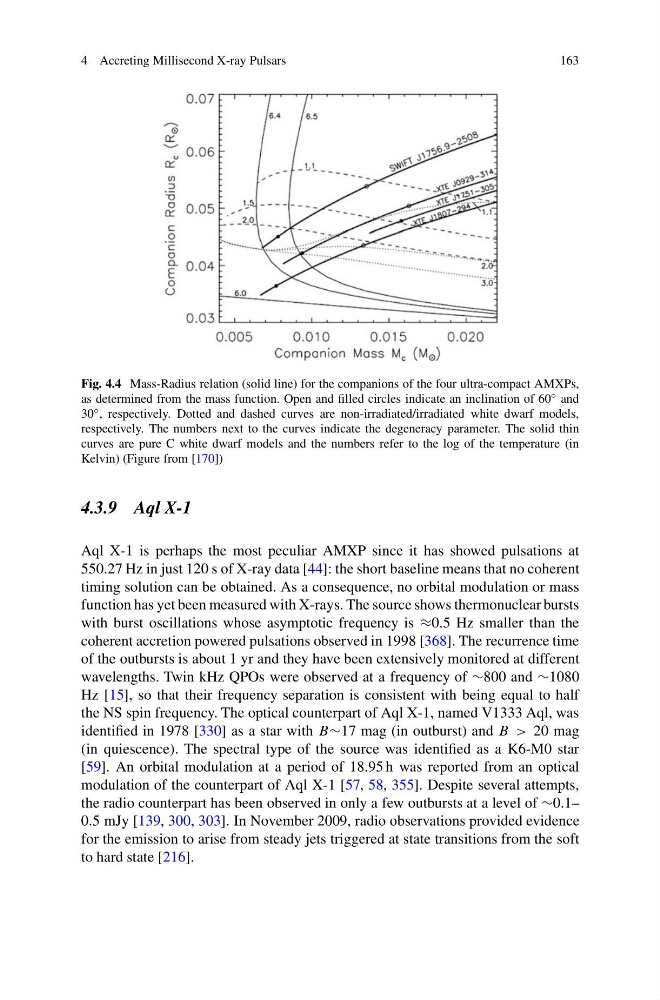
Fig. 4.4 Mass-Radius relation (solid line) for the companions of the four ultra-compact AMXPs,
as determined from the mass function. Open and filled circles indicate an inclination of 60 ◦ and
30 ◦ , respectively. Dotted and dashed curves are non-irradiated/irradiated white dwarf models,
respectively. The numbers next to the curves indicate the degeneracy parameter. The solid thin
curves are pure C white dwarf models and the numbers refer to the log of the temperature (in
Kelvin) (Figure from [170])
4.3.9 Aql X-1
Aql X-1 is perhaps the most peculiar AMXP since it has showed pulsations at
550.27 Hz in just 120 s of X-ray data [44]: the short baseline means that no coherent
timing solution can be obtained. As a consequence, no orbital modulation or mass
function has yet been measured with X-rays. The source shows thermonuclear bursts
with burst oscillations whose asymptotic frequency is ≈0.5 Hz smaller than the
coherent accretion powered pulsations observed in 1998 [368]. The recurrence time
of the outbursts is about 1 yr and they have been extensively monitored at different
wavelengths. Twin kHz QPOs were observed at a frequency of ∼800 and ∼1080
Hz [15], so that their frequency separation is consistent with being equal to half
the NS spin frequency. The optical counterpart of Aql X-1, named V1333 Aql, was
identified in 1978 [330] as a star with B∼17 mag (in outburst) and B > 20 mag
(in quiescence). The spectral type of the source was identified as a K6-M0 star
[59]. An orbital modulation at a period of 18.95 h was reported from an optical
modulation of the counterpart of Aql X-1 [57, 58, 355]. Despite several attempts,
the radio counterpart has been observed in only a few outbursts at a level of ∼0.1–
0.5 mJy [139, 300, 303]. In November 2009, radio observations provided evidence
for the emission to arise from steady jets triggered at state transitions from the soft
to hard state [216].
163
Fig. 4.4 Mass-Radius relation (solid line) for the companions of the four ultra-compact AMXPs,
as determined from the mass function. Open and filled circles indicate an inclination of 60 ◦ and
30 ◦ , respectively. Dotted and dashed curves are non-irradiated/irradiated white dwarf models,
respectively. The numbers next to the curves indicate the degeneracy parameter. The solid thin
curves are pure C white dwarf models and the numbers refer to the log of the temperature (in
Kelvin) (Figure from [170])
4.3.9 Aql X-1
Aql X-1 is perhaps the most peculiar AMXP since it has showed pulsations at
550.27 Hz in just 120 s of X-ray data [44]: the short baseline means that no coherent
timing solution can be obtained. As a consequence, no orbital modulation or mass
function has yet been measured with X-rays. The source shows thermonuclear bursts
with burst oscillations whose asymptotic frequency is ≈0.5 Hz smaller than the
coherent accretion powered pulsations observed in 1998 [368]. The recurrence time
of the outbursts is about 1 yr and they have been extensively monitored at different
wavelengths. Twin kHz QPOs were observed at a frequency of ∼800 and ∼1080
Hz [15], so that their frequency separation is consistent with being equal to half
the NS spin frequency. The optical counterpart of Aql X-1, named V1333 Aql, was
identified in 1978 [330] as a star with B∼17 mag (in outburst) and B > 20 mag
(in quiescence). The spectral type of the source was identified as a K6-M0 star
[59]. An orbital modulation at a period of 18.95 h was reported from an optical
modulation of the counterpart of Aql X-1 [57, 58, 355]. Despite several attempts,
the radio counterpart has been observed in only a few outbursts at a level of ∼0.1–
0.5 mJy [139, 300, 303]. In November 2009, radio observations provided evidence
for the emission to arise from steady jets triggered at state transitions from the soft
to hard state [216].