

4 Accreting Millisecond X-ray Pulsars
153
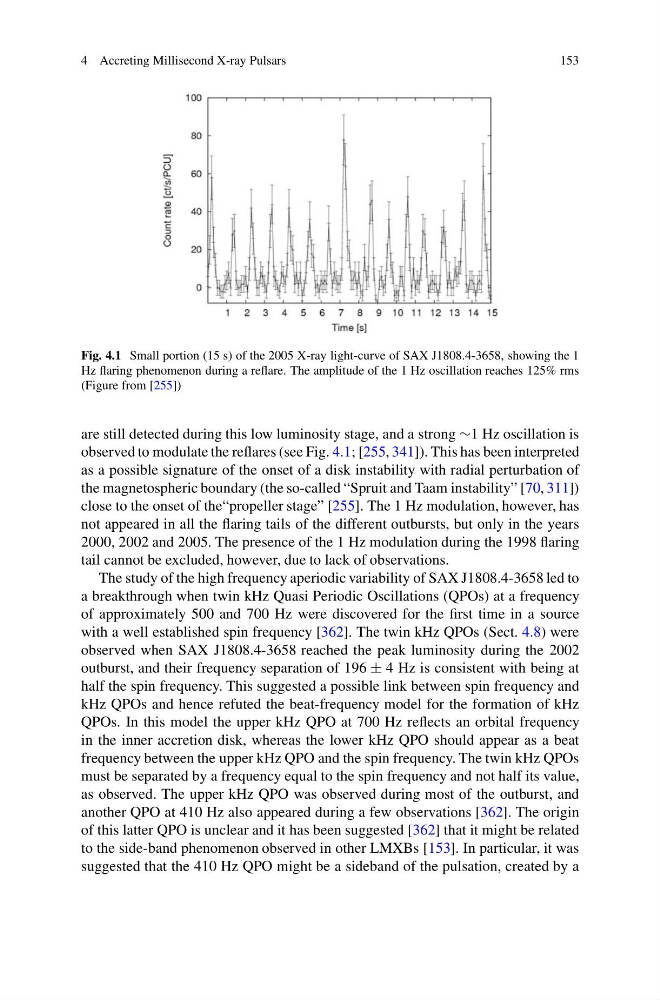
Fig. 4.1 Small portion (15 s) of the 2005 X-ray light-curve of SAX J1808.4-3658, showing the 1
Hz flaring phenomenon during a reflare. The amplitude of the 1 Hz oscillation reaches 125% rms
(Figure from [255])
are still detected during this low luminosity stage, and a strong ∼1 Hz oscillation is
observed to modulate the reflares (see Fig. 4.1; [255, 341]). This has been interpreted
as a possible signature of the onset of a disk instability with radial perturbation of
the magnetospheric boundary (the so-called “Spruit and Taam instability” [70, 311])
close to the onset of the“propeller stage” [255]. The 1 Hz modulation, however, has
not appeared in all the flaring tails of the different outbursts, but only in the years
2000, 2002 and 2005. The presence of the 1 Hz modulation during the 1998 flaring
tail cannot be excluded, however, due to lack of observations.
The study of the high frequency aperiodic variability of SAX J1808.4-3658 led to
a breakthrough when twin kHz Quasi Periodic Oscillations (QPOs) at a frequency
of approximately 500 and 700 Hz were discovered for the first time in a source
with a well established spin frequency [362]. The twin kHz QPOs (Sect. 4.8) were
observed when SAX J1808.4-3658 reached the peak luminosity during the 2002
outburst, and their frequency separation of 196 ± 4 Hz is consistent with being at
half the spin frequency. This suggested a possible link between spin frequency and
kHz QPOs and hence refuted the beat-frequency model for the formation of kHz
QPOs. In this model the upper kHz QPO at 700 Hz reflects an orbital frequency
in the inner accretion disk, whereas the lower kHz QPO should appear as a beat
frequency between the upper kHz QPO and the spin frequency. The twin kHz QPOs
must be separated by a frequency equal to the spin frequency and not half its value,
as observed. The upper kHz QPO was observed during most of the outburst, and
another QPO at 410 Hz also appeared during a few observations [362]. The origin
of this latter QPO is unclear and it has been suggested [362] that it might be related
to the side-band phenomenon observed in other LMXBs [153]. In particular, it was
suggested that the 410 Hz QPO might be a sideband of the pulsation, created by a
153
Fig. 4.1 Small portion (15 s) of the 2005 X-ray light-curve of SAX J1808.4-3658, showing the 1
Hz flaring phenomenon during a reflare. The amplitude of the 1 Hz oscillation reaches 125% rms
(Figure from [255])
are still detected during this low luminosity stage, and a strong ∼1 Hz oscillation is
observed to modulate the reflares (see Fig. 4.1; [255, 341]). This has been interpreted
as a possible signature of the onset of a disk instability with radial perturbation of
the magnetospheric boundary (the so-called “Spruit and Taam instability” [70, 311])
close to the onset of the“propeller stage” [255]. The 1 Hz modulation, however, has
not appeared in all the flaring tails of the different outbursts, but only in the years
2000, 2002 and 2005. The presence of the 1 Hz modulation during the 1998 flaring
tail cannot be excluded, however, due to lack of observations.
The study of the high frequency aperiodic variability of SAX J1808.4-3658 led to
a breakthrough when twin kHz Quasi Periodic Oscillations (QPOs) at a frequency
of approximately 500 and 700 Hz were discovered for the first time in a source
with a well established spin frequency [362]. The twin kHz QPOs (Sect. 4.8) were
observed when SAX J1808.4-3658 reached the peak luminosity during the 2002
outburst, and their frequency separation of 196 ± 4 Hz is consistent with being at
half the spin frequency. This suggested a possible link between spin frequency and
kHz QPOs and hence refuted the beat-frequency model for the formation of kHz
QPOs. In this model the upper kHz QPO at 700 Hz reflects an orbital frequency
in the inner accretion disk, whereas the lower kHz QPO should appear as a beat
frequency between the upper kHz QPO and the spin frequency. The twin kHz QPOs
must be separated by a frequency equal to the spin frequency and not half its value,
as observed. The upper kHz QPO was observed during most of the outburst, and
another QPO at 410 Hz also appeared during a few observations [362]. The origin
of this latter QPO is unclear and it has been suggested [362] that it might be related
to the side-band phenomenon observed in other LMXBs [153]. In particular, it was
suggested that the 410 Hz QPO might be a sideband of the pulsation, created by a