

2 General Relativity Measurements from Pulsars
89
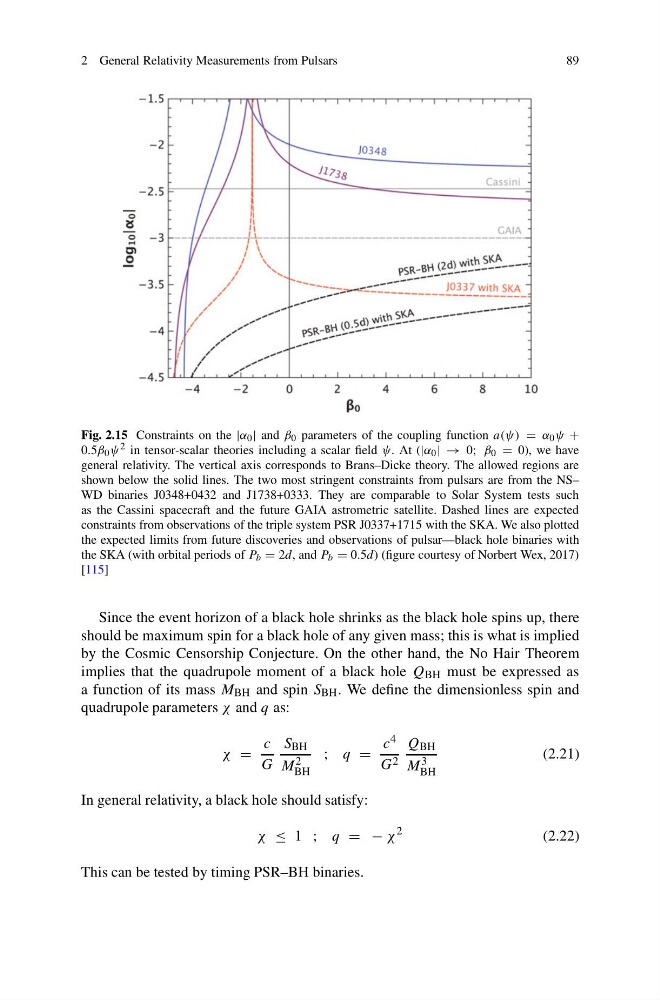
Fig. 2.15 Constraints on the |α 0 | and β 0 parameters of the coupling function a(ψ) = α 0 ψ +
0.5β 0 ψ 2 in tensor-scalar theories including a scalar field ψ. At (|α 0 | → 0; β 0 = 0), we have
general relativity. The vertical axis corresponds to Brans–Dicke theory. The allowed regions are
shown below the solid lines. The two most stringent constraints from pulsars are from the NS–
WD binaries J0348+0432 and J1738+0333. They are comparable to Solar System tests such
as the Cassini spacecraft and the future GAIA astrometric satellite. Dashed lines are expected
constraints from observations of the triple system PSR J0337+1715 with the SKA. We also plotted
the expected limits from future discoveries and observations of pulsar—black hole binaries with
the SKA (with orbital periods of P b = 2d, and P b = 0.5d) (figure courtesy of Norbert Wex, 2017)
[115]
Since the event horizon of a black hole shrinks as the black hole spins up, there
should be maximum spin for a black hole of any given mass; this is what is implied
by the Cosmic Censorship Conjecture. On the other hand, the No Hair Theorem
implies that the quadrupole moment of a black hole Q BH must be expressed as
a function of its mass M BH and spin S BH . We define the dimensionless spin and
quadrupole parameters χ and q as:
χ =
c
G
S BH
M 2
BH
; q =
c 4
G 2
Q BH
M 3
BH
(2.21)
In general relativity, a black hole should satisfy:
χ ≤ 1 ; q = − χ
2
(2.22)
This can be tested by timing PSR–BH binaries.
89
Fig. 2.15 Constraints on the |α 0 | and β 0 parameters of the coupling function a(ψ) = α 0 ψ +
0.5β 0 ψ 2 in tensor-scalar theories including a scalar field ψ. At (|α 0 | → 0; β 0 = 0), we have
general relativity. The vertical axis corresponds to Brans–Dicke theory. The allowed regions are
shown below the solid lines. The two most stringent constraints from pulsars are from the NS–
WD binaries J0348+0432 and J1738+0333. They are comparable to Solar System tests such
as the Cassini spacecraft and the future GAIA astrometric satellite. Dashed lines are expected
constraints from observations of the triple system PSR J0337+1715 with the SKA. We also plotted
the expected limits from future discoveries and observations of pulsar—black hole binaries with
the SKA (with orbital periods of P b = 2d, and P b = 0.5d) (figure courtesy of Norbert Wex, 2017)
[115]
Since the event horizon of a black hole shrinks as the black hole spins up, there
should be maximum spin for a black hole of any given mass; this is what is implied
by the Cosmic Censorship Conjecture. On the other hand, the No Hair Theorem
implies that the quadrupole moment of a black hole Q BH must be expressed as
a function of its mass M BH and spin S BH . We define the dimensionless spin and
quadrupole parameters χ and q as:
χ =
c
G
S BH
M 2
BH
; q =
c 4
G 2
Q BH
M 3
BH
(2.21)
In general relativity, a black hole should satisfy:
χ ≤ 1 ; q = − χ
2
(2.22)
This can be tested by timing PSR–BH binaries.