

962
Appendix: All Solutions to the Problems
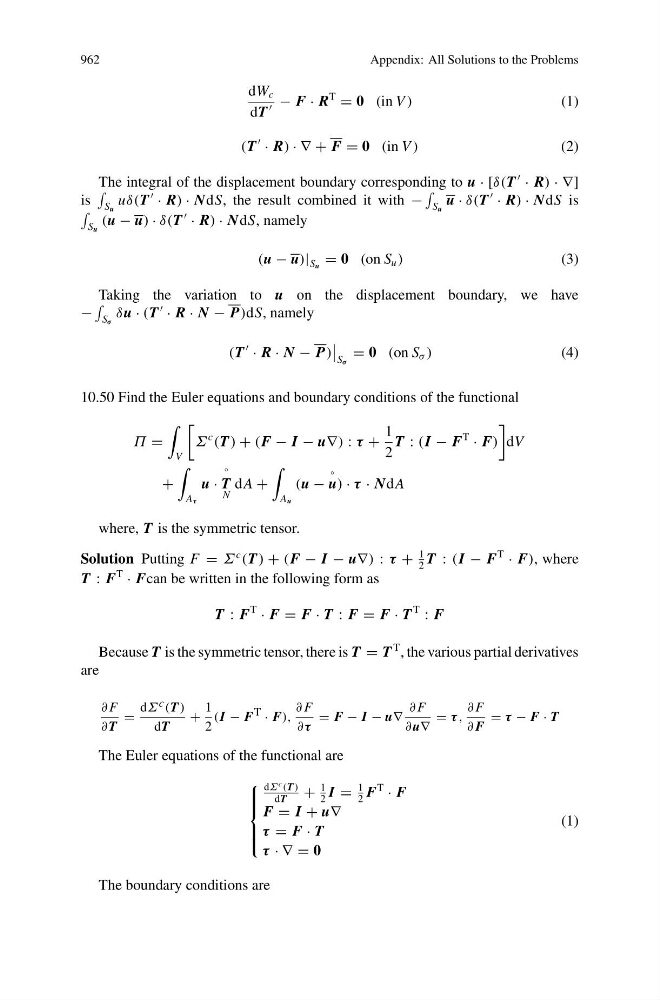
dW c
dT
− F · R
T
= 0 (in V )
(1)
(T
· R) · ∇ + F = 0 (in V )
(2)
The integral of the displacement boundary corresponding to u · [δ(T
· R) · ∇]
is
S u
uδ(T
· R) · NdS, the result combined it with −
S u
u · δ(T
· R) · NdS is
S u
(u − u) · δ(T
· R) · NdS, namely
(u − u)| S u = 0 (on S u )
(3)
Taking the variation to u on the displacement boundary, we have
−
S σ
δu · (T
· R · N − P)dS, namely
(T
· R · N − P)
S σ
= 0 (on S σ )
(4)
10.50 Find the Euler equations and boundary conditions of the functional
Π =
V
Σ
c
(T ) + (F − I − u∇) : τ +
1
2
T : (I − F
T
· F)
dV
+
A τ
u ·
◦
T
N
dA +
A u
(u −
◦
u) · τ · NdA
where, T is the symmetric tensor.
Solution Putting F = Σ
c
(T ) + (F − I − u∇) : τ +
1
2
T : (I − F
T
· F), where
T : F
T
· Fcan be written in the following form as
T : F
T
· F = F · T : F = F · T
T
: F
Because T is the symmetric tensor, there is T = T
T , the various partial derivatives
are
∂ F
∂ T
=
dΣ c (T )
dT
+
1
2
(I − F T · F),
∂ F
∂τ
= F − I − u∇
∂ F
∂ u∇
= τ ,
∂ F
∂ F
= τ − F · T
The Euler equations of the functional are
⎧
⎪ ⎪ ⎨
⎪ ⎪ ⎩
dΣ
c (T )
dT
+
1
2
I =
1
2
F
T
· F
F = I + u∇
τ = F · T
τ · ∇ = 0
(1)
The boundary conditions are