

960
Appendix: All Solutions to the Problems
∂ F
∂ S
=
∂ F
∂Σ c (S)
dΣ
c
(S)
dS
− R
T
− R
T
· (u∇) =
dΣ
c
(S)
dS
− R
T
· (I + u∇)
=
dΣ
c
(S)
dS
− R
T
· F =
dΣ
c
(S)
dS
− U
∂ F
∂ u
= (R · S) · ∇ + F
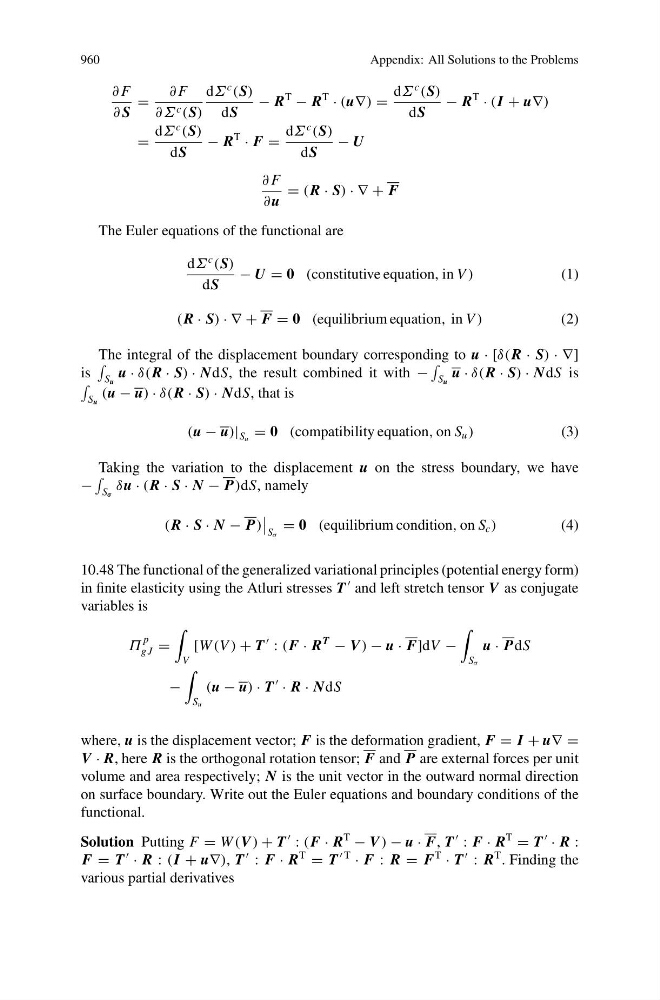
The Euler equations of the functional are
dΣ
c
(S)
dS
− U = 0 (constitutive equation, in V )
(1)
(R · S) · ∇ + F = 0 (equilibrium equation, in V )
(2)
The integral of the displacement boundary corresponding to u · [δ(R · S) · ∇]
is
S u
u · δ(R · S) · NdS, the result combined it with −
S u
u · δ(R · S) · NdS is
S u
(u − u) · δ(R · S) · NdS, that is
(u − u)| S u = 0 (compatibility equation, on S u )
(3)
Taking the variation to the displacement u on the stress boundary, we have
−
S σ
δu · (R · S · N − P)dS, namely
(R · S · N − P)
S σ
= 0 (equilibrium condition, on S c )
(4)
10.48 The functional of the generalized variational principles (potential energy form)
in finite elasticity using the Atluri stresses T
and left stretch tensor V as conjugate
variables is
Π
p
g J =
V
[W (V ) + T
: (F · R
T
− V ) − u · F]dV −
S σ
u · PdS
−
S u
(u − u) · T
· R · NdS
where, u is the displacement vector; F is the deformation gradient, F = I + u∇ =
V · R, here R is the orthogonal rotation tensor; F and P are external forces per unit
volume and area respectively; N is the unit vector in the outward normal direction
on surface boundary. Write out the Euler equations and boundary conditions of the
functional.
Solution Putting F = W (V ) + T
: (F · R
T
− V ) − u · F, T
: F · R
T
= T
· R :
F = T
· R : (I + u∇), T
: F · R
T
= T
T
· F : R = F
T
· T
: R
T . Finding the
various partial derivatives