

Appendix: All Solutions to the Problems
945
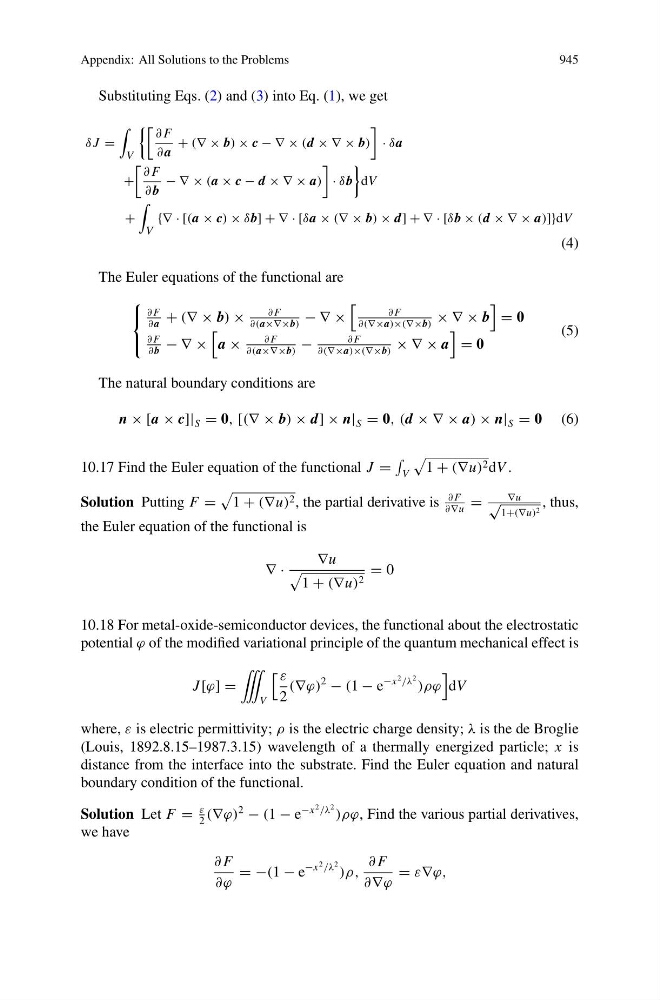
Substituting Eqs. (2) and (3) into Eq. (1), we get
δ J =
V
∂ F
∂ a
+ (∇ × b) × c − ∇ × (d × ∇ × b)
· δa
+
∂ F
∂ b
− ∇ × (a × c − d × ∇ × a)
· δb
dV
+
V
{∇ · [(a × c) × δb] + ∇ · [δa × (∇ × b) × d] + ∇ · [δb × (d × ∇ × a)]}dV
(4)
The Euler equations of the functional are
⎧
⎨
⎩
∂ F
∂ a
+ (∇ × b) ×
∂ F
∂(a×∇×b)
− ∇ ×
∂ F
∂(∇×a)×(∇×b)
× ∇ × b
= 0
∂ F
∂ b
− ∇ ×
a ×
∂ F
∂(a×∇×b)
−
∂ F
∂(∇×a)×(∇×b)
× ∇ × a
= 0
(5)
The natural boundary conditions are
n × [a × c]| S = 0, [(∇ × b) × d] × n| S = 0, (d × ∇ × a) × n| S = 0 (6)
10.17 Find the Euler equation of the functional J =
V
1 + (∇u) 2 dV .
Solution Putting F =
1 + (∇u) 2 , the partial derivative is
∂ F
∂∇u
=
∇u
√
1+(∇u) 2
, thus,
the Euler equation of the functional is
∇ ·
∇u
1 + (∇u) 2
= 0
10.18 For metal-oxide-semiconductor devices, the functional about the electrostatic
potential ϕ of the modified variational principle of the quantum mechanical effect is
J [ϕ] =
˚
V
ε
2
(∇ϕ)
2
− (1 − e
−x
2 /λ
2 )ρϕ
dV
where, ε is electric permittivity; ρ is the electric charge density; λ is the de Broglie
(Louis, 1892.8.15–1987.3.15) wavelength of a thermally energized particle; x is
distance from the interface into the substrate. Find the Euler equation and natural
boundary condition of the functional.
Solution Let F =
ε
2
(∇ϕ)
2
− (1 − e
−x
2 /λ
2 )ρϕ, Find the various partial derivatives,
we have
∂ F
∂ϕ
= −(1 − e
−x
2 /λ
2 )ρ,
∂ F
∂∇ϕ
= ε∇ϕ,