

Appendix: All Solutions to the Problems
927
T =
1
2
m(L
2
˙
ϕ
2
+ L
2 ˙
θ
2 sin
2
ϕ), V = mgL cos ϕ
L = T − V =
1
2
m L
2
( ˙
ϕ
2
+ ˙
θ
2 sin
2
ϕ) − mgL cos ϕ
The corresponding functional is
J =
1
2
m L
t 1
t 0
(L ˙
ϕ
2
+ L ˙
θ
2 sin
2
ϕ − 2g cos ϕ)dt
The Euler equations of the functional namely the differential equations of motion
of the spherical pendulum are
−m L
2
¨
ϕ + m L
2 ˙
θ
2 sin ϕ cos ϕ + mgL sin ϕ = 0
m L
2
( ¨
θ sin
2
ϕ + 2 ˙
θ sin ϕ cos ϕ) = 0
or
L ¨
ϕ − L ˙
θ
2 sin ϕ cos ϕ − g sin ϕ = 0
¨
θ sin
2
ϕ + 2 ˙
θ ˙
ϕ sin ϕ cos ϕ = 0
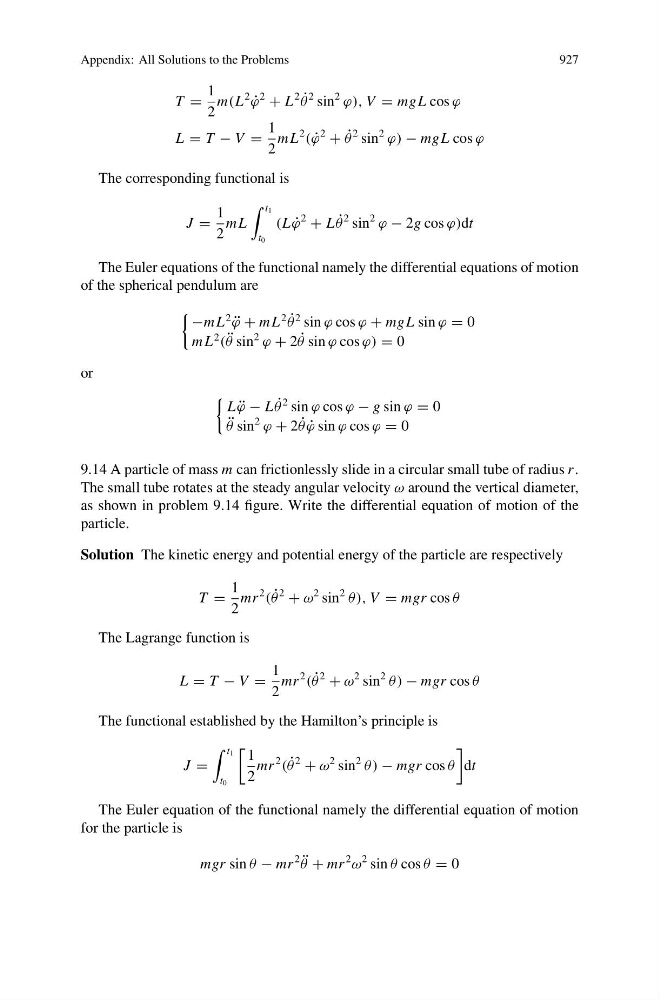
9.14 A particle of mass m can frictionlessly slide in a circular small tube of radius r .
The small tube rotates at the steady angular velocity ω around the vertical diameter,
as shown in problem 9.14 figure. Write the differential equation of motion of the
particle.
Solution The kinetic energy and potential energy of the particle are respectively
T =
1
2
mr
2
( ˙
θ
2
+ ω
2 sin
2
θ), V = mgr cos θ
The Lagrange function is
L = T − V =
1
2
mr
2
( ˙
θ
2
+ ω
2 sin
2
θ) − mgr cos θ
The functional established by the Hamilton’s principle is
J =
t 1
t 0
1
2
mr
2
( ˙
θ
2
+ ω
2 sin
2
θ) − mgr cos θ
dt
The Euler equation of the functional namely the differential equation of motion
for the particle is
mgr sin θ − mr
2 ¨
θ + mr
2
ω
2 sin θ cos θ = 0