

918
Appendix: All Solutions to the Problems
The total potential energy of the beam is
π = U + V =
4π
4 E I
l 3
∞
n=1
n
4 a
2
n −
l
0
q
∞
n=1
a n
1 − cos
2nπx
l
dx
(5)
When the beam is in a state of stable equilibrium, Π takes the minima, there is
∂Π
∂a n
= 0 (n = 1, 2, . . .)
(6)
or
8π
4 E I
l 3 n
4 a n − ql = 0
( 7 )
Solve for a n
a n =
ql
4
8π 4 n 4 E I
(8)
Thus, the deflection curve equation of the beam can be obtained
y =
∞
n=1
ql
4
8π 4 n 4 E I
1 − cos
2nπx
l
=
ql
4
8π 4 E I
∞
n=1
1
n 4
1 − cos
2nπx
l
(9)
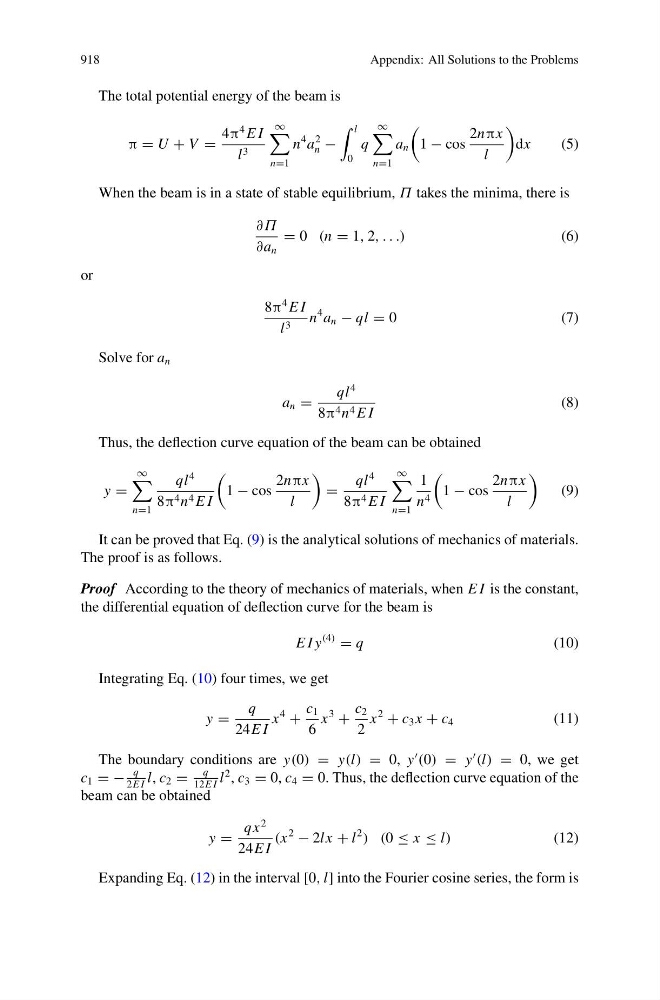
It can be proved that Eq. (9) is the analytical solutions of mechanics of materials.
The proof is as follows.
Proof According to the theory of mechanics of materials, when E I is the constant,
the differential equation of deflection curve for the beam is
E I y
(4)
= q
(10)
Integrating Eq. (10) four times, we get
y =
q
24E I
x
4
+
c 1
6
x
3
+
c 2
2
x
2
+ c 3 x + c 4
(11)
The boundary conditions are y(0) = y(l) = 0, y
(0) = y
(l) = 0, we get
c 1 = −
q
2E I
l, c 2 =
q
12E I
l
2 , c 3 = 0, c 4 = 0. Thus, the deflection curve equation of the
beam can be obtained
y =
qx
2
24E I
(x
2
− 2lx + l
2
) (0 ≤ x ≤ l)
(12)
Expanding Eq. (12) in the interval [0, l] into the Fourier cosine series, the form is