

904
Appendix: All Solutions to the Problems
Substituting it back into the original variable, we get
u 2 =
32λ i l
3
27π 2 λ i l 3 − 18π 4 sin
π
l
x + sin
2π
l
x
a 2 sin ω i t (i = 1, 2)
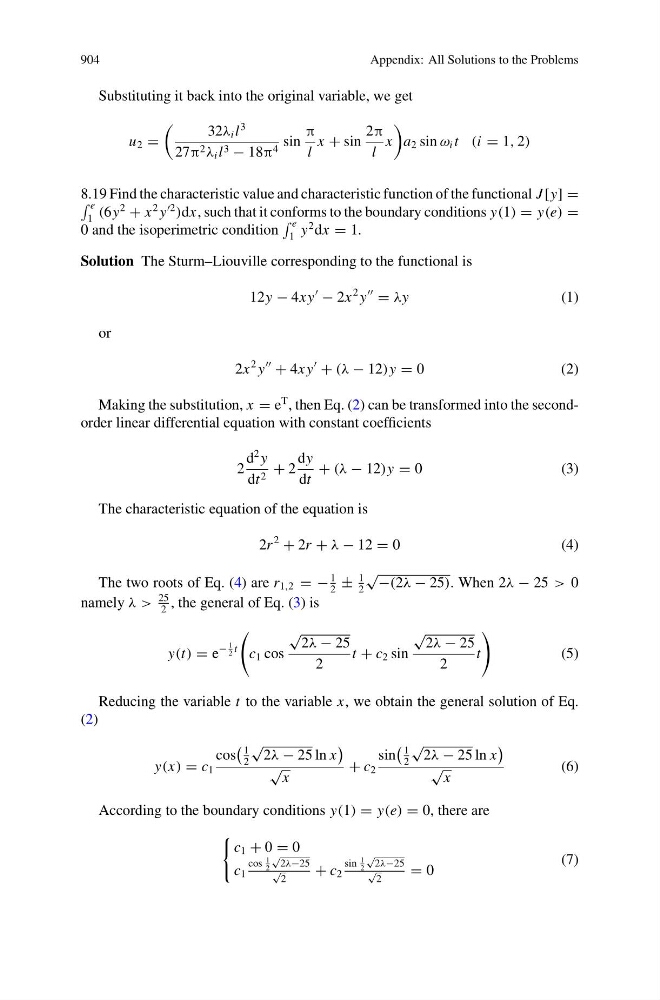
8.19 Find the characteristic value and characteristic function of the functional J [y] =
e
1 (6y
2
+ x
2 y
2
)dx, such that it conforms to the boundary conditions y(1) = y(e) =
0 and the isoperimetric condition
e
1 y
2 dx = 1.
Solution The Sturm–Liouville corresponding to the functional is
12y − 4x y
− 2x
2 y
= λy
(1)
or
2x
2 y
+ 4x y
+ (λ − 12)y = 0
( 2 )
Making the substitution, x = e
T , then Eq. (2) can be transformed into the secondorder linear differential equation with constant coefficients
2
d
2 y
dt 2 + 2
dy
dt
+ (λ − 12)y = 0
( 3 )
The characteristic equation of the equation is
2r
2
+ 2r + λ − 12 = 0
( 4 )
The two roots of Eq. (4) are r 1,2 = −
1
2
±
1
2
√ −(2λ − 25). When 2λ − 25 > 0
namely λ >
25
2
, the general of Eq. (3) is
y(t) = e
−
1
2 t
c 1 cos
√
2λ − 25
2
t + c 2 sin
√
2λ − 25
2
t
(5)
Reducing the variable t to the variable x, we obtain the general solution of Eq.
(2)
y(x) = c 1
cos
1
2
√
2λ − 25 ln x
√
x
+ c 2
sin
1
2
√
2λ − 25 ln x
√
x
(6)
According to the boundary conditions y(1) = y(e) = 0, there are
c 1 + 0 = 0
c 1
cos
1
2
√
2λ−25
√
2
+ c 2
sin
1
2
√
2λ−25
√
2
= 0
(7)