

896
Appendix: All Solutions to the Problems
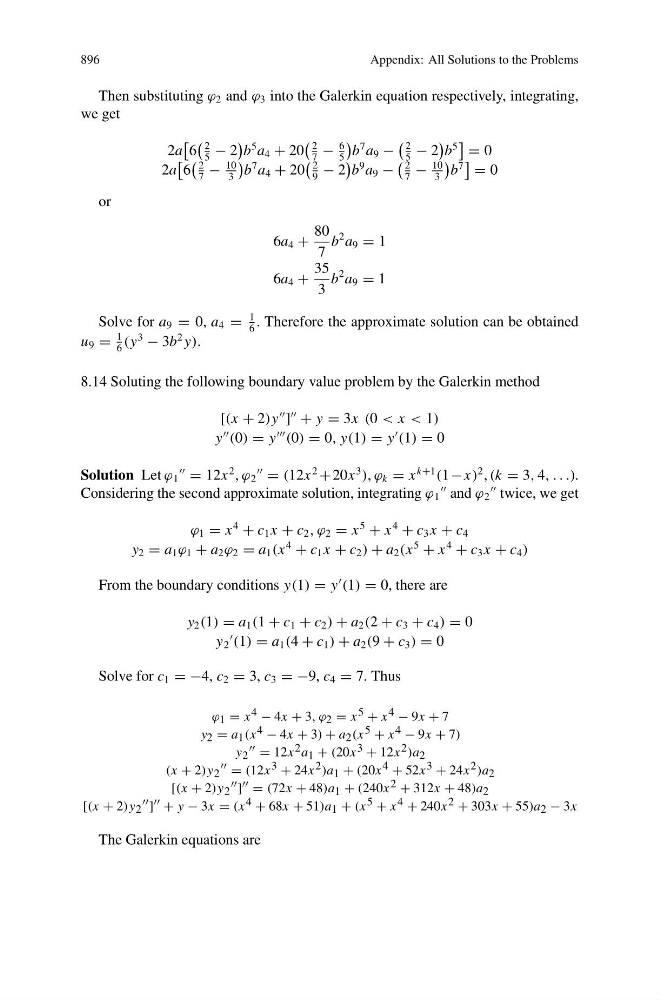
Then substituting ϕ 2 and ϕ 3 into the Galerkin equation respectively, integrating,
we get
2a
6
2
5
− 2
b
5 a 4 + 20
2
7
−
6
5
b
7 a 9 −
2
5
− 2
b
5
= 0
2a
6
2
7
−
10
3
b
7 a 4 + 20
2
9
− 2
b
9 a 9 −
2
7
−
10
3
b
7
= 0
or
6a 4 +
80
7
b
2 a 9 = 1
6a 4 +
35
3
b
2 a 9 = 1
Solve for a 9 = 0, a 4 =
1
6
. Therefore the approximate solution can be obtained
u 9 =
1
6
(y
3
− 3b
2 y).
8.14 Soluting the following boundary value problem by the Galerkin method
[(x + 2)y
]
+ y = 3x (0 < x < 1)
y
(0) = y
(0) = 0, y(1) = y
(1) = 0
Solution Let ϕ 1
= 12x
2 , ϕ 2
= (12x
2
+20x
3
), ϕ k = x
k+1
(1− x)
2 , (k = 3, 4, . . .).
Considering the second approximate solution, integrating ϕ 1
and ϕ 2
twice, we get
ϕ 1 = x
4
+ c 1 x + c 2 , ϕ 2 = x
5
+ x
4
+ c 3 x + c 4
y 2 = a 1 ϕ 1 + a 2 ϕ 2 = a 1 (x
4
+ c 1 x + c 2 ) + a 2 (x
5
+ x
4
+ c 3 x + c 4 )
From the boundary conditions y(1) = y
(1) = 0, there are
y 2 (1) = a 1 (1 + c 1 + c 2 ) + a 2 (2 + c 3 + c 4 ) = 0
y 2
(1) = a 1 (4 + c 1 ) + a 2 (9 + c 3 ) = 0
Solve for c 1 = −4, c 2 = 3, c 3 = −9, c 4 = 7. Thus
ϕ 1 = x 4 − 4x + 3, ϕ 2 = x 5 + x 4 − 9x + 7
y 2 = a 1 (x 4 − 4x + 3) + a 2 (x 5 + x 4 − 9x + 7)
y 2
= 12x 2 a 1 + (20x 3 + 12x 2 )a 2
(x + 2)y 2
= (12x 3 + 24x 2 )a 1 + (20x 4 + 52x 3 + 24x 2 )a 2
[(x + 2)y 2
] = (72x + 48)a 1 + (240x 2 + 312x + 48)a 2
[(x + 2)y 2
] + y − 3x = (x 4 + 68x + 51)a 1 + (x 5 + x 4 + 240x 2 + 303x + 55)a 2 − 3x
The Galerkin equations are