

Appendix: All Solutions to the Problems
891
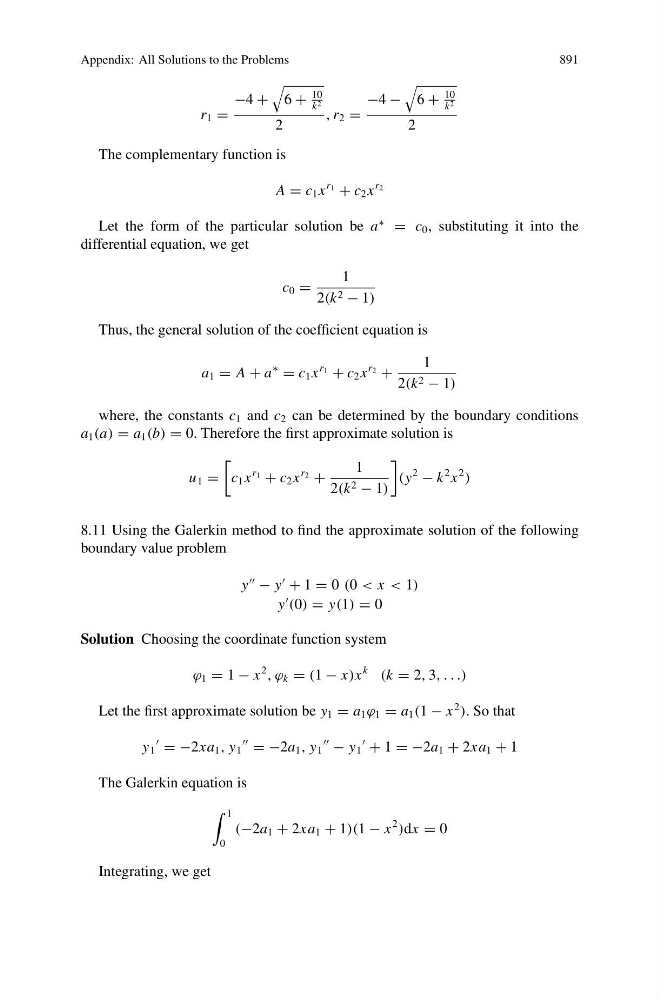
r 1 =
−4 +
6 +
10
k 2
2
, r 2 =
−4 −
6 +
10
k 2
2
The complementary function is
A = c 1 x
r 1 + c 2 x
r 2
Let the form of the particular solution be a
∗
= c 0 , substituting it into the
differential equation, we get
c 0 =
1
2(k 2 − 1)
Thus, the general solution of the coefficient equation is
a 1 = A + a
∗
= c 1 x
r 1 + c 2 x
r 2 +
1
2(k 2 − 1)
where, the constants c 1 and c 2 can be determined by the boundary conditions
a 1 (a) = a 1 (b) = 0. Therefore the first approximate solution is
u 1 =
c 1 x
r 1 + c 2 x
r 2 +
1
2(k 2 − 1)
(y
2
− k
2 x
2
)
8.11 Using the Galerkin method to find the approximate solution of the following
boundary value problem
y
− y
+ 1 = 0 (0 < x < 1)
y
(0) = y(1) = 0
Solution Choosing the coordinate function system
ϕ 1 = 1 − x
2
, ϕ k = (1 − x)x
k
(k = 2, 3, . . .)
Let the first approximate solution be y 1 = a 1 ϕ 1 = a 1 (1 − x
2
). So that
y 1
= −2xa 1 , y 1
= −2a 1 , y 1
− y 1
+ 1 = −2a 1 + 2xa 1 + 1
The Galerkin equation is
1
0
(−2a 1 + 2xa 1 + 1)(1 − x
2
)dx = 0
Integrating, we get