

Appendix: All Solutions to the Problems
889
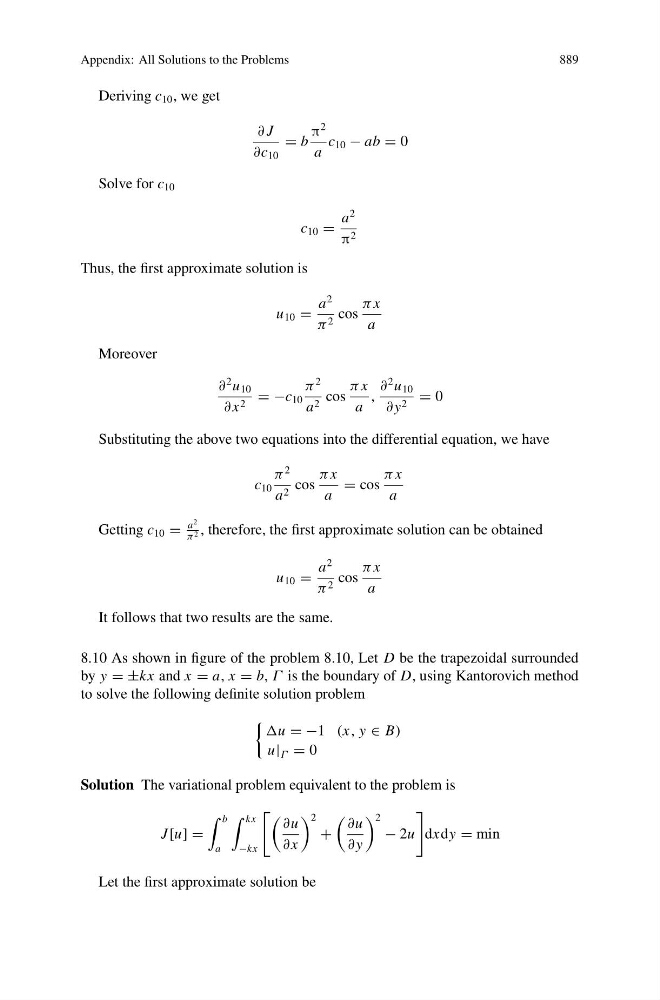
Deriving c 10 , we get
∂ J
∂c 10
= b
π
2
a
c 10 − ab = 0
Solve for c 10
c 10 =
a
2
π 2
Thus, the first approximate solution is
u 10 =
a
2
π 2 cos
π x
a
Moreover
∂
2 u 10
∂ x 2 = −c 10
π
2
a 2 cos
π x
a
,
∂
2 u 10
∂ y 2 = 0
Substituting the above two equations into the differential equation, we have
c 10
π
2
a 2 cos
π x
a
= cos
π x
a
Getting c 10 =
a
2
π 2 , therefore, the first approximate solution can be obtained
u 10 =
a
2
π 2 cos
π x
a
It follows that two results are the same.
8.10 As shown in figure of the problem 8.10, Let D be the trapezoidal surrounded
by y = ±kx and x = a, x = b, Γ is the boundary of D, using Kantorovich method
to solve the following definite solution problem
u = −1 (x, y ∈ B)
u| Γ = 0
Solution The variational problem equivalent to the problem is
J [u] =
b
a
kx
−kx
∂u
∂ x
2
+
∂u
∂ y
2
− 2u
dxdy = min
Let the first approximate solution be