

882
Appendix: All Solutions to the Problems
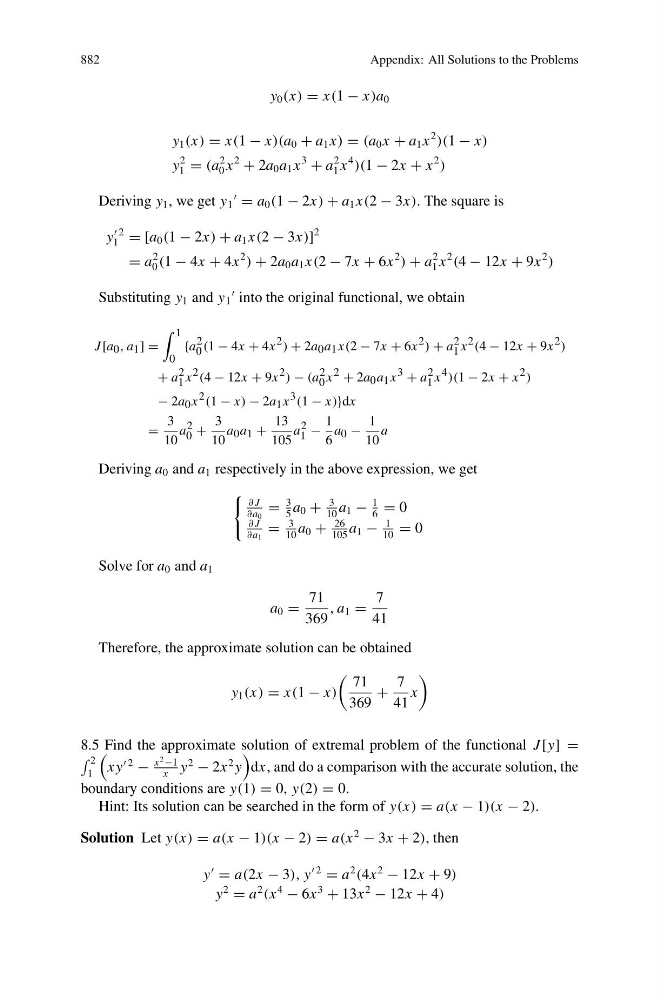
y 0 (x) = x(1 − x)a 0
y 1 (x) = x(1 − x)(a 0 + a 1 x) = (a 0 x + a 1 x
2
)(1 − x)
y
2
1 = (a
2
0 x
2
+ 2a 0 a 1 x
3
+ a
2
1 x
4
)(1 − 2x + x
2
)
Deriving y 1 , we get y 1
= a 0 (1 − 2x) + a 1 x(2 − 3x). The square is
y
2
1 = [a 0 (1 − 2x) + a 1 x(2 − 3x)]
2
= a
2
0 (1 − 4x + 4x
2
) + 2a 0 a 1 x(2 − 7x + 6x
2
) + a
2
1 x
2
(4 − 12x + 9x
2
)
Substituting y 1 and y 1
into the original functional, we obtain
J [a 0 , a 1 ] =
1
0
{a 2
0 (1 − 4x + 4x 2 ) + 2a 0 a 1 x(2 − 7x + 6x 2 ) + a 2
1 x 2 (4 − 12x + 9x 2 )
+ a 2
1 x 2 (4 − 12x + 9x 2 ) − (a 2
0 x 2 + 2a 0 a 1 x 3 + a 2
1 x 4 )(1 − 2x + x 2 )
− 2a 0 x 2 (1 − x) − 2a 1 x 3 (1 − x)}dx
=
3
10
a 2
0 +
3
10
a 0 a 1 +
13
105
a 2
1 −
1
6
a 0 −
1
10
a
Deriving a 0 and a 1 respectively in the above expression, we get
∂ J
∂a 0
=
3
5
a 0 +
3
10
a 1 −
1
6
= 0
∂ J
∂a 1
=
3
10
a 0 +
26
105
a 1 −
1
10
= 0
Solve for a 0 and a 1
a 0 =
71
369
, a 1 =
7
41
Therefore, the approximate solution can be obtained
y 1 (x) = x(1 − x)
71
369
+
7
41
x
8.5 Find the approximate solution of extremal problem of the functional J [y] =
2
1
x y
2
−
x
2 −1
x
y
2
− 2x
2 y
dx, and do a comparison with the accurate solution, the
boundary conditions are y(1) = 0, y(2) = 0.
Hint: Its solution can be searched in the form of y(x) = a(x − 1)(x − 2).
Solution Let y(x) = a(x − 1)(x − 2) = a(x
2
− 3x + 2), then
y
= a(2x − 3), y
2
= a
2
(4x
2
− 12x + 9)
y
2
= a
2
(x
4
− 6x
3
+ 13x
2
− 12x + 4)