

Appendix: All Solutions to the Problems
875
the Ox axis. And let ϕ(y) ∈ C(D), ω(y) ∈ C
1
(D), and they are both greater than
zero, f (x, y) ∈ C(D), u ∈ C
2
(D). Prove: The variational problem equivalent to the
boundary value problem namely the Tricomi problem
⎧
⎨
⎩
T u ≡ −ϕ(y)u xx −
∂
∂ y
[ω(y)u y ] = f (x, y) (x, y ∈ D)
∂u
∂ y
Γ 1
= 0, u| Γ 2 = 0
is the minimum problem of finding the functional
J [u] =
¨
D
[ϕ(y)u
2
x + ω(y)u
2
y − 2 f (x, y)u]dxdy, u| Γ 2 = 0,
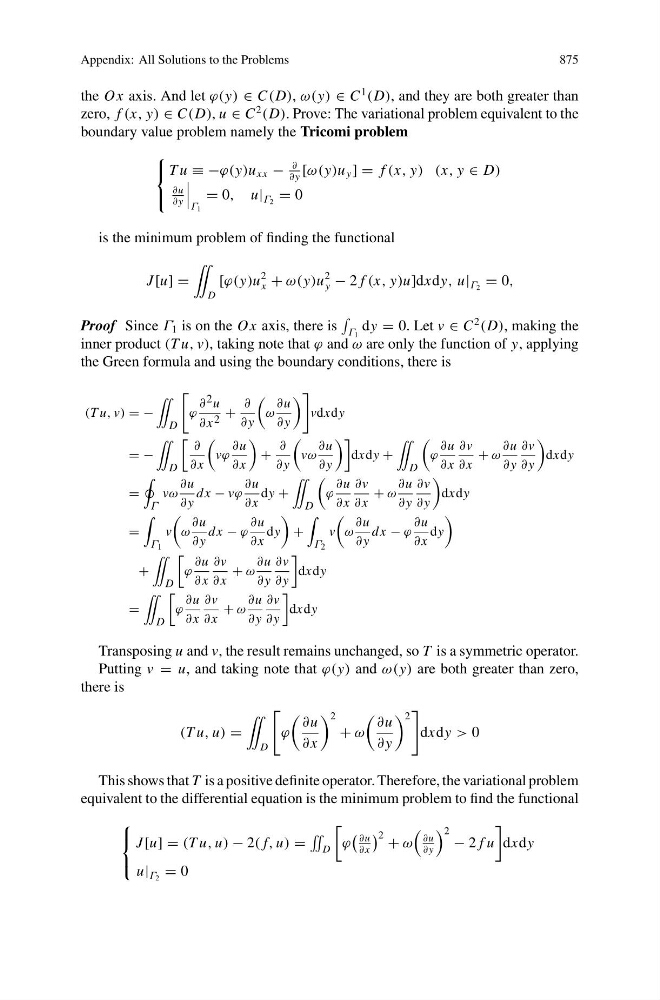
Proof Since Γ 1 is on the Ox axis, there is
Γ 1
dy = 0. Let v ∈ C
2
(D), making the
inner product (T u, v), taking note that ϕ and ω are only the function of y, applying
the Green formula and using the boundary conditions, there is
(T u, v) = −
¨
D
ϕ
∂ 2 u
∂ x 2 +
∂
∂ y
ω
∂u
∂ y
vdxdy
= −
¨
D
∂
∂ x
vϕ
∂u
∂ x
+
∂
∂ y
vω
∂u
∂ y
dxdy +
¨
D
ϕ
∂u
∂ x
∂v
∂ x
+ ω
∂u
∂ y
∂v
∂ y
dxdy
=
Γ
vω
∂u
∂ y
dx − vϕ
∂u
∂ x
dy +
¨
D
ϕ
∂u
∂ x
∂v
∂ x
+ ω
∂u
∂ y
∂v
∂ y
dxdy
=
Γ 1
v
ω
∂u
∂ y
dx − ϕ
∂u
∂ x
dy
+
Γ 2
v
ω
∂u
∂ y
dx − ϕ
∂u
∂ x
dy
+
¨
D
ϕ
∂u
∂ x
∂v
∂ x
+ ω
∂u
∂ y
∂v
∂ y
dxdy
=
¨
D
ϕ
∂u
∂ x
∂v
∂ x
+ ω
∂u
∂ y
∂v
∂ y
dxdy
Transposing u and v, the result remains unchanged, so T is a symmetric operator.
Putting v = u, and taking note that ϕ(y) and ω(y) are both greater than zero,
there is
(T u, u) =
¨
D
ϕ
∂u
∂ x
2
+ ω
∂u
∂ y
2
dxdy > 0
This shows that T is a positive definite operator. Therefore, the variational problem
equivalent to the differential equation is the minimum problem to find the functional
⎧
⎨
⎩
J [u] = (T u, u) − 2( f, u) =
˜
D
ϕ
∂u
∂ x
2 + ω
∂u
∂ y
2 − 2 f u
dxdy
u| Γ 2 = 0