

866
Appendix: All Solutions to the Problems
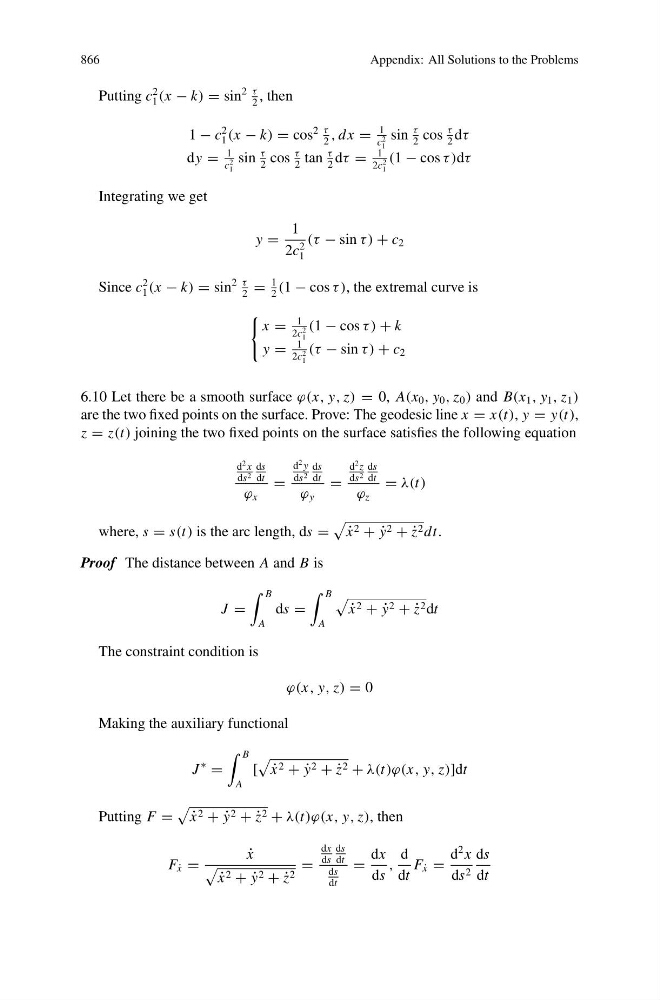
Putting c
2
1 (x − k) = sin
2 τ
2
, then
1 − c
2
1 (x − k) = cos
2 τ
2
, dx =
1
c
2
1
sin
τ
2
cos
τ
2
dτ
dy =
1
c
2
1
sin
τ
2
cos
τ
2
tan
τ
2
dτ =
1
2c
2
1
(1 − cos τ )dτ
Integrating we get
y =
1
2c
2
1
(τ − sin τ ) + c 2
Since c
2
1 (x − k) = sin
2 τ
2
=
1
2
(1 − cos τ ), the extremal curve is
x =
1
2c
2
1
(1 − cos τ ) + k
y =
1
2c
2
1
(τ − sin τ ) + c 2
6.10 Let there be a smooth surface ϕ(x, y, z) = 0, A(x 0 , y 0 , z 0 ) and B(x 1 , y 1 , z 1 )
are the two fixed points on the surface. Prove: The geodesic line x = x(t), y = y(t),
z = z(t) joining the two fixed points on the surface satisfies the following equation
d
2 x
ds 2
ds
dt
ϕ x
=
d
2 y
ds 2
ds
dt
ϕ y
=
d
2 z
ds 2
ds
dt
ϕ z
= λ(t)
where, s = s(t) is the arc length, ds =
˙
x 2 + ˙
y 2 + ˙
z 2 dt.
Proof The distance between A and B is
J =
B
A
ds =
B
A
˙
x 2 + ˙
y 2 + ˙
z 2 dt
The constraint condition is
ϕ(x, y, z) = 0
Making the auxiliary functional
J
∗
=
B
A
[
˙
x 2 + ˙
y 2 + ˙
z 2 + λ(t)ϕ(x, y, z)]dt
Putting F =
˙
x 2 + ˙
y 2 + ˙
z 2 + λ(t)ϕ(x, y, z), then
F ˙
x =
˙
x
˙
x 2 + ˙
y 2 + ˙
z 2
=
dx
ds
ds
dt
ds
dt
=
dx
ds
,
d
dt
F ˙
x =
d
2 x
ds 2
ds
dt