

864
Appendix: All Solutions to the Problems
Using the boundary conditions x(0) = y(0) = 0, x(1) = y(1) = 1, we get
c 1 = c 2 = c 4 = 0, c 2 =
1
sinh(π/2)
, thus the extremal curve is x = y =
cosh 2t
sinh(π/2)
.
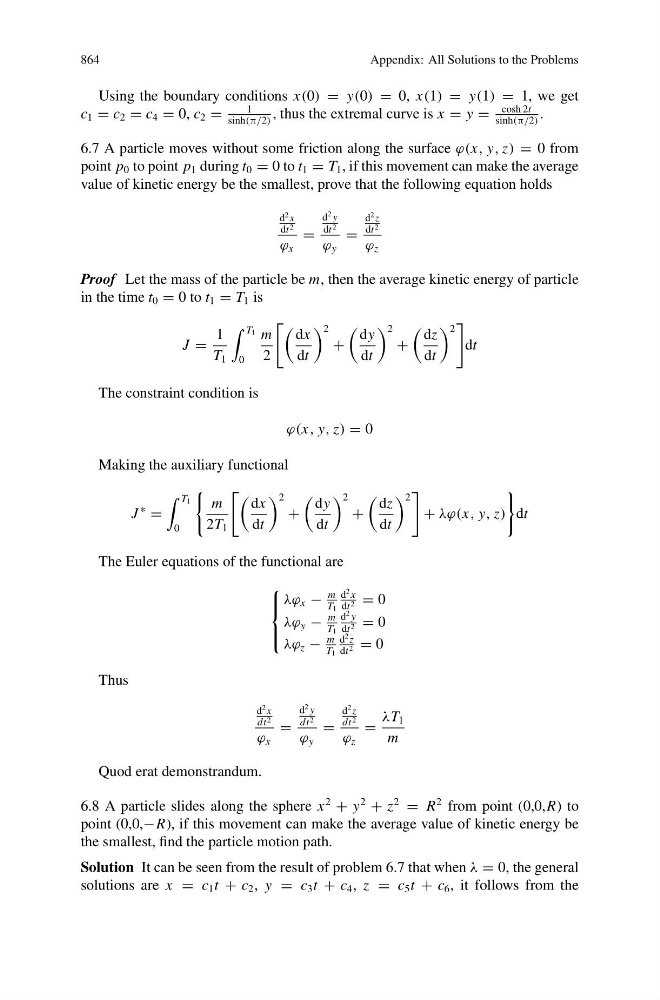
6.7 A particle moves without some friction along the surface ϕ(x, y, z) = 0 from
point p 0 to point p 1 during t 0 = 0 to t 1 = T 1 , if this movement can make the average
value of kinetic energy be the smallest, prove that the following equation holds
d
2 x
dt 2
ϕ x
=
d
2 y
dt 2
ϕ y
=
d
2 z
dt 2
ϕ z
Proof Let the mass of the particle be m, then the average kinetic energy of particle
in the time t 0 = 0 to t 1 = T 1 is
J =
1
T 1
T 1
0
m
2
dx
dt
2
+
dy
dt
2
+
dz
dt
2
dt
The constraint condition is
ϕ(x, y, z) = 0
Making the auxiliary functional
J
∗
=
T 1
0
m
2T 1
dx
dt
2
+
dy
dt
2
+
dz
dt
2
+ λϕ(x, y, z)
dt
The Euler equations of the functional are
⎧
⎪ ⎨
⎪ ⎩
λϕ x −
m
T 1
d
2 x
dt 2 = 0
λϕ y −
m
T 1
d
2 y
dt 2 = 0
λϕ z −
m
T 1
d
2 z
dt 2 = 0
Thus
d
2 x
dt 2
ϕ x
=
d
2 y
dt 2
ϕ y
=
d
2 z
dt 2
ϕ z
=
λT 1
m
Quod erat demonstrandum.
6.8 A particle slides along the sphere x
2
+ y
2
+ z
2
= R
2 from point (0,0,R) to
point (0,0,−R), if this movement can make the average value of kinetic energy be
the smallest, find the particle motion path.
Solution It can be seen from the result of problem 6.7 that when λ = 0, the general
solutions are x = c 1 t + c 2 , y = c 3 t + c 4 , z = c 5 t + c 6 , it follows from the