

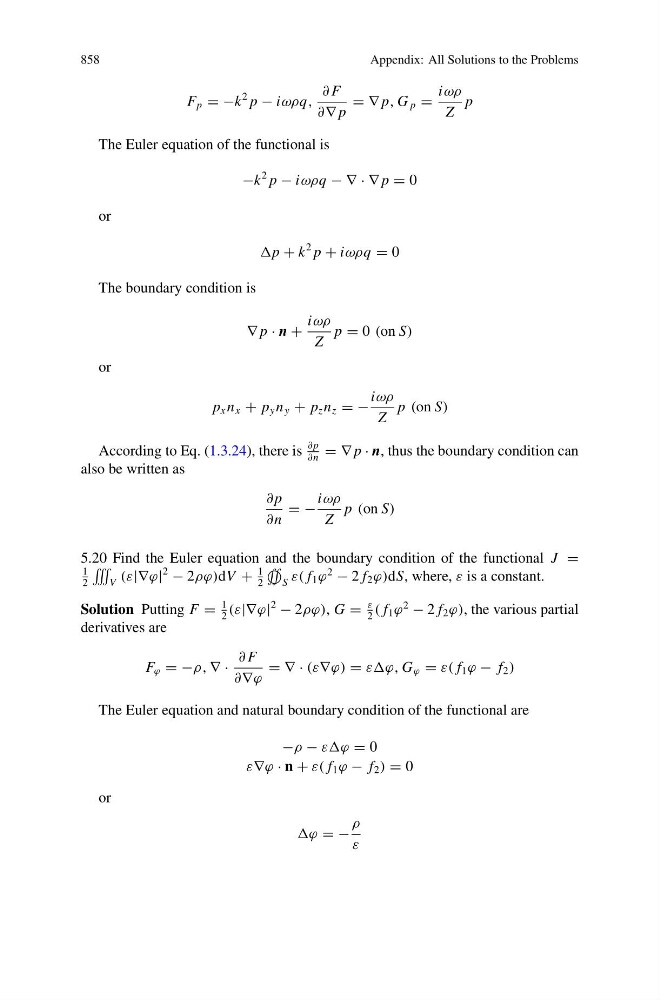
858
Appendix: All Solutions to the Problems
F p = −k
2 p − iωρq,
∂ F
∂∇ p
= ∇ p, G p =
iωρ
Z
p
The Euler equation of the functional is
−k
2 p − iωρq − ∇ · ∇ p = 0
or
p + k
2 p + iωρq = 0
The boundary condition is
∇ p · n +
iωρ
Z
p = 0 (on S)
or
p x n x + p y n y + p z n z = −
iωρ
Z
p (on S)
According to Eq. (1.3.24), there is
∂ p
∂n
= ∇ p · n, thus the boundary condition can
also be written as
∂ p
∂n
= −
iωρ
Z
p (on S)
5.20 Find the Euler equation and the boundary condition of the functional J =
1
2
˝
V (ε|∇ϕ|
2
− 2ρϕ)dV +
1
2
S ε( f 1 ϕ
2
− 2 f 2 ϕ)dS, where, ε is a constant.
Solution Putting F =
1
2
(ε|∇ϕ|
2
− 2ρϕ), G =
ε
2
( f 1 ϕ
2
− 2 f 2 ϕ), the various partial
derivatives are
F ϕ = −ρ, ∇ ·
∂ F
∂∇ϕ
= ∇ · (ε∇ϕ) = εεϕ, G ϕ = ε( f 1 ϕ − f 2 )
The Euler equation and natural boundary condition of the functional are
−ρ − εεϕ = 0
ε∇ϕ · n + ε( f 1 ϕ − f 2 ) = 0
or
ϕ = −
ρ
ε