

856
Appendix: All Solutions to the Problems
or
y
+ (k
2
− λ)y = 0
If k
2
− λ > 0, then the general solution of the Euler equation is
y = c 1 cos
k 2 − λx + c 2 sin
k 2 − λx
Because the integrand is an even function, there is c 2 = 0, from the boundary
conditions y(−1) = y(1) = 0, we get
√
k 2 − λ =
π
2
, λ = k
2
−
λ
2
4
, at this moment
y = c 1 cos
π
2
x, substituting it into the additional condition, there is
2c
2
1
1
0
cos
2 π
2
xdx = c
2
1
1
0
(1 + cos π x)dx = c
2
1 = 1
we get c 1 = ±1, thus the extremal curve is y = ± cos
π
2
x.
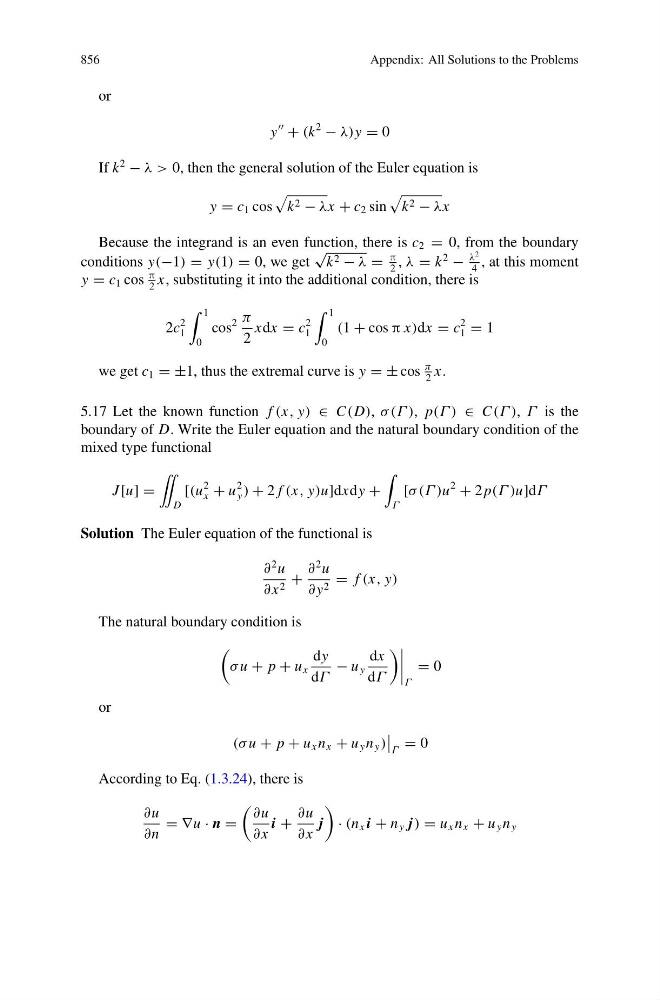
5.17 Let the known function f (x, y) ∈ C(D), σ (Γ ), p(Γ ) ∈ C(Γ ), Γ is the
boundary of D. Write the Euler equation and the natural boundary condition of the
mixed type functional
J [u] =
¨
D
[(u
2
x + u
2
y ) + 2 f (x, y)u]dxdy +
Γ
[σ (Γ )u
2
+ 2 p(Γ )u]dΓ
Solution The Euler equation of the functional is
∂
2 u
∂ x 2 +
∂
2 u
∂ y 2 = f (x, y)
The natural boundary condition is
σ u + p + u x
dy
dΓ
− u y
dx
dΓ
Γ
= 0
or
(σ u + p + u x n x + u y n y )
Γ = 0
According to Eq. (1.3.24), there is
∂u
∂n
= ∇u · n =
∂u
∂ x
i +
∂u
∂ x
j
· (n x i + n y j ) = u x n x + u y n y