

848
Appendix: All Solutions to the Problems
⎧
⎨
⎩
y
√
1+y 2 +z 2
=
dy
ds
= c 1
z
√
1+y 2 +z 2
=
dz
ds
=
λ(x)dx = k(x)
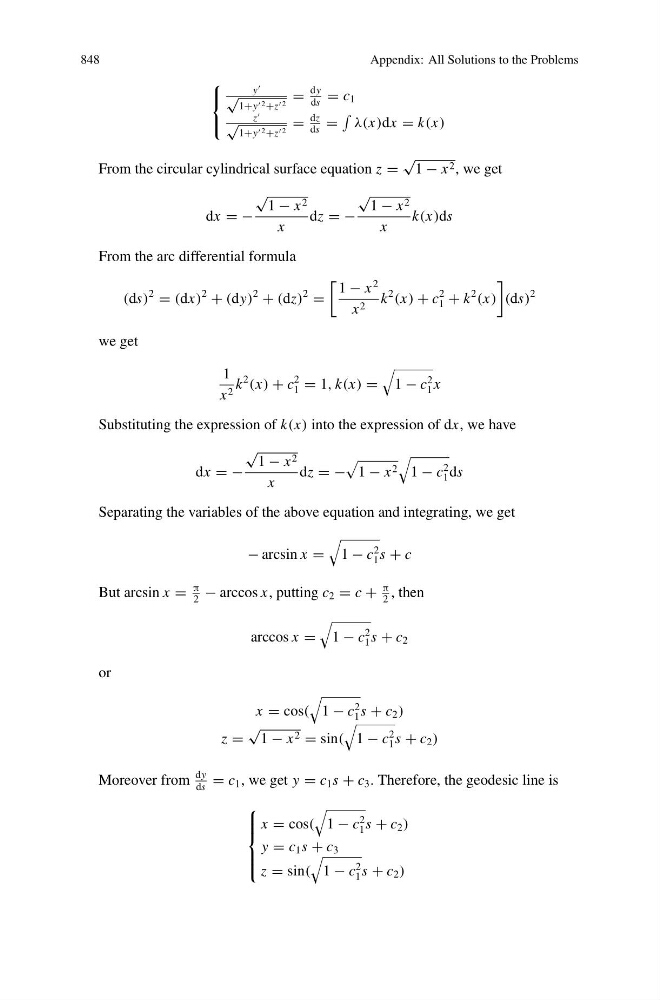
From the circular cylindrical surface equation z =
√
1 − x 2 , we get
dx = −
√
1 − x 2
x
dz = −
√
1 − x 2
x
k(x)ds
From the arc differential formula
(ds)
2
= (dx)
2
+ (dy)
2
+ (dz)
2
=
1 − x
2
x 2 k
2
(x) + c
2
1 + k
2
(x)
(ds)
2
we get
1
x 2 k
2
(x) + c
2
1 = 1, k(x) =
1 − c
2
1 x
Substituting the expression of k(x) into the expression of dx, we have
dx = −
√
1 − x 2
x
dz = −
1 − x 2
1 − c
2
1 ds
Separating the variables of the above equation and integrating, we get
− arcsin x =
1 − c
2
1 s + c
But arcsin x =
π
2
− arccos x, putting c 2 = c +
π
2
, then
arccos x =
1 − c
2
1 s + c 2
or
x = cos(
1 − c
2
1 s + c 2 )
z =
√
1 − x 2 = sin(
1 − c
2
1 s + c 2 )
Moreover from
dy
ds
= c 1 , we get y = c 1 s + c 3 . Therefore, the geodesic line is
⎧
⎪ ⎪ ⎨
⎪ ⎪ ⎩
x = cos(
1 − c
2
1 s + c 2 )
y = c 1 s + c 3
z = sin(
1 − c
2
1 s + c 2 )