

Appendix: All Solutions to the Problems
843
Solving for c 2 = ±2. Thus the extremal curve is y = ±2 sin n π x, where n is
integer.
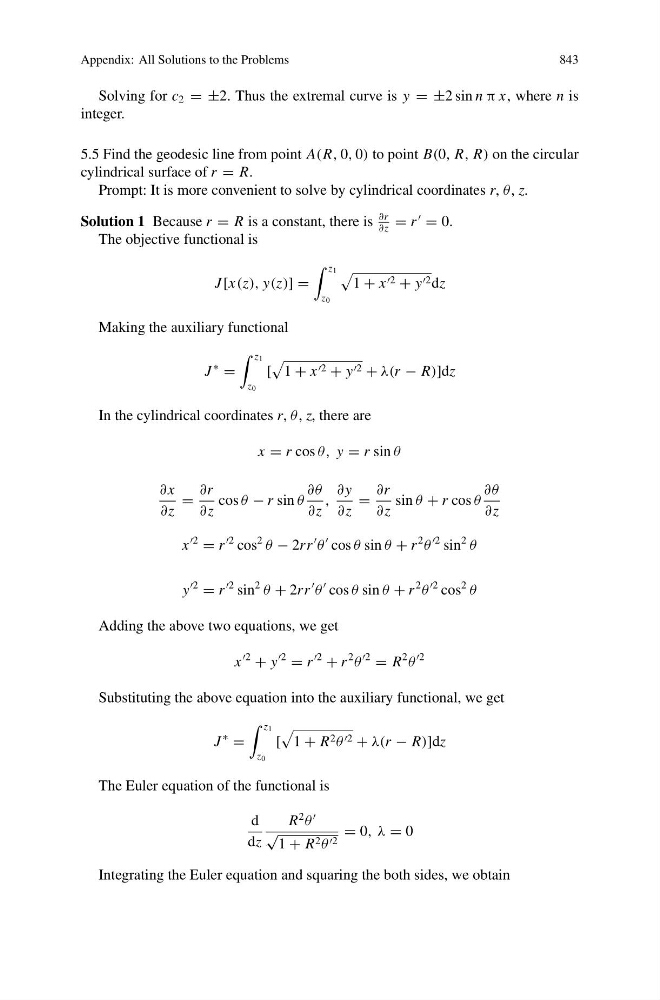
5.5 Find the geodesic line from point A(R, 0, 0) to point B(0, R, R) on the circular
cylindrical surface of r = R.
Prompt: It is more convenient to solve by cylindrical coordinates r, θ , z.
Solution 1 Because r = R is a constant, there is
∂r
∂z
= r
= 0.
The objective functional is
J [x(z), y(z)] =
z 1
z 0
1 + x 2 + y 2 dz
Making the auxiliary functional
J
∗
=
z 1
z 0
[
1 + x 2 + y 2 + λ(r − R)]dz
In the cylindrical coordinates r, θ , z, there are
x = r cos θ, y = r sin θ
∂ x
∂z
=
∂r
∂z
cos θ − r sin θ
∂θ
∂z
,
∂ y
∂z
=
∂r
∂z
sin θ + r cos θ
∂θ
∂z
x
2
= r
2 cos
2
θ − 2rr
θ
cos θ sin θ + r
2
θ
2 sin
2
θ
y
2
= r
2 sin
2
θ + 2rr
θ
cos θ sin θ + r
2
θ
2 cos
2
θ
Adding the above two equations, we get
x
2
+ y
2
= r
2
+ r
2
θ
2
= R
2
θ
2
Substituting the above equation into the auxiliary functional, we get
J
∗
=
z 1
z 0
[
1 + R 2 θ 2 + λ(r − R)]dz
The Euler equation of the functional is
d
dz
R
2
θ
√
1 + R 2 θ 2
= 0, λ = 0
Integrating the Euler equation and squaring the both sides, we obtain