

Appendix: All Solutions to the Problems
841
y = y 1 = −
5
2
x
2
+
7
2
x, z = x.
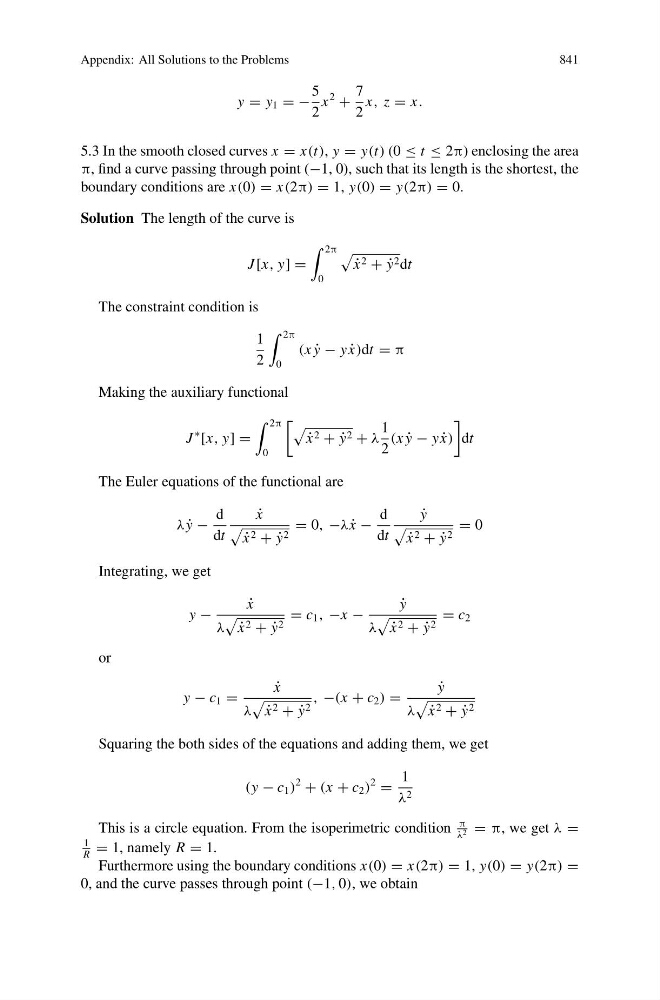
5.3 In the smooth closed curves x = x(t), y = y(t) (0 ≤ t ≤ 2π) enclosing the area
π, find a curve passing through point (−1, 0), such that its length is the shortest, the
boundary conditions are x(0) = x(2π) = 1, y(0) = y(2π) = 0.
Solution The length of the curve is
J [x, y] =
2π
0
˙
x 2 + ˙
y 2 dt
The constraint condition is
1
2
2π
0
(x ˙
y − y ˙
x)dt = π
Making the auxiliary functional
J
∗
[x, y] =
2π
0
˙
x 2 + ˙
y 2 + λ
1
2
(x ˙
y − y ˙
x)
dt
The Euler equations of the functional are
λ ˙
y −
d
dt
˙
x
˙
x 2 + ˙
y 2
= 0, −λ ˙
x −
d
dt
˙
y
˙
x 2 + ˙
y 2
= 0
Integrating, we get
y −
˙
x
λ
˙
x 2 + ˙
y 2
= c 1 , −x −
˙
y
λ
˙
x 2 + ˙
y 2
= c 2
or
y − c 1 =
˙
x
λ
˙
x 2 + ˙
y 2
, −(x + c 2 ) =
˙
y
λ
˙
x 2 + ˙
y 2
Squaring the both sides of the equations and adding them, we get
(y − c 1 )
2
+ (x + c 2 )
2
=
1
λ 2
This is a circle equation. From the isoperimetric condition
π
λ 2 = π, we get λ =
1
R
= 1, namely R = 1.
Furthermore using the boundary conditions x(0) = x(2π) = 1, y(0) = y(2π) =
0, and the curve passes through point (−1, 0), we obtain