

804
Appendix: All Solutions to the Problems
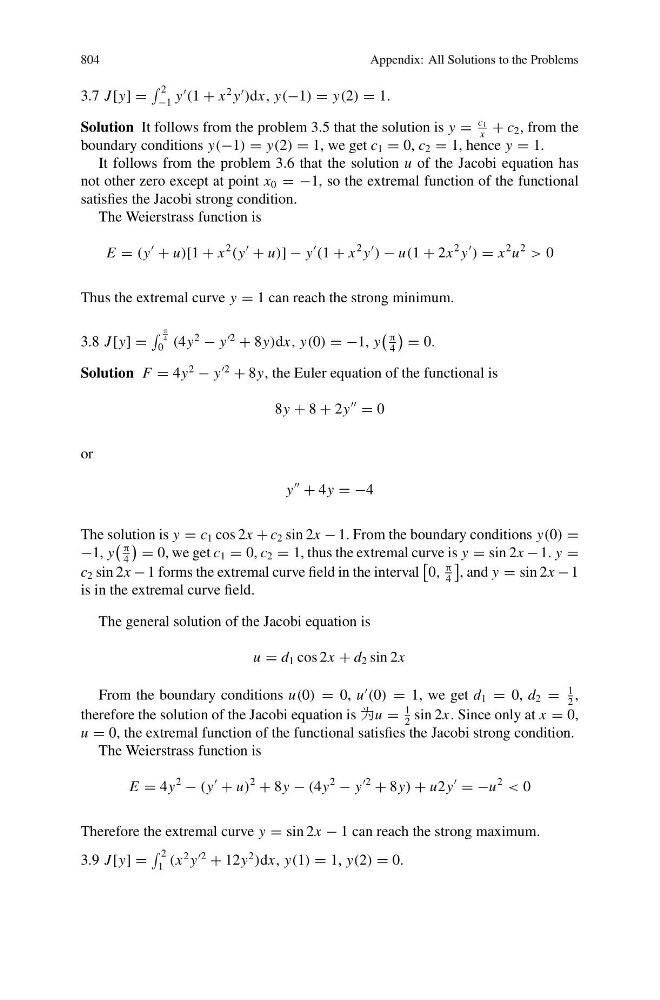
3.7 J [y] =
2
−1 y
(1 + x
2 y
)dx, y(−1) = y(2) = 1.
Solution It follows from the problem 3.5 that the solution is y =
c 1
x
+ c 2 , from the
boundary conditions y(−1) = y(2) = 1, we get c 1 = 0, c 2 = 1, hence y = 1.
It follows from the problem 3.6 that the solution u of the Jacobi equation has
not other zero except at point x 0 = −1, so the extremal function of the functional
satisfies the Jacobi strong condition.
The Weierstrass function is
E = (y
+ u)[1 + x
2
(y
+ u)] − y
(1 + x
2 y
) − u(1 + 2x
2 y
) = x
2 u
2
> 0
Thus the extremal curve y = 1 can reach the strong minimum.
3.8 J [y] =
π
4
0 (4y
2
− y
2
+ 8y)dx, y(0) = −1, y
π
4
= 0.
Solution F = 4y
2
− y
2
+ 8y, the Euler equation of the functional is
8y + 8 + 2y
= 0
or
y
+ 4y = −4
The solution is y = c 1 cos 2x + c 2 sin 2x − 1. From the boundary conditions y(0) =
−1, y
π
4
= 0, we get c 1 = 0, c 2 = 1, thus the extremal curve is y = sin 2x − 1. y =
c 2 sin 2x − 1 forms the extremal curve field in the interval
0,
π
4
, and y = sin 2x − 1
is in the extremal curve field.
The general solution of the Jacobi equation is
u = d 1 cos 2x + d 2 sin 2x
From the boundary conditions u(0) = 0, u
(0) = 1, we get d 1 = 0, d 2 =
1
2
,
therefore the solution of the Jacobi equation is 为u =
1
2
sin 2x. Since only at x = 0,
u = 0, the extremal function of the functional satisfies the Jacobi strong condition.
The Weierstrass function is
E = 4y
2
− (y
+ u)
2
+ 8y − (4y
2
− y
2
+ 8y) + u2y
= −u
2
< 0
Therefore the extremal curve y = sin 2x − 1 can reach the strong maximum.
3.9 J [y] =
2
1 (x
2 y
2
+ 12y
2
)dx, y(1) = 1, y(2) = 0.