

Appendix: All Solutions to the Problems
797
−
d
dx
F V x −
d
dy
F V y −
d
dz
F V z = −2V xx − 2V yy − 2V zz = 0
namely V xx + V yy + V zz = V = 0, it is the harmonic equation.
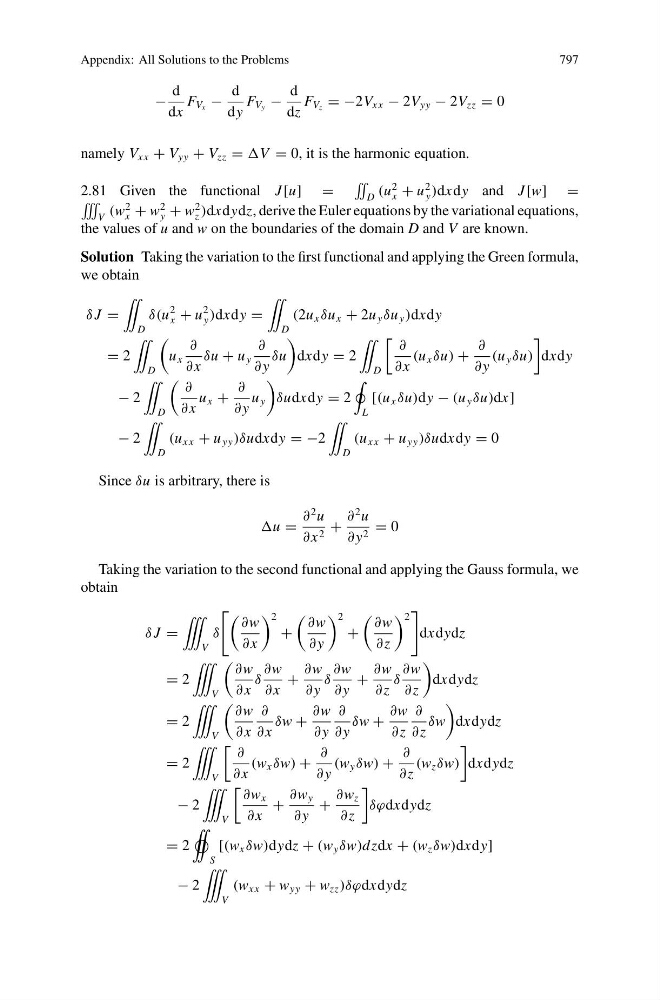
2.81 Given the functional J [u] =
˜
D (u
2
x + u
2
y )dxdy and J [w] =
˝
V (w
2
x + w
2
y + w
2
z )dxdydz, derive the Euler equations by the variational equations,
the values of u and w on the boundaries of the domain D and V are known.
Solution Taking the variation to the first functional and applying the Green formula,
we obtain
δ J =
¨
D
δ(u
2
x + u
2
y )dxdy =
¨
D
(2u x δu x + 2u y δu y )dxdy
= 2
¨
D
u x
∂
∂ x
δu + u y
∂
∂ y
δu
dxdy = 2
¨
D
∂
∂ x
(u x δu) +
∂
∂ y
(u y δu)
dxdy
− 2
¨
D
∂
∂ x
u x +
∂
∂ y
u y
δudxdy = 2
L
[(u x δu)dy − (u y δu)dx]
− 2
¨
D
(u xx + u yy )δudxdy = −2
¨
D
(u xx + u yy )δudxdy = 0
Since δu is arbitrary, there is
u =
∂
2 u
∂ x 2 +
∂
2 u
∂ y 2 = 0
Taking the variation to the second functional and applying the Gauss formula, we
obtain
δ J =
˚
V
δ
∂w
∂ x
2
+
∂w
∂ y
2
+
∂w
∂z
2
dxdydz
= 2
˚
V
∂w
∂ x
δ
∂w
∂ x
+
∂w
∂ y
δ
∂w
∂ y
+
∂w
∂z
δ
∂w
∂z
dxdydz
= 2
˚
V
∂w
∂ x
∂
∂ x
δw +
∂w
∂ y
∂
∂ y
δw +
∂w
∂z
∂
∂z
δw
dxdydz
= 2
˚
V
∂
∂ x
(w x δw) +
∂
∂ y
(w y δw) +
∂
∂z
(w z δw)
dxdydz
− 2
˚
V
∂w x
∂ x
+
∂w y
∂ y
+
∂w z
∂z
δϕdxdydz
= 2
S
[(w x δw)dydz + (w y δw)dzdx + (w z δw)dxdy]
− 2
˚
V
(w xx + w yy + w zz )δϕdxdydz