

Appendix: All Solutions to the Problems
795
1 − μ + 1 + μ
1 − μ
u xx +
2μ
1 − μ
v xy + v xy + u yy = u xx +
1 + μ
1 − μ
u xx
+
2μ + 1 − μ
1 − μ
v xy + u yy = u +
1 + μ
1 − μ
(u xx + v xy ) = 0
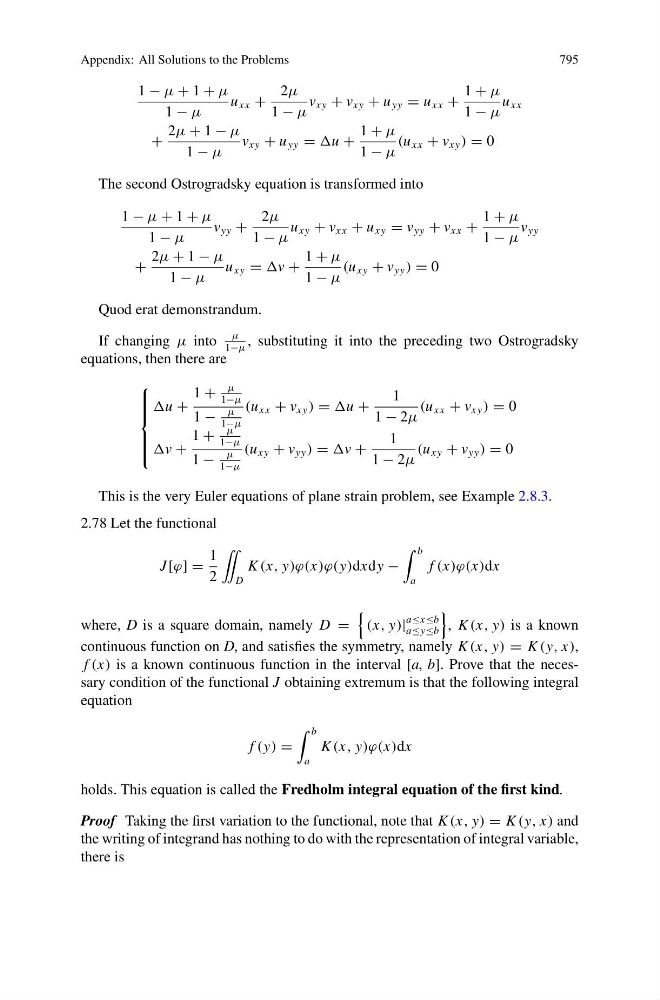
The second Ostrogradsky equation is transformed into
1 − μ + 1 + μ
1 − μ
v yy +
2μ
1 − μ
u xy + v xx + u xy = v yy + v xx +
1 + μ
1 − μ
v yy
+
2μ + 1 − μ
1 − μ
u xy = v +
1 + μ
1 − μ
(u xy + v yy ) = 0
Quod erat demonstrandum.
If changing μ into
μ
1−μ
, substituting it into the preceding two Ostrogradsky
equations, then there are
⎧
⎪ ⎪ ⎪ ⎨
⎪ ⎪ ⎪ ⎩
u +
1 +
μ
1−μ
1 −
μ
1−μ
(u xx + v xy ) = u +
1
1 − 2μ
(u xx + v xy ) = 0
v +
1 +
μ
1−μ
1 −
μ
1−μ
(u xy + v yy ) = v +
1
1 − 2μ
(u xy + v yy ) = 0
This is the very Euler equations of plane strain problem, see Example 2.8.3.
2.78 Let the functional
J [ϕ] =
1
2
¨
D
K (x, y)ϕ(x)ϕ(y)dxdy −
b
a
f (x)ϕ(x)dx
where, D is a square domain, namely D =
(x, y)|
a≤x≤b
a≤y≤b
, K (x, y) is a known
continuous function on D, and satisfies the symmetry, namely K (x, y) = K (y, x),
f (x) is a known continuous function in the interval [a, b]. Prove that the necessary condition of the functional J obtaining extremum is that the following integral
equation
f (y) =
b
a
K (x, y)ϕ(x)dx
holds. This equation is called the Fredholm integral equation of the first kind.
Proof Taking the first variation to the functional, note that K (x, y) = K (y, x) and
the writing of integrand has nothing to do with the representation of integral variable,
there is