

786
Appendix: All Solutions to the Problems
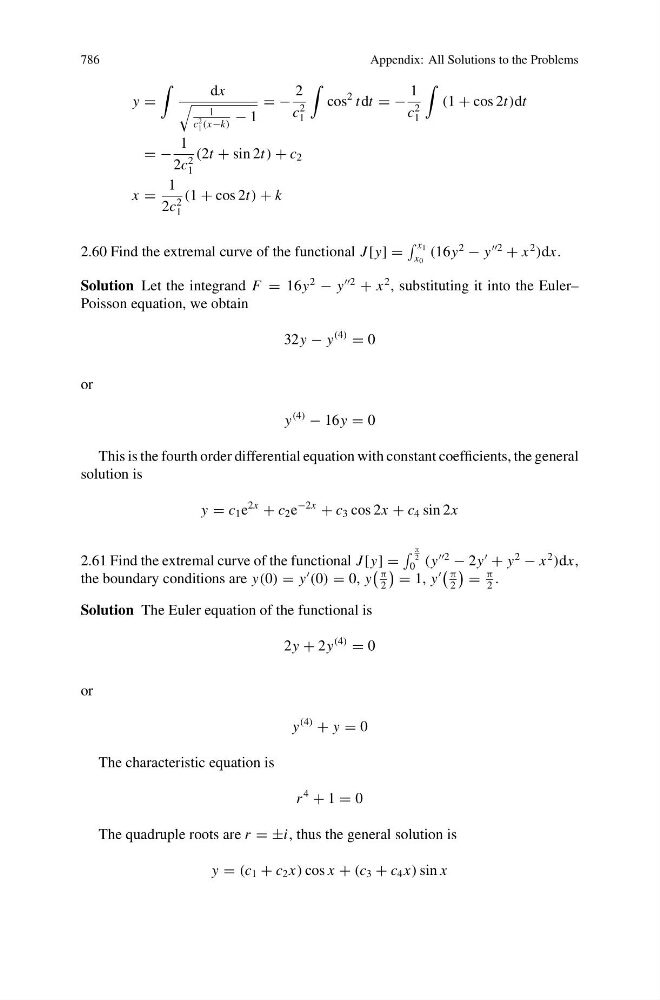
y =
dx
1
c
2
1 (x−k)
− 1
= −
2
c
2
1
cos
2 tdt = −
1
c
2
1
(1 + cos 2t)dt
= −
1
2c
2
1
(2t + sin 2t) + c 2
x =
1
2c
2
1
(1 + cos 2t) + k
2.60 Find the extremal curve of the functional J [y] =
x 1
x 0
(16y
2
− y
2
+ x
2
)dx.
Solution Let the integrand F = 16y
2
− y
2
+ x
2 , substituting it into the Euler–
Poisson equation, we obtain
32y − y
(4)
= 0
or
y
(4)
− 16y = 0
This is the fourth order differential equation with constant coefficients, the general
solution is
y = c 1 e
2x
+ c 2 e
−2x
+ c 3 cos 2x + c 4 sin 2x
2.61 Find the extremal curve of the functional J [y] =
π
2
0 (y
2
− 2y
+ y
2
− x
2
)dx,
the boundary conditions are y(0) = y
(0) = 0, y
π
2
= 1, y
π
2
=
π
2
.
Solution The Euler equation of the functional is
2y + 2y
(4)
= 0
or
y
(4)
+ y = 0
The characteristic equation is
r
4
+ 1 = 0
The quadruple roots are r = ±i, thus the general solution is
y = (c 1 + c 2 x) cos x + (c 3 + c 4 x) sin x