

Appendix: All Solutions to the Problems
779
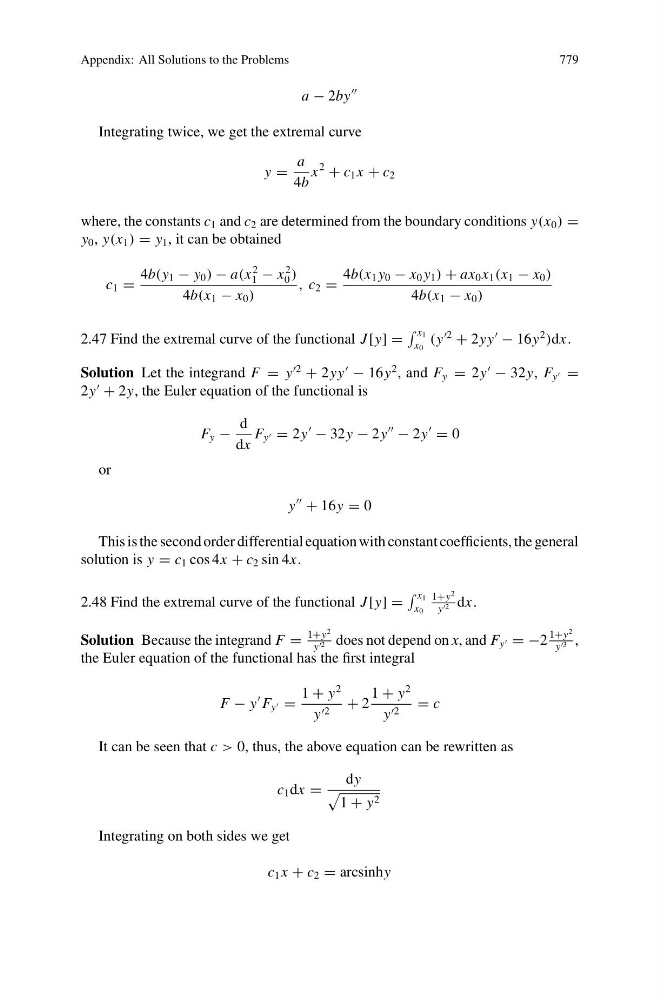
a − 2by
Integrating twice, we get the extremal curve
y =
a
4b
x
2
+ c 1 x + c 2
where, the constants c 1 and c 2 are determined from the boundary conditions y(x 0 ) =
y 0 , y(x 1 ) = y 1 , it can be obtained
c 1 =
4b(y 1 − y 0 ) − a(x
2
1 − x
2
0 )
4b(x 1 − x 0 )
, c 2 =
4b(x 1 y 0 − x 0 y 1 ) + ax 0 x 1 (x 1 − x 0 )
4b(x 1 − x 0 )
2.47 Find the extremal curve of the functional J [y] =
x 1
x 0
(y
2
+ 2yy
− 16y
2
)dx.
Solution Let the integrand F = y
2
+ 2yy
− 16y
2 , and F y = 2y
− 32y, F y =
2y
+ 2y, the Euler equation of the functional is
F y −
d
dx
F y = 2y
− 32y − 2y
− 2y
= 0
or
y
+ 16y = 0
This is the second order differential equation with constant coefficients, the general
solution is y = c 1 cos 4x + c 2 sin 4x.
2.48 Find the extremal curve of the functional J [y] =
x 1
x 0
1+y
2
y 2 dx.
Solution Because the integrand F =
1+y
2
y 2 does not depend on x, and F y = −2
1+y
2
y 3 ,
the Euler equation of the functional has the first integral
F − y
F y =
1 + y
2
y 2 + 2
1 + y
2
y 2 = c
It can be seen that c > 0, thus, the above equation can be rewritten as
c 1 dx =
dy
1 + y 2
Integrating on both sides we get
c 1 x + c 2 = arcsinhy