

758
Appendix: All Solutions to the Problems
˚
V
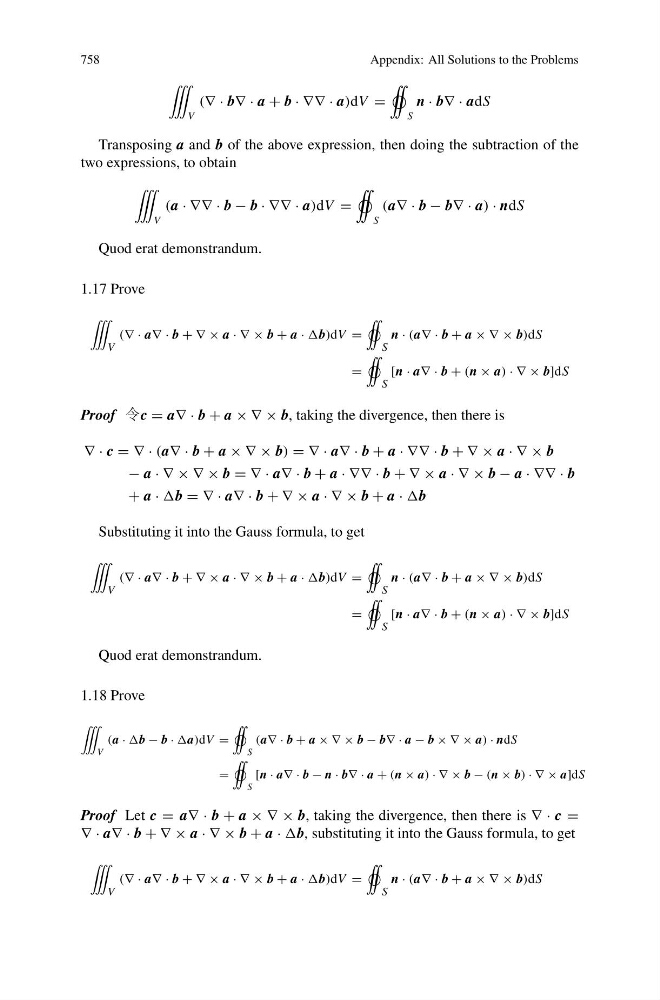
(∇ · b∇ · a + b · ∇∇ · a)dV =
S
n · b∇ · adS
Transposing a and b of the above expression, then doing the subtraction of the
two expressions, to obtain
˚
V
(a · ∇∇ · b − b · ∇∇ · a)dV =
S
(a∇ · b − b∇ · a) · ndS
Quod erat demonstrandum.
1.17 Prove
˚
V
(∇ · a∇ · b + ∇ × a · ∇ × b + a · b)dV =
S
n · (a∇ · b + a × ∇ × b)dS
=
S
[n · a∇ · b + (n × a) · ∇ × b]dS
Proof 令c = a∇ · b + a × ∇ × b, taking the divergence, then there is
∇ · c = ∇ · (a∇ · b + a × ∇ × b) = ∇ · a∇ · b + a · ∇∇ · b + ∇ × a · ∇ × b
− a · ∇ × ∇ × b = ∇ · a∇ · b + a · ∇∇ · b + ∇ × a · ∇ × b − a · ∇∇ · b
+ a · b = ∇ · a∇ · b + ∇ × a · ∇ × b + a · b
Substituting it into the Gauss formula, to get
˚
V
(∇ · a∇ · b + ∇ × a · ∇ × b + a · b)dV =
S
n · (a∇ · b + a × ∇ × b)dS
=
S
[n · a∇ · b + (n × a) · ∇ × b]dS
Quod erat demonstrandum.
1.18 Prove
˚
V
(a · b − b · a)dV =
S
(a∇ · b + a × ∇ × b − b∇ · a − b × ∇ × a) · ndS
=
S
[n · a∇ · b − n · b∇ · a + (n × a) · ∇ × b − (n × b) · ∇ × a]dS
Proof Let c = a∇ · b + a × ∇ × b, taking the divergence, then there is ∇ · c =
∇ · a∇ · b + ∇ × a · ∇ × b + a · b, substituting it into the Gauss formula, to get
˚
V
(∇ · a∇ · b + ∇ × a · ∇ × b + a · b)dV =
S
n · (a∇ · b + a × ∇ × b)dS