

Appendix: All Solutions to the Problems
755
˚
V
u
2 vdV = −
˚
V
∇u · ∇vdV +
S
u
∂∂v
∂n
dS =
˚
V
vudV
+
S
u
∂∂v
∂n
− v
∂u
∂n
dS
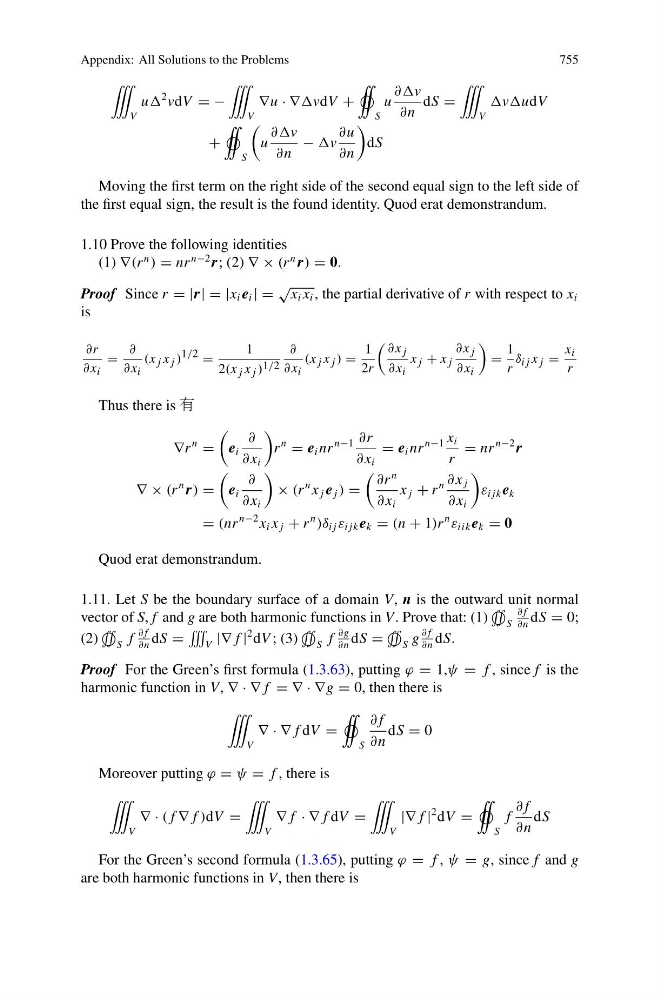
Moving the first term on the right side of the second equal sign to the left side of
the first equal sign, the result is the found identity. Quod erat demonstrandum.
1.10 Prove the following identities
(1) ∇(r
n
) = nr
n−2 r; (2) ∇ × (r
n r) = 0.
Proof Since r = |r| = |x i e i | =
√ x i x i , the partial derivative of r with respect to x i
is
∂r
∂ x i
=
∂
∂ x i
(x j x j ) 1/2 =
1
2(x j x j ) 1/2
∂
∂ x i
(x j x j ) =
1
2r
∂ x j
∂ x i
x j + x j
∂ x j
∂ x i
=
1
r
δ i j x j =
x i
r
Thus there is 有
∇r
n
=
e i
∂
∂ x i
r
n
= e i nr
n−1 ∂r
∂ x i
= e i nr
n−1 x i
r
= nr
n−2 r
∇ × (r
n r) =
e i
∂
∂ x i
× (r
n x j e j ) =
∂r
n
∂ x i
x j + r
n ∂ x j
∂ x i
ε i jk e k
= (nr
n−2 x i x j + r
n
)δ i j ε i jk e k = (n + 1)r
n
ε iik e k = 0
Quod erat demonstrandum.
1.11. Let S be the boundary surface of a domain V, n is the outward unit normal
vector of S, f and g are both harmonic functions in V. Prove that: (1)
S
∂ f
∂n
dS = 0;
(2)
S f
∂ f
∂n
dS =
˝
V
|∇ f |
2 dV ; (3)
S f
∂g
∂n
dS =
S g
∂ f
∂n
dS.
Proof For the Green’s first formula (1.3.63), putting ϕ = 1,ψ = f , since f is the
harmonic function in V, ∇ · ∇ f = ∇ · ∇g = 0, then there is
˚
V
∇ · ∇ f dV =
S
∂ f
∂n
dS = 0
Moreover putting ϕ = ψ = f , there is
˚
V
∇ · ( f ∇ f )dV =
˚
V
∇ f · ∇ f dV =
˚
V
|∇ f |
2 dV =
S
f
∂ f
∂n
dS
For the Green’s second formula (1.3.65), putting ϕ = f , ψ = g, since f and g
are both harmonic functions in V, then there is