

752
Appendix: All Solutions to the Problems
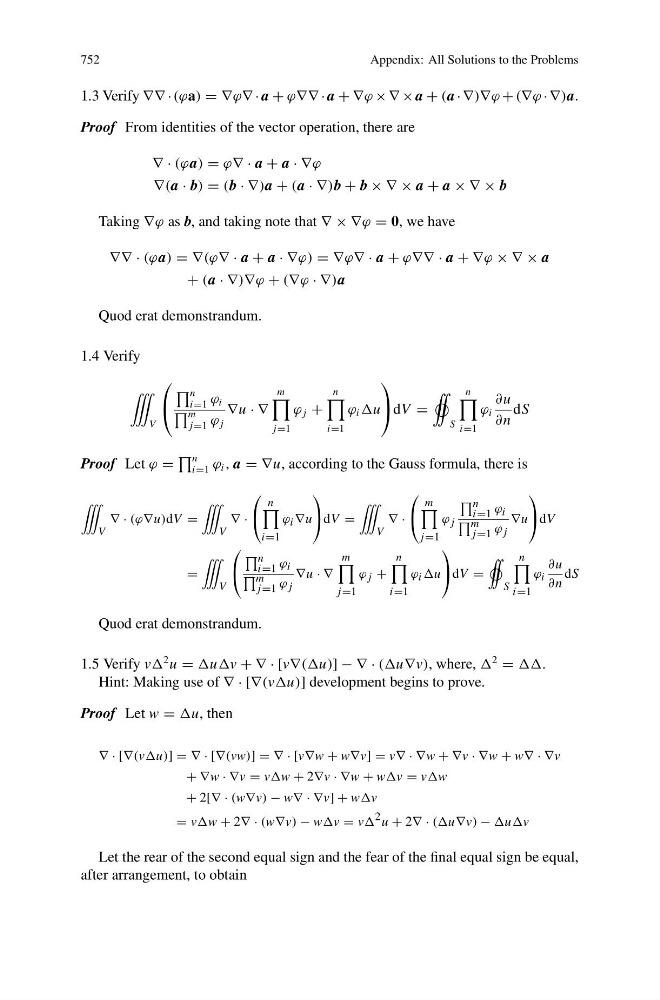
1.3 Verify ∇∇ · (ϕa) = ∇ϕ∇ · a + ϕ∇∇ · a + ∇ϕ × ∇ × a + (a · ∇)∇ϕ + (∇ϕ · ∇)a.
Proof From identities of the vector operation, there are
∇ · (ϕa) = ϕ∇ · a + a · ∇ϕ
∇(a · b) = (b · ∇)a + (a · ∇)b + b × ∇ × a + a × ∇ × b
Taking ∇ϕ as b, and taking note that ∇ × ∇ϕ = 0, we have
∇∇ · (ϕa) = ∇(ϕ∇ · a + a · ∇ϕ) = ∇ϕ∇ · a + ϕ∇∇ · a + ∇ϕ × ∇ × a
+ (a · ∇)∇ϕ + (∇ϕ · ∇)a
Quod erat demonstrandum.
1.4 Verify
˚
V
⎛
⎝
n
i=1 ϕ i
m
j=1 ϕ j
∇u · ∇
m
j=1
ϕ j +
n
i=1
ϕ i u
⎞
⎠ dV =
S
n
i=1
ϕ i
∂u
∂n
dS
Proof Let ϕ =
n
i=1 ϕ i , a = ∇u, according to the Gauss formula, there is
˚
V
∇ · (ϕ∇u)dV =
˚
V
∇ ·
⎛
⎝
n
i=1
ϕ i ∇u
⎞
⎠ dV =
˚
V
∇ ·
⎛
⎝
m
j=1
ϕ j
n
i=1 ϕ i
m
j=1 ϕ j
∇u
⎞
⎠ dV
=
˚
V
⎛
⎝
n
i=1 ϕ i
m
j=1 ϕ j
∇u · ∇
m
j=1
ϕ j +
n
i=1
ϕ i u
⎞
⎠ dV =
S
n
i=1
ϕ i
∂u
∂n
dS
Quod erat demonstrandum.
1.5 Verify v
2 u = uv + ∇ · [v∇((u)] − ∇ · ((u∇v), where,
2
= .
Hint: Making use of ∇ · [∇(vu)] development begins to prove.
Proof Let w = u, then
∇ · [∇(vu)] = ∇ · [∇(vw)] = ∇ · [v∇w + w∇v] = v∇ · ∇w + ∇v · ∇w + w∇ · ∇v
+ ∇w · ∇v = vw + 2∇v · ∇w + wv = vw
+ 2[∇ · (w∇v) − w∇ · ∇v] + wv
= vw + 2∇ · (w∇v) − wv = v 2 u + 2∇ · ((u∇v) − uv
Let the rear of the second equal sign and the fear of the final equal sign be equal,
after arrangement, to obtain